Feature

Jim Starlin and Warlock

by David Beard

Comics publishers republish older material not only for its artistic relevance, but also because republication is very profitable; prior to the ’80s, industry giants like Marvel and DC employed creators on a “work for hire” basis, with the company owning the rights to the stories and characters outright.  Eventually creators began demanding a piece of the action in the contracts they negotiated, but generally speaking, when comics created prior to that are collected and reprinted, revenues generated for the publisher are nearly pure profit.

Partly for that reason, Marvel has reprinted its comics of the 1960s and 1970s a near-uncountable number of times, including the story of Adam Warlock. Initially published in various series between 1967 and 1977, this character’s tale became widely heralded as a masterful execution of superhero comics. Originally a third-tier character created by Jack Kirby and Stan Lee in the pages of Fantastic Four and Thor, Warlock was a petulant infant in a super-powered body—a mere seed of an idea used mostly as a plot device during a time when comics were measured by the number of punches thrown.

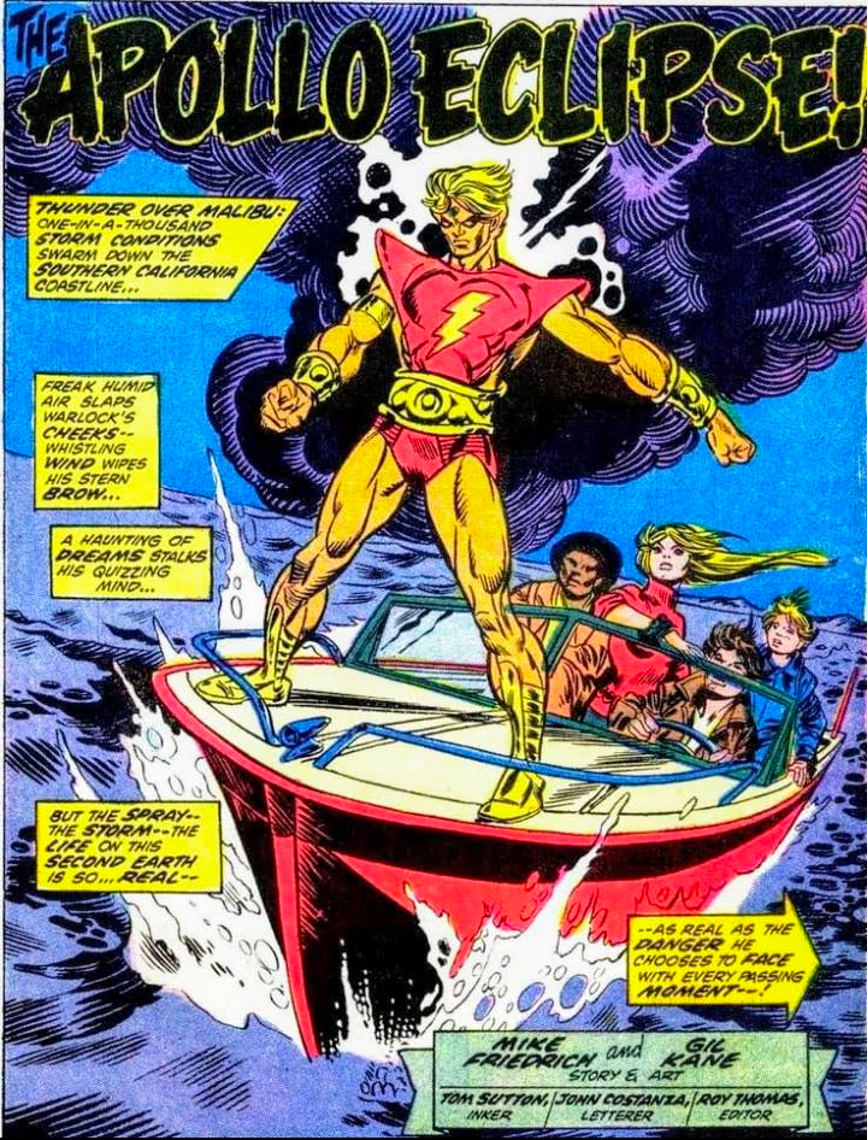
The seed was watered when Roy Thomas and Gil Kane (abetted occasionally by other creative hands) revived the character in 1972; they developed both the first man theme (note the character’s first name) and added a Christ allegory.  In their version, Warlock was a pacifist called to fight to save humanity; his enemy was a “Man-Beast” leading humans down the path of violence, suffering, and death.  Stirring moments intentionally and unabashedly echoed Gospel scenes, as can be seen in this illustration’s allusion to Jesus and the apostles in a storm: 

Thomas and his collaborators used such allusions to the New Testament (and to Jesus Christ Superstar, a popular Broadway musical at the time) numerous times in their run from 1972-1973 before the series was canceled, but Warlock wouldn’t have long to wait for a revival: In 1974, a rising star creator at Marvel, Jim Starlin, reinvented the character. Starlin attempted to be as close to an author as mass-market comics would allow at the time, writing, drawing, and even coloring the first installment of Warlock’s story himself. (The only help he received in assembling the issue was from Annette Kawecki, who drew the letters on the page.)

For the next three years (one month at a time, in about twenty-page chapters), Starlin told a story of memorable complexity and originality. His Warlock fought “the Universal Church of Truth,” which extended its reign across the galaxy by offering new species a choice: either join the Church or be eradicated. But Starlin used the narrative to critique more than institutional corruption and the broken psychodynamics of religion. The Church was led by a villain called the Magus, and when Starlin revealed that the Magus was actually a future version of Warlock, the story explored a common anxiety among the young:  the fear that as they age, they will become as corrupt as the elders they decry.

In our current time, readers of Starlin’s Warlock saga and his similarly reimagined Captain Marvel series of the ’70s can see resonances within the Marvel Cinematic Universe.  In the Avengers movies, the villain Thanos seeks to collect the infinity stones so that he can end half of all life in the universe as a solution to overpopulation.  Only the Avengers can stop him, in a powerful battle that demands sacrifice among them (and takes hours of digital animation).

But Starlin’s comics made the point even finer; in their telling, Thanos seeks to collect the infinity stones to end all life, and he does so as a love offering to Death, depicted as an embodied character. To younger readers today, this may be hard to connect with; it’s difficult to explain the poetic, indeed Romantic tradition of embodying death that suffused 1970s popular culture. Death was always dark and powerful, like a grim reaper, and often sexy and alluring, like a lover; she appeared as such on countless heavy metal album covers and comics—especially Jim Starlin comics. For example, in Starlin’s 1982 graphic novel The Death of Captain Marvel (the very first original graphic novel published by Marvel Comics), the character interacts with the embodiment of death as he grapples with his own terminal cancer:

In the Avengers movies, the heroes are defeated by Thanos in Infinity War, then rally to victory in Endgame.  In Starlin’s comics, Thanos defeats the Avengers and there is no salvation by heroes—only Adam Warlock, fulfilling his messianic overtones, can defeat Thanos, and only at the cost of his own life. Starlin’s original version offers a more satisfying literary conclusion, though of course, as always in the comics medium, the door was left open for future iterations of the character.

The story of Warlock, then, begins in the 1960s as a plot device, moves through a clever but incompletely envisioned character arc built around the Christ story, and finally becomes a vehicle for political statement and emotional drama. While the parts of this sequence have been reprinted many times in various formats, they can now be found together in the Adam Warlock Omnibus (Marvel, $125) released earlier this year, which collects everything from his early appearances in Fantastic Four and Thor to the end of the ’70s Starlin epic.

As a whole, the Warlock story has been immensely valuable to Marvel for more than forty years, and perhaps gave a leg up to Starlin too; subsequent to this series, he was one of the first artists who were able to sign contracts with Marvel and other comics publishers which gave him ownership of his work. His most significant opus over this time has been Dreadstar, in which the eponymous rogue and a ragtag band of comrades are squeezed by the imperial Monarchy on one side and the theocratical Instrumentality on the other, picking up on the critique of organized religion and politics Starlin first introduced in Warlock.  Transposed from a superhero narrative into a science fiction one, Starlin’s Dreadstar loses the optimism inherent in Warlock, but it certainly retains the emotional drama, thematic complexity, deft characterization, and eye-popping draftsmanship for which his body of work is justly acclaimed. 

Disappointingly, however, Starlin’s success in negotiating ownership of works like Dreadstar has resulted in making these books more of a niche attraction; while Marvel cranks out new editions of Warlock over and over, paying Starlin nothing for the honor, Starlin has had to crowdfund the most recent edition of his creator-owned comics. Still, Warlock remains an impressive example of Jim Starlin’s early work and tenure in the comics medium.

Click below to purchase this book through Bookshop and support your local independent bookstore:

Rain Taxi Online Edition Fall 2023 | © Rain Taxi, Inc. 2023

Enheduana

The Complete Poems of the World's First Author

Sophus Helle
Yale University Press ($30)

 .  
by Pierre Joris and Nicole Peyrafitte

Pierre Joris: It is excellent to have Sophus Helle’s new collection of translations of texts attributed to the Sumerian poet Enheduana framed by a very insightful series of essays. He points to her importance today as the “world’s first known author,” whose poems also include a “complex and self-reflective account of authorship, as she depicts herself stepping into literary history.” Under that light she can be seen as a post-modern—thus totally contemporary—author, despite the fact that she lived around 2300 BC! Though even more interesting is how Helle sums up her themes, all of which are also highly relevant today: “exile, social disruption, the power of storytelling, gender roles, the devastation of war, and the terrifying forces of nature.”

If I remember correctly, the first place we came across one of those Sumerian poems was in Jerome Rothenberg’s anthology Technicians of the Sacred (University of California Press, 1985). There Jerry reproduced a translation he worked on (via a literal translation of the Sumerian by Betty Meador and Renata Leggit) of a poem called “The Vulva Song of Inanna,” without mentioning its possible author, Enheduana. You immediately took to this poem and included it in your performance work. Can you speak to the importance of this text for you?

Nicole Peyrafitte: This is how it went for me: I was interested in feminine representations that would directly address the vulva and you pointed me to “The Vulva Song of Inanna,” in Technicians. This text blew my mind and I started looking deeper into this Inana* character, who sounded totally unleashed—and unleashed she was and still is for me!

But let’s be very clear—and it is important because there is a lot of confusion about this—“The Vulva Song of Inanna” is not attributed to Enheduana, nor is “Inanna’s Descent to the Nether World.” “The Vulva Song of Inanna” comes from another collection of tablets often referred to as “the Sacred Marriage.” Betty Meador worked with Jerry on this translation for Technicians, and later published Inanna Lady of the Largest Heart, Poems of the Sumerian High Priestess Enheduanna (University of Texas Press, 2000), and in the acknowledgments of this book,she mentions she began translating Sumerian Sacred Marriage Hymns in collaboration with J.R.

By the way, a recent review of the Barbie film, titled “Barbie is the New Inanna,” compares Barbie’s quest and travel to the human world with Inana’s descent into the netherworld. The reviewer, Meg Elison, makes an interesting point in the online magazine “The Wild Hunt,” though she too was a bit fussy about authorship of those two poems, as she attributes them to Enheduana. I have seen this conflation often made by popular culture stories inspired by Inana; it is not a big deal, but now we have info like this incredibly well done and accessible book to help us appreciate the depth of the complexities of this culture that lasted many thousands of years.

So yes! It was immediately important; Inana resonated deeply. She was full of paradoxes, irreverences, uninhibited. The way she sang and celebrated her vulva was so liberating. The con/fusion between vulva and vagina had always bothered me. I had already been thinking of the vulva in terms of a hidden face, and as vestibule to the vagina. In some prehistoric caves, like the one at Gargas, both representations are present.

As for Enheduana, it was you who got into this material via a book you found in the mid 1990s that got you fascinated by the linguistic intricacies of Sumerian—also mentioned by Helle when he explains the Sumerian dialect called “Emesal (literally, ‘thin tongue’), which in literary texts is spoken only by goddesses. . . . [and] associated with the female gender.” I, on the other hand, was looking into the material translated and studied by Samuel Noah Kramer and his French associate Jean Bottéro. It was exhilarating to discover this complex culture, and it was so refreshing and empowering to be able to read four-thousand-year old, pre-monotheistic material where women had autonomy, with, on top of their pantheon, a female deity that would go to hell, steal the “me’s,” the powers of other gods, and sing the plowing of her vulva loud and clear!

Kramer was the first to translate this material in the late 1930s. Material had been excavated in the late nineteenth century, but the decipherment of Sumerian—which is neither a Semitic nor an Indo-European language—was difficult and time-consuming. As Kramer put it in Sumerian Mythology (Harper Torchbooks, 1961): “The very name Sumer was erased from the minds and memory of man for over two thousand years.”

Besides the vulva song, the other text I was truly fascinated by was “Inanna’s descent to the netherworld.” Though none of these texts are part of the corpus attributed to Enheduana, she most certainly drew both literary and political inspiration from them. We are pretty sure she had read or heard all these stories and was fully aware of Inana’s importance in that part of the world her father King Sargon had conquered. Just for context, the Nippur excavation unearthed some 30,000 tablets, mostly in Sumerian, and ninety-five percent of which are of an economic character.

PJ: I first came across “Inanna’s descent to the netherworld” in Charles Olson’s The Chiasma, or Lectures in the New Sciences of Man, where he proposes the need to study a group of women he links back to what he calls “Cro-Magnon” culture and forward to the next cultural complex, the Greeks, pitching Inana’s descent as the opposite of Orpheus’s, etc. But we’re getting too far away—although the various ways we both came to those Sumerian texts is enlightening, too, showing the complexity of the situation. And this is also important because Helle’s book clears up much of these matters and is an excellent way into this very complex domain in which information is continuously shifting as new material is discovered and as new insights are gained into a very complex language and culture.

NP: Yes, indeed, the depth of the essays is impressive! They move from the historical to the political, from the question of authorship to that of translation, and address how all these layers play into each other—a true tour de force that gives many tools to contextualize Enheduana from then to today.

PJ: Though at this point, a wide range of more general books on Sumer and Sumerian literature is available, which enables Helle to focus on this figure and the questions she raises. There are also good websites where you can get info about all matters Sumerian, such as: https://etcsl.orinst.ox.ac.uk/. Also mentioned by Helle, the second episode of the podcast series Ishtar Diaries, featuring the Iraqi American poet Dunya Mikhail (now living in exile in these States) speaking about her relation to Enheduana and the latter’s influence on her work: https://soundcloud.com/columbiaglobalcenters/in-praise-of-ishtar?in=columbiaglobalcenters/sets/ishtar-diaries.

NP: One of the core interests of the book is the proposition that here we have the first named author we know of. Even if this proposition may raise questions, Helle is clear: “Regardless, the fact that the ancient scribes saw Enheduana as the author of these poems is significant . . . The idea of authorship, the notion that a poetic text could be traced back to a named and identifiable individual rather than to a collective and anonymous tradition was born when these hymns were ascribed to Enheduana, and that is true regardless of whether the attribution was correct.”

PJ: Indeed, there probably were, before her and elsewhere in the world, named poet-authors, whose work and identity completely escapes us. Still, it is interesting to think that we now know of an author, a woman, who is way earlier than good old “Homer,” whoever he was, if he even existed as a person, and who in the Western-civ tradition is pitched as the first and greatest of poets. No place here for details, but we need a translation of Raoul Schrott’s book, Homers Heimat (Homer’s Homeland), which shows how, whoever Homer was, the Iliad, rather than the brand-new poem inaugurating this new Greek “high culture,” is in fact linked to and even derived from Assyrian and other Middle Eastern models. At any rate, fascinating as all this is, it will have to remain hazy to a great extent; the book under hand is however very helpful in a number of ways.

NP: Helle raises all kinds of complexities and controversies such as, did she really write all those texts attributed to her or not? But recently as we visited the excellent show at the Morgan Library “She Who Wrote: Enheduanna and Women of Mesopotamia, 3400-2000 BC”; it was interesting to listen and talk to visitors and hear how Enheduana is immediately mythologized into “the first woman poet ever,” a figure of pure genius to be admired and adored without looking further into her historical situation—

PJ: —Yes, a sort of absolute origin—and thus Enheduana gets reduced to just another myth—

NP: —Everybody immediately puts her on a pedestal and that’s not right, that’s not what she is. We have proof that Inana qua deity to be worshipped, as well as the poems and stories about her, go back at least 2,000 years before Enheduana. Essential also to see Enheduana’s total appropriation of an earlier culture as she was sent to Ur by her father, the Akkadian conquerer-king and empire founder Sargon, and as far as we know, she had to first learn Sumerian, both the language and the culture, in order to do her job as priestess to Inana and simultaneously as the political head of that city-state.

So, yes, give Enheduana the credit due her, but see her in the light of who she actually is and what she did—and here, Helle’s book is much better informed and richer in setting the context. In the essay “Enheduana’s World” he writes: “Enheduana lived through one of the most turbulent periods in the history if the ancient Near East. . . . her family was at the heart of it. . . . cities were caught in a web of conflicts, peace pacts, and exchanges of goods and ideas, but each was its own political entity. . . . Then came Enheduana’s father, Sargon of Akkad. He united the cities under one rule, creating the first known empire.”

PJ: I of course find it very exciting to think that she, the “first female author” thus wrote in her second language, a language that wasn’t her mother-tongue! And so, if Jerry Rothenberg and I get to finish another anthology we have in mind, Blows Against the Mother-Tongue, a world-wide survey of poets who wrote in their second or third languages, Enheduana would of course open that book. Now in today’s terms, there then also arises the specter of cultural appropriation . . .

NP: Well, it is possible that she did know some Sumerian, because in those days, cultures in adjacent “countries” were probably more porous than we think. Instead of imposing her religion, smartly enough she adopts and uses the locally established religion—though as a woman, of course, she might very well have been seduced and felt totally empowered by the figure of Inana.

PJ: Yes, one could suggest that the figure of a powerful goddess must have been very attractive to her, a deity that was not only the goddess of love and sex, but also that of war and chaos, and who turns out to be maybe the major god-figure of that area for centuries to come, as the Acadian, then Assyrian, then Babylonian figure of Ishtar.

NP: Both the Hymn to and the Exaltation of Inana prove that Ehneduana has done her research and was rewriting that earlier material for her own purposes, be they personal, ritual or political—

PJ: —and here we may actually use another Olsonianism, though rather than making that word into “his-story” we can say “her-story”—

NP: —The tablets that predated her informed her and/or her scribes’ writings. As we mentioned the corpus is huge, it goes from myth of origins to wars and ecological disasters, to love and its rituals.

PJ: From a purely literary p.o.v. it seems that the oeuvre we can attribute to Enheduana qua author consists essentially of two poems plus a set of hymns—the first and most celebrated being “The Exaltation of Inana”—and Helle shows how this is a poem as much about its author than about the goddess and details the reasons why this is important: The priestess has to make sure the goddess has power over the land so that she, her priestess, also can have and hold power, and she has to do this via the power of the poem. As Helle puts it: “In a sense, the Exaltation is a poem about itself, about whether Enheduana will succeed in elevating Inana, overcoming her loss of eloquence, and so saving her own life.” The second is the so-called “Hymn to Inana,” a longish poem which Helle reproduces with the expanse of its missing sections indicated (many tablets were broken or lost) showing the fragmentariness of the work as it has come down to us.

NP: The Hymn, or what we have of it, is very interesting because it shows the complexity of Inana: her mighty power over the main gods, her sympathy for the less fortunate, and her protection of women (as in “and build a home / for the women, to / fill it with goods”), while at the same time she is certainly not perfect—an aspect that is usually anathema to the idea of a supreme godhead’s character.

PJ: How do you see / hear / sense—both qua poet and performance artist—Helle’s translations in comparison to the older ones?

NP: So far these translations are my favorites. They are tight, have great rhythm, and are stripped of “literary embellishments.” All the things I learn from you about what a good translation needs!

PJ: Let’s just give one example. Here is a section from Meador’s translation of The Hymn to Inana (first column), juxtaposed with Helle’s version (second column):

fighting is her play
she never tires of it
she goes out running
strapping on her sandals

a whirlwind warrior
bound on a twister
she tears the king’s robe
dust-dry south wind
sweeps at her bidding
leaves in its trail
breast-beating despair
lioness Inanna
crouched in a reed thicket
leaps to slash the fearless

mountain wildcat
prowling the roads
shows wet fangs
gnashes her teeth

wild bull queen
mistress of brawn
boldly strong
no one dares turn away

           Her joy is to
speed up conflict
and combat: ever
restless she straps
on her sandals. She
splits the blazing,
furious storm, the
whirlwind billows
around her as if
it were a dress.
Her touches bring
despair: the south
wind. . . . . . . . . . . .
. . . . . . . . . . . . . . . . .
Sitting on leashed
lions, Inana tears
apart those who
feel no fear of her.
Like a leopard of
the mountains, she
bursts onto the road
. . . . . . . . . . . . . . . . . .
. . . . . . . . . . . . . . . . . .
Queen, huge aurochs!
Fierce in her might,
no one turns to fight
her. . . . . . . . . . . . . . .

The Meador does have its qualities, it reads well, but the tightness of Helle’s lines (it would be interesting to know how or if those line-breaks correspond to indications on the tablets) feels less lyrically contrived, and if they don’t seem as melodically flowing, that may well have to do with his attempt to render the Sumerian as literally as possible (using, for example “aurochs” rather than the generic “bull” informs us of the age of the poem, because the aurochs is by now an extinct species). Also indicating the missing parts, i.e., unreadable or broken off parts, of the tablets (something used to great effect by Armand Schwerner in the poems of The Tablets), makes us aware of the actual, physical substratum of the text, thus keeping the poem linked to its double origin, especially its second age—that of the Babylonian scribes’ clay copies. Rather than trying to restore a lost original, Helle’s version allows us to stay aware of the level of translation the poems incarnate.

NP and PJ: Stephen Orgel argues in his recent The Invention of Shakespeare (University of Pennsylvania Press, 2022) that “no version of a Shakespeare play is ever a final version,” because texts are always under construction, showing that even as recent and massively studied an author and oeuvre as Shakespeare(‘s) is never fixed or absolute but always in the process of being translated and retranslated (all language and writing, one of us has written elsewhere, are translations ab initio). This is certainly also true of Enheduana’s work.

To close, let us take note of Helle’s rare (for a scholar) conviction that the work presented in his book is in no way final. For him, “the translations given in this book are necessarily temporary,” because, he is sure “within the next decade the philological interpretation for Enheduana’s poetry will probably change, because it is always changing, and updated translations will have to be produced.” Which is an exciting prospect. As Helle puts it: “In her third life, Enheduana is still in the process of being born.”


Footnotes:

*Unless we are referring to a book title by another author, we will be using the spelling of Inana and Enheduana with one “n” only, as suggested by Sophus Helle.

** http://www.holladaypaganism.com/goddesses/cyclopedia/l/LE-HEV-H.HTM#return


Click below to purchase this book through Bookshop and support your local independent bookstore:

Rain Taxi Online Edition Fall 2023 | © Rain Taxi, Inc. 2023

Carnal Knowledge: Colette’s Chéri and The End of Chéri

Chéri and The End of Chéri
Colette

Translated by Rachel Careau; Foreword by Lydia Davis
W.W. Norton & Company ($28)


Chéri and The End of Chéri
Colette

Translated by Paul Eprile; Introduction by Judith Thurman
New York Review Books Classics ($28)

by Kevin Brown                              

Our Colette problem isn’t that there’s too little of her. The problem is where to begin. Did she write fifty, seventy-five books? Nobody knows. Most agree the Chéri novellas are a good place to start. Chéri and The End of Chéri, two novellas with recurring themes and characters, tell distinct but related stories about a complicated relationship between forever-teen Frédéric Peloux (“Chéri”) and aging ex-courtesan Léa de Lonval. Two recent translations of these works offer readers the opportunity to engage them anew.

1.

Chéri is Léa’s book. Like French classics such as Red and Black, Lost Illusions, Madame Bovary, and Swann’s Way, Chéri immortalizes one of fiction’s least forgettable women, and each of these books is as remarkable for what it has in common with the others, commonalities too numerous to be coincidental, as for what distinguishes it.

Adultery, for example, figures in all of these books, but they’re about more than cheating—they’re about corruption, seduction and betrayal. In Balzac’s Lost Illusions and Lost Souls, street prostitutes swarm the muddy arcade of the Palais Royal. The same is true of the town Rouen in Madame Bovary. As Chéri begins, the Eiffel Tower is new, and Léa is among the last of the courtesans, representing the end of an era dating back to antiquity. (Courtesans were less sex workers than stylish ladies “kept” by wealthy men who could blow a couple thousand francs a month to maintain them in style.)

Aging out from this profession, Léa has never lost her head until now. The façade Léa presents is that of someone who’s seen everything, but she’s kidding herself. Controlling though she is, Léa—like Charles Bovary, like Emma, like Swann—will play the fool for love. Sooner or later, everybody does.

Like Stendhal, Balzac, Flaubert, and Proust, Colette creates self-contained worlds crammed with material objects. Her characters are eccentric; Madame Camille de La Berche, whom translator Paul Eprile calls “the Baroness,” blurs gender boundaries; she’s as laconic as others are prattling, but when she does speak, she is blunt to the point of rudeness. Washing down snails with cheap white wine, she barks, brays, or whinnies. Hairs sprout from her nose, knuckles, ears, and upper lip.

On Thursdays, Fred’s mother Charlotte Peloux entertains guests like Léa. Flush with seventy-four-year-old brandy, they play card games and gossip. (“Colette’s militancy is limited to the boudoir,” as Judith Thurman says in her introduction to Colette’s The Pure and the Impure [New York Review Books Classics, 2000].) For people passing from youthful beauty to old age, “loosened up by a martini” (as translator Rachel Careau puts it in her version of Chéri), cat-spats help pass the time.

Léa is queen bee of the clique—but it’s unclear whether she has real friends or just deal friends. What’s very clear is that she keeps her enemies close. Léa makes a killing off December crude in the stock market, which brings out the competitor in Madam Peloux, a wily trader herself. Colette’s irony is hypodermically fanged. Léa’s observation of Ma’am Peloux, fidgety and prattling, a chicken head fluttering her chicken wings, is typically pitiless. Lolotte’s every utterance, her every “swoon and squeal,” is trumpeted at the top of her lungs. She “never repeated a truism less than twice.” Picture Jimmy Two-Times from Goodfellas, “who got that nickname because he said everything twice, like: ‘I’m gonna go get the papers, get the papers.’”

More interesting than what Charlotte and Léa say about Chéri is what they don’t say. Charlotte birthed him, but Léa informally adopted and practically raised him from the time his ribs were still showing. Léa scolds and coddles him, like an overprotective mother, saying things like, “Put on your overcoat, you might catch cold” or “quit picking at the little hangnails on your toe.” When Fred sulks or throws one of his little tantrums, Léa strokes his head as if he were a house pet: “There . . . there . . . What’s the matter?” Fred needs Léa as much as, if not more than, he needs his own mother, who knows it. Sex is almost beside the point.

The Chéri novellas are studies in what Julien Gracq, in his Afterword to Chateaubriand’s Memoirs from Beyond the Grave, called power “fallen to the distaff.” Sidonie-Gabrielle Colette was the daughter of a retired captain, but her mother Sido gave the orders. Lion cubs raised by prides like these will find the pattern easy to spot.

Madame Peloux arranges a lucrative marriage between Fred and Edmée, a teen who never makes a fuss; she “has a way,” mère Peloux tells us, “of swallowing affronts as if they were sweetened milk.” One month passes and Léa pretends she no longer cares but in her well-appointed world, things aren’t quite right. She loses sleep; she imagines Fred making love to Edmée’s perfect, youthful body. Little things begin to bother Léa, like the broken glass in a picture frame.

Six months pass. Fred can’t stop obsessing over his “Nounoune.” One midnight, as Léa’s wandering thoughts search out their slippers and ready themselves for bed, who on earth should ring the bell and bound up the stairs?

“I’ve come back!”

After the lovers consummate a final tryst, Léa dreams of the life they’ll escape into, the way a mother visualizes a nursery. Like Emma, like Mathilde de la Mole, Léa actually believes they’ll run away and live together happily ever after. It’s too late for that. Between that second slice of toast and hot chocolate, the love affair comes to an end. Fred, the boy who hasn’t yet become a man, has wrecked not one but two unhappy homes. As for Edmée, what will become of her?

2.

Chéri (1920) is Léa’s book. The End of Chéri (1926) is Fred’s.

*

“Colette in English,” says Judith Thurman, “has never sounded like Colette.” Until now. Careau gets granular, in an 18-page Translator’s Note, on the challenges of translating Colette into English, noting that the author belongs to the Generation of 1870, an era marked by Prussia’s military defeat of France, the Third Republic, and the French Union of 1946-1954, the year Colette died. Careau resists bringing Colette’s idiom up to date, but it should be noted this is a tactic, not a mistake.

Of course, sometimes it works and sometimes it doesn’t. Careau uses the word “reticule” for what Eprile translates as “handbag”; very likely, she’s attempting to replicate in English what Michael La Pointe calls Colette’s “occasionally archaic diction.” A poet in his own right, Eprile resorts to different tactics; his “Damn!” is current usage so idiomatic it doesn’t draw attention to itself, whereas Careau gambles that “drat!” won’t seem jarringly antiquated.

As Lydia Davis has argued when speaking of her own acclaimed translations of Proust, sometimes “what one gains in exactness one loses in expressive power.” Careau’s fidelity to Colette’s “concision, subtraction, condensation” makes her version seem intentionally raw. In the context of World War I, for example, Eprile’s phrase “somebody who’s been mustard-gassed” has more immediacy than Careau’s “a gassing victim”; it actually speeds up rather than bogging down the text. Elsewhere Careau writes, “We’re purebred Parigots, we are!” and this is exactly what Colette says: “On est des parigots de race, nous!” But Eprile suggests that what Colette really means is, “We’re the real Parisians!”

On some occasions, Eprile hews closer to the original, preferring to leave untranslated a word that works better in French. For example, in The End of Chéri, a pivotal character with a smelly “matted crow’s nest of hair,” shuffling about in felt house-slippers and surrounded by the paraphernalia of her vices (tarot cards, snuff boxes, a revolver, etc.), is called by Careau “the Girlfriend”; Colette and Eprile both call her “La Copine.”

The half-dozen things Careau considers outright flaws in a translation are sometimes judgment calls or clarifications; living writers working with a translator will often consent to or even insist upon such changes. Substitution is not always wrong. In fairness to Eprile, alterations that might seem like embellishments or omissions are sometimes unavoidable. Things Colette leaves unsaid Eprile will explain by way of addition: The green-and-red ribbon Fred absent-mindedly fingers, for example, is specified as the Croix de Guerre, a medal of bravery. Consistent with her strategy, Careau prefers supplying useful endnotes, eleven pages of them, to paraphrase or otherwise explain these references.

Colette’s prose is reputedly hard to translate. Careful writers stack word-associations and the play of overtones as if they were musical chords, and Colette does this, scaling up and down registers, formal and informal, technical and slang. Her vocabulary is large because it consists of words—the botanical names of flora and fauna, a lush and nuanced color palette, specific foodstuffs and kitchen utensils, regional colloquialisms—which may not reflect the reader’s everyday usage, though a gardener or a gourmand might find them less strange. In short, Colette is a prose poet, and poetry is often challenging for casual readers because of its extreme compression and associative properties. Sensory confusion—synesthesia is the technical term—is one aspect of this; in Colette, cherry brandy smells like hydrogen cyanide, and she likens that rot-gut whiskey smell to “wet bridle leather.”

And while two new reappearances of the Chéri novellas may seem like overkill, it’s not Eprile’s or Careau’s fault that Colette should be translated for the umpteenth time by two different publishers in the same year while so many other writers languish in relative obscurity. Our Colette problem is a publishing industry problem: While some noteworthy presses (including the two who issued these books) are generating this kind of work, ever-fewer imprints promote ever-fewer writers from chronically under-represented parts of the Portuguese-, Spanish-, and even French-speaking worlds—to say nothing of languages less familiar to the average American.

Which brings up the economics of literary translation. Careau’s version is eighty-five production-cost pages longer than Eprile’s, and hews more closely to the original French publication. This makes for an aesthetically heightened experience: In terms of paragraphing and space-breaks, Careau mimics to great advantage the breathing room, section breaks, and overall musical sense of Colette’s prose rhythms. But neither translation renders the other superfluous; this isn’t a zero-sum game. Leave glaring mistranslations to scholars with native or near-native knowledge of French. There’s something for everybody to quibble over.

*

Like many classic French writers, Colette came to the capital from the provinces, seeking fame on the world’s biggest stage. Proust was the only one born anywhere near Paris, in Neuilly; Stendhal came from Grenoble, Balzac from Tours, and Flaubert from Rouen. Like Balzac, Colette pushed herself to the point of exhaustion and beyond, sometimes writing for ten hours a day.  She was also, as she says of Léa in The End of Chéri, “clear eyed, shrewd in the way of country folk.” As editor at Le Matin, she commanded Georges Simenon to leave all that literary stuff out of his writing, and she creates the illusion of having followed her own advice—but the Chéri books are read 100 years after publication for good reason.

That reason involves Colette’s creation of the narrative as a summa of sensory perception. Knowledge of self, carnal knowledge, aren’t bookishly arrived at in this tale. In her Foreword to the Careau translation, Lydia Davis suggests Colette may have been stereotyped by critics because her early books seemed to be about marriage, domesticity, and interpersonal relationships. Today, it’s obvious the Chéri novellas are those of a writer very much in the classical French literary tradition. Three classical elements of great writing are superabundant in Colette: (1) breadth of experience; (2) depth of insight; and (3) elevation of style. She can be lushly chromatic but also very precise, the way Ravel is said to be. Only rarely is she guilty of what Michel Leiris calls, in his dazzling Brisées: Broken Branches (as translated by Lydia Davis), “the evasiveness of lyricism.” Her prose is justly celebrated for its classical restraint and discipline.

Another way to come at this is to note that the Chéri novellas are composed, to a very intentional degree, of surfaces. There are soft-tissue surfaces (keratin layers of nails, hair, and skin sculpted into hollows of collarbone, forearms downed like cornsilk) and hard surfaces (the heavy décor of 1888, torpedo cars). The fundamental layers of interior design are all lush: color, lighting, line, patterns, texture, fabrics. Colette expends much narrative energy on sets and costumes, detailing, for example, how  “Léa went out with the determined gait imposed by certain shoes and certain homespun clothes on their wearer.” No less than Stendhal, Balzac, Flaubert, and Proust, Colette is entirely serious about the whims of fashion. One Careau endnote cites a longstanding milliner mentioned in Coco Chanel: An Intimate Life (2011), and this is not frivolous;  people who wouldn’t be caught dead in a morning coat at the races may remember historical events somewhat hazily, but they have elephantine recollections of the hat they wore at Del Mar on opening day in 1937. Surfaces, the relentlessness of details rooted in mundane reality, are how Colette conveys the interior life of her characters.

Colette is doing many (if not more) of the things her literary confreres are noted for as well.  She’s as creative as Stendhal in her use of point of view, which hummingbirds back and forth between omniscience and interior monologue. Her social canvas, from the demi-monde to the haut monde, is as deep and wide as Balzac’s. Her savagery is laugh-out-loud-funny, like Flaubert’s. Léa’s catnap is as convincingly experimental as Charles’s carriage dream in Swann’s Way. And, like Proust, Colette reveals that time is not a clockwise construct of past, present, and future, with measurably fixed durations; linearity breaks down in The End of Chéri because Fred’s sensory perceptions flow in such a way that his experience of a given point in time is almost indistinguishable from any other. Colette does all these things brilliantly, but with what Careau calls “extreme and seemingly effortless economy” because she jettisons many of her predecessors’ creaky plot conventions—ladders and forged letters, for example—while usefully retaining others, like spying and attempted bribery.

*

The End of Chéri

The End of Chéri is in some ways as much a post-World War I fiction as Mrs. Dalloway. Fred returns home from the Great War, as Stendhal had from the Napoleonic wars, but he doesn’t see himself as the frustrated hero Julien does. Rather, Fred suffers from post-traumatic stress disorder: He flashes back to trenches full of corpse-kids killed by shrapnel, reliving how he was nearly suffocated by bodies blown apart and raining down. Fred isn’t physically disabled, but he’s damaged goods, and those who knew him before the war worry. Fred doesn’t eat right; he loses weight; he neglects his appearance. Perhaps most tellingly he invents excuses—the late hour, a headache—to avoid having sex with Edmée.

In Colette, historical events and movements on the world stage don’t unfold as mere backdrops. They allow her characters to occur and recur from book to book, as they do in Balzac, but also to grow and change—as in Balzac they sometimes don’t. Careau devotes eleven pages of endnotes to Colette’s historical references. Americans are everywhere, as are African Americans and jazz. In Chéri, Edmée seemed a reticent young girl, but that’s really because boarding school and other forms of banishment from her jealous mother’s increasingly remote affections taught Edmée silence and cunning. Five unhappily married years and a World War later, head nurse Edmée practically runs the hospital for wounded veterans, where she works.

Mirrors are everywhere Fred looks, but there’s much he never sees. Like Julien, Fred is such a pretty boy that women’s “silent tribute” follows him through the streets.  He hardly notices. Fred can be cold and distant, but he doesn’t work at striking that pose the way Julien does. It just comes naturally. In neither novella does Fred gain sudden insight into who and what he really is; he doesn’t see himself through the lens of French history or society the way, without sermonizing, Colette reveals him. His growth is stunted—to what extent by Léa’s unofficial, six-year adoption, a “long adolescence under trusteeship,” it’s hard to say.

There’s a reason people treat Fred like he’s twelve years old. Six years younger, Edmée is in some ways typical of strong women whose dominance in the domestic sphere leads conceited, greedy, and entirely obtuse husbands around by the nose. She has become the adult in the room. Is Edmée having an affair with the hospital’s head doctor, or is she just trying to make Fred jealous? We cannot know for sure, but what’s easy to see is that she rules the roost with authority, and is faithful, at least, to keeping up appearances. Not that Fred cares—he’s too busy looking in the mirror to keep up appearances beyond it.

Fred’s distracted irritability, his sociopathic indifference toward the feelings of others, his extreme self-absorption, and his miserliness aren’t his most striking characteristics. Stendhal correlates Mme. de Rênal’s outer beauty with her inner goodness; Colette contrasts Fred’s beauty with his almost complete lack of moral compass. In The End of Chéri, he seldom laughs; he’s become such an unsympathetic character that even dogs and cats shun him. He seems especially perplexed by changing gender roles. During the War, women were driving supply trucks, hanging around auto-mechanic garages, smoking cigars, and talking politics. Now they want the vote.

Edmée has come into her own and lives, under the same roof, a life increasingly emancipated from Fred. Fred himself is not so circumspect. He has reached the point where he can conceive of nothing that interests him or motivates him to think beyond the present moment. With no real friends, only hangers-on who fear “the final hour of [their] prosperity has come,” Fred is someone who no one needs. He hires friends the way clients hire courtesans. Alienation, anomie, and boredom are overarching themes The End of Chéri shares with Red and Black.

And by the end of The End of Chéri, Fred doesn’t even pretend to love Edmée. Their marriage has deteriorated to the point where he loves jewelry-shopping for her—bracelets, headpieces—more than he loves her for herself. It helps him pass the time. He’s as repulsed by his wife’s perfect body as she is with his perfect face. He doesn’t dote on actual children, yet he asks if she wants to have a baby. “He wrung his past, squeezed out the remaining juices onto the desert of his present,” Colette tells us. Even before his last day, rigor mortis has begun to set in. Fred’s looking for a foxhole to die in. Fred is thirty years old.

*

Despite spending the last years of her life bedridden with crippling arthritis of the hips, Colette outlived Proust by thirty years or so, and published twice as many pages. Among those pages, Chéri and The End of Chéri have aged beautifully. These new editions prove without a doubt that Colette’s great novellas are brief, but they are not small.


Click below to purchase these books through Bookshop and support your local independent bookstore:

Rain Taxi Online Edition Summer 2023 | © Rain Taxi, Inc. 2023

The Return of Cyrus

King of the World: The Life of Cyrus the Great

Matt Waters
Oxford University Press ($27.95)

Cyrus the Great: Conqueror, Liberator, Anointed One

Stephen Dando-Collins
Turner Publishing ($27.99)

Persians: The Age of the Great Kings

Lloyd Llewellyn-Jones
Basic Books ($35)

by Rasoul Sorkhabi

On a recent trip to California, I visited an exhibition at the Getty Villa Museum titled “Persia: Ancient Iran and the Classical World.” As I marveled at artifacts from a bygone age, I wondered why antiquity fascinates us. For one thing, there is romance in history—when we encounter distant lands and times, we are compelled to contemplate how other peoples lived and worked, how they managed their economies and governance, what they believed and taught to their children, and so forth. Moreover, the Mediterranean and Middle Eastern region is the root of Western civilization. The Persian Empire of 550-330 BC was the world’s earliest empire, operating for over two centuries on a vast scale—from the Nile valley and Anatolia (Asia Minor) on the west through the main Iranian plateau to the Indus valley and central Asia on the east.

As it turns out, three recent books offer a wealth of information about this ancient empire and its founder, Cyrus the Great. There are not many sources to piece together the biography of a man who lived 2,500 years ago, but historians have done an amazing detective job with extant records, including several ancient Greek books—notably, Historia by Herodotus (“father of history”), Persica by Ctesias (a Greek physician at the Persian court), and Cyropaedia (“education of Cyrus”) by Xenophon—as well as a number of cuneiform inscriptions and clay tables in Mesopotamia (today’s Iraq) and Persia (Iran), all found in the nineteenth and twentieth centuries.

The narratives of Cyrus the Great in Matt Waters’s King of the World and Stephen Dando-Collins’s Cyrus the Great understandably overlap in content. Both books also use a non-technical language; nevertheless, they show significant differences in style and depth. In King of the World, Waters, a professor of ancient history at the University of Wisconsin-Eau Claire, discusses how Cyrus rose from a young prince of a small city state (Anshan in southwest Iran) to overrun the Median empire in northern Iran in 550 BC, the Lydian empire in Anatolia in 547 BC, and finally, Babylon in 539 BC. King of the World is a handbook on all things Cyrusian, with scholarly end notes, a comprehensive bibliography, and thirty-nine illustrations dispersed throughout the book.

By contrast, prolific writer Dando-Collins in Cyrus the Great takes a more journalistic tack; he gives, in twenty-one brief chapters, a sweeping account of the life and political career of Cyrus, emphasizing how Cyrus became many things to many people, including “founder” of the Persian Empire and “liberator” for the Babylonians and the Jews captive in Babylon. We learn that Cyrus’s name is mentioned nineteen times in the Hebrew Bible (Old Testament), and he is the only non-Jewish man of antiquity referred to as God-sent Shepherd or Anointed One (Ezra, 45:1-2).

In 1879, during excavation of a great temple in Mesopotamia, a barrel-shaped cylinder of baked clay with Babylonian inscription was uncovered. Named the Cyrus Cylinder, it is now preserved at British Museum in London. The inscription is a proclamation by Cyrus as to how he entered Babylon peacefully, brought justice and liberty to the people, and restored temples and religious freedom. A readable translation of the Cyrus Cylinder is given in King of the World. Indeed, the title of Waters’ book comes from the first line of Cyrus’s declaration: “I am Cyrus, King of the World, Great King.”

Broader in purview, Lloyd Llewellyn-Jones’s Persians: The Age of the Great Kings recounts the birth, growth, and fall of the Persian empire under the Achaemenid dynasty. Like Waters, Llewelyn-Jones is a prominent scholar of ancient Persia, though on the other side of the Atlantic; he teaches at Cardiff University, Wales, and directs the Ancient Iran Program of the British Institute of Persian Studies in London.

Llewelyn-Jones has distilled a great deal of recent research on the Persian empire into captivating prose. After Edward Said’s Orientalism (Pantheon, 1978), many scholars tried to re-narrate histories of Eastern civilizations through fresh eyes. Llewelyn-Jones has done this for ancient Persia, drawing on some Greco-Roman documents, but also on Iranian inscriptions, arts, and archeology. The author acknowledges that the great kings of the Persian empire, like other empire builders, accomplished their feats through imperial ambitions and military conquests. Nevertheless, he argues that we should not fall into the Greco-Roman cliché of the Persian kings as “lustful, capricious, mad tyrants.” In fact, the Persian empire respected pluralism, and the kings did not impose the Persian language, religion, architecture, and customs on the peoples of their empire (as the Romans did, for instance). Persian palaces were decorated by artworks commissioned to artists of various ethnicities, and thirty different ethnic peoples lived under what Llewelyn-Jones calls Pax Persica. The Achaemenid Persian empire designed an efficient governance based on “provincial administration” introduced “the first use of coinage,” built “first-rate roads,” the most important being the Royal Road which ran for 2400 km from Susa in Persia to Sardis In Lydia, and created “the earliest forms of the Pony Express.” The empire was conquered in 330 BC by Alexander the Great, who paid respect to Cyrus the Great by visiting his tomb twice—although, as Llewelyn-Jones remarks, Alexander did not live to enjoy the rewards of his world conquest, as he died in Babylon on his way back to Greece at age thirty-two.

As we go back in time with books such as these, words from ancient languages gain our curious attention. At the end of Persians: The Age of the Great Kings, Llewellyn-Jones explains the Old Persian pronunciation and meaning of the names in his narrative that may now sound strange and meaningless. For example, Achaemenes means “a person with a friendly mind”; Cyrus means “humiliator of the enemy”; Darius means “holding firm the good.” While some of these ancient Persian names are rare now and some persist in modern Western usage, all of them stand for living, breathing connections to our roots.

Click below to purchase these books through Bookshop and support your local independent bookstore:

Rain Taxi Online Edition Summer 2023 | © Rain Taxi, Inc. 2023

George Mackay Brown: An Appreciation

by Mike Dillon

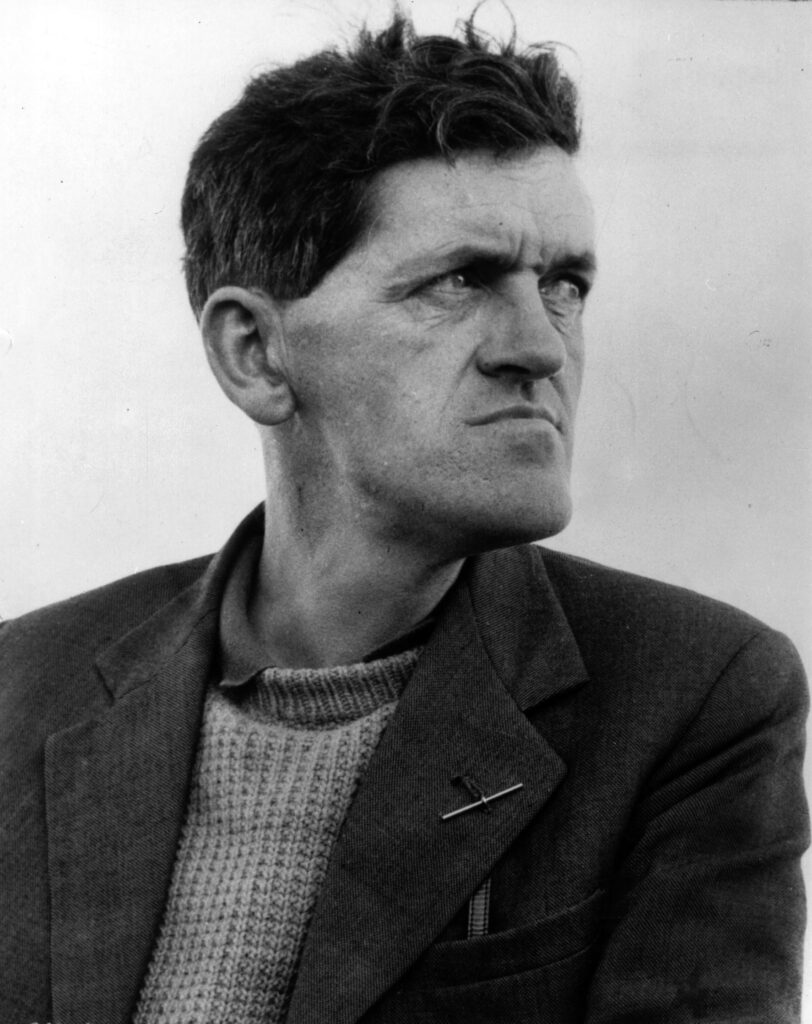
A virtuoso with words, the prolific Scottish poet, novelist, short story writer, playwright, and essayist George Mackay Brown remains too little known in literary circles. “I have never seen his poetry sufficiently praised,” no less than Seamus Heaney opined. Heaney repeatedly extolled Brown’s work, claiming “since the beginning of his career he has added uniquely and steadfastly to the riches of poetry in English.”

Shadowed by tuberculosis most of his life and in his later years by cancer, Brown died in 1996 at age seventy-four. In 2021, to mark the centenary of his birth, Scottish publisher Polygon issued Carve the Runes: Selected Poems and Simple Fire: Collected Short Stories. The same year, Polygon also published a new edition of Brown’s classic 1969 treatise, An Orkney Tapestry.

A Roman Catholic convert, the intensely private, granite-jawed author with an impish smile was given to spells of depression. Especially in the early stages of his career, he took refuge in drink; ill health placed the lifelong bachelor on the government dole. Biographical speculation on Brown’s relationships with women is wrapped in a cloud of unknowing.

“I think the only perfect poem or piece of music is pure silence,” Brown said in a 1987 interview in Ron Ferguson’s George Mackay Brown: The Wound and the Gift, one of the few book-length critical works on the author. “The silence which follows a beautiful piece of music or poem is richer and more perfect—something towards which the music or poem aspires, but never quite achieves.”

Numerous honorary degrees and awards came his way, including the Order of the British Empire. When his 1994 novel, Beside the Ocean of Time, was shortlisted for the Booker Prize, Brown fretted over the attendant publicity and gave no public readings. The final poem in the last book Brown published in his lifetime, Following a Lark, captures his stance:

A Work for Poets

To have carved on the days of our vanity
A sun
A star
A cornstalk

Also a few marks
From an ancient forgotten time
A child may read

That not far from the stone
A well
Might open for wayfarers

Here is a work for poets —
Carve the runes
Then be content with silence

The Orkney archipelago, with its roots in fishing and farming and Viking inheritance, lies off the north coast of Scotland. Brown grew up in the seaside town of Stromness on the biggest island, Orkney, otherwise named Mainland. Most of his life was spent there, except for stints in Edinburgh, where he studied under fellow Orcadian poet Edwin Muir at Newbattle Abbey College. Once in the big city, Brown became part of the circle of hard-drinking poets who frequented the Rose Street pubs—Hugh MacDiarmid, Norman MacCaig, and Iain Crichton Smith among them.

Brown did for the Orkneys what William Faulkner did for his fictional Yoknapatawpha County: he conjured a literary universe, often set in the past, from the daily life of ordinary people. The Orkneys bear a hard, elemental beauty from which this bard shaped a sacramental dimension, as in “The Death of Peter Esson: Tailor, Town Librarian, Free Kirk Elder,” an exquisite sonnet that begins:

Peter at some immortal cloth, it seemed,
Fashioned and stitched, for long had he sat
Heraldic on his bench. We never dreamed
It was his shroud he was busy at.

A Calendar of Love, Brown’s first book of short stories published in 1967, prompted a review in The Observer to note the author “really does possess the magician’s touch. . . . to lighten up the most humdrum detail of an ordinary life and transform it into something unforgettable.”

Brown’s first novel Greenvoe appeared in 1972 and won the Scottish Arts Council Prize. In this bittersweet comedy, an Orcadian island finds itself in the shadow of a sinister, mysterious military-industrial project called Operation Black Star, which leaves the precious patterns of island life suddenly vulnerable: “Afternoon was always the quietest time in the village. The fishermen were still at sea. The crofters had not yet unyoked. There was little sound in Greenvoe on a summer afternoon but the murmur of multiplication tables through the tall school window, and the drone of bluebottles among Mr. Joseph Evie’s confectionary, and the lapping of water against the pier.”

A year later came Brown’s most ambitious novel, Magnus, the story of a saint and martyr that stands at the center of the author’s entire output. As told in the Orkneyinga Saga, Magnus Erlendson vied with his cousin for the Earldom of Orkney. After years of civil war, the two met on the island of Egilsay for a peace conference, and to end the conflict, Magnus went willingly to his execution, a blood sacrifice echoing Christ’s. Brown’s telling adds a dash of magic realism when the 12th-century story of Magnus fast-forwards to the modern era and the martyrdom of Dietrich Bonhoeffer at the hands of the Nazis. The time-shift reminds us that the old patterns come around again and again wearing new clothes (or uniforms).

Magnus features a striking meditation on Christ’s martyrdom: “That was the one and only central sacrifice of history. I am the bread of life. All previous rituals had been a foreshadowing of this; all subsequent rituals a re-enactment. The fires at the centre of the earth, the sun above, all divine essences and ecstasies, come to this silence at last — a circle of bread and a cup of wine on an altar.”

Brown’s posthumous Collected Poems appeared in 2005. A year later came Maggie Fergusson’s essential biography, George Mackay Brown: The Life. Along with Polygon’s centenary titles, these books offer readers access to a singular literary figure, one who railed from his remote outpost against Western culture’s post-World War II torrent towards standardization. There are critics who consider him a Luddite, but better to say Brown staked out his ground as bold counterpoint to the white noise that would snatch us away from the numinous. Brown set out to re-enchant the world, and at his best, he did. Let’s give him the final word:

Death, critics say, is a theme that nags through my work: the end, the darkness, the silence. So it must be with every serious artist, but still I think art strikes out in the end for life, quickening, joy. The good things that we enjoy under the sun have no meaning unless they are surrounded by the mysterious fecund sleep.


Rain Taxi Online Edition Spring 2023 | © Rain Taxi, Inc. 2023

Three New Publishers' Self-Retrospectives

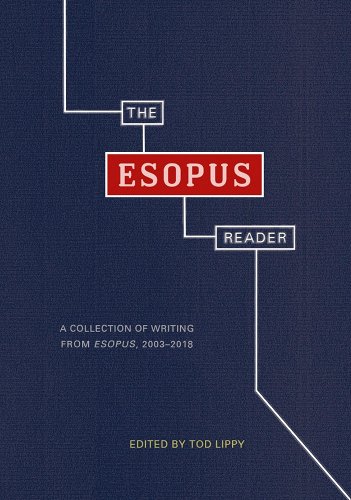
The Esopus Reader
A Collection of Writing from Esopus, 2003–2018
Edited by Tod Lippy

Esopus Books ($32)

A Something Else Reader
Edited by Dick Higgins

Primary Information ($29.95)

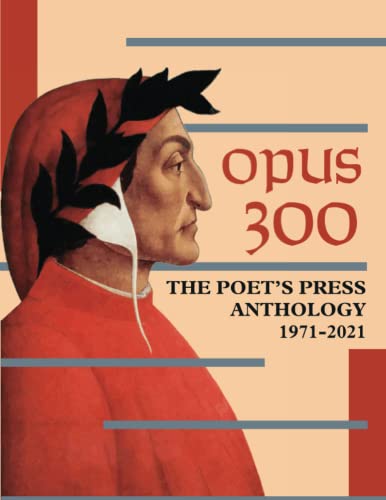
Opus 300
The Poet’s Press Anthology 1971-2021
Edited by Brett Rutherford

The Poet’s Press ($19.95)

by Richard Kostelanetz

Though I collect books about many subjects to a desultory degree, the only genre in which I try to collect every important example is one whose definition is probably of my own invention: publishers’ self-retrospectives. Quite simply, from their past publications, the publisher of books or a magazine selects a purportedly choice anthology (by definition, a collection of flowers). My critical assumption is that, better than individual issues, such books portray what publishers think they have achieved and thus how they wish to be remembered. Sometimes such a book appears as the publisher continues working, though quite often the retrospective appears as the publication is shutting down.

Esopus was a remarkable magazine of aesthetic culture that Tod Lippy, a filmmaker and curator, edited and published semiannually from 2003 to 2018 in Lower Manhattan. Its most immediately striking quality was its physicality—a glorious nine by twelve inches in size, the magazine was printed full-color, on thick paper, and often with pullouts or sections smaller than the magazine itself. Because Lippy’s literacy was broad, on successive pages were subjects that weren’t normally found together, and as the chapters were individually designed, the mere turn of the page promised a higher reading experience. 

Given the quality of individual issues, The Esopus Reader disappoints, reprinting only choice longer texts in uniform blocks of continuous type within a more conventional size and format. The main disappointment is not that the articles aren’t good, but that this Reader doesn’t represent what was unique and best about Esopus.

In its short life from 1963 to 1974, Something Else Press was the most important publisher of avant-garde texts in the world. To those of us becoming literate about avant-garde writing in the 1960s, it became a kind of graduate school, telling us not only what wasn’t taught in institutions of higher education, but also which books and artists we should know and what ideas to respect. Founded and financed by Dick Higgins (1938-1998), a polymathic writer who was also a brilliant book designer, Something Else produced pamphlets, perfect-bound books in various sizes, book-art, anthologies, and ephemera that was indeed, as Higgins claimed, “something else.”

The current publisher of A Something Else Reader, Primary Information, claims that Higgins prepared in 1972 a typescript that was only recently discovered, more than two decades after his death. While this claim surprised me, as I knew Higgins fairly well at the time, I can’t now imagine anyone other than him doing this retrospective as well. Indeed, so good are his selections from his publications that Higgins demonstrates that he, unlike some other bookmakers, must have read his output carefully.

One theme of this new book is that many texts that were highly original then are still highly original now. A second is that avant-garde writing has not one strand but many. Rather than resetting the selections to produce a visually uniform appearance, this Reader reprints pages as they originally looked (including a text of mine, entirely numerical, consuming barely a third of an otherwise blank page). The book concludes with an “Analytical Checklist,” a model of its kind, by Hugh Fox, himself an intrepid small press writer, that originally appeared in The Little Magazine Review

Sooner than reprint whole examples in a short review, let me note that among the literary artists reprinted here are Jackson Mac Low, Eugen Gomringer, Robert Filliou, Wolf Vostell, Dieter Roth, Richard Melzer, Kitasono Katue, Allan Kaprow, Brion Gysin, Alison Knowles, Ian Hamilton Finlay, Claes Oldenburg, Gertrude Stein, and Higgins himself. If you know little or none of the literary art of these names, consider starting your education here. In any university course about avant-garde literature, this Reader could become a foundational text.

The theme of Brett Rutherford’s Opus 300: The Poet’s Press Anthology 1971-2021 is persistence over neglect. Rutherford’s press started small and never got much bigger as he moved away from his roots in Pittsburgh and hopped between cities, taking administration jobs and in his spare time publishing single-author collections and themed anthologies that would not have otherwise happened.

As with his 299 earlier publications, Rutherford has been generous—here with 146 writers, 363 poems, two excerpts from plays, and five prose works. Thoughtful are his headnotes for contributors both familiar and unfamiliar. He mostly published his contemporaries, but the most surprising inclusions are obscure British authors: Thomas Lovell Beddoes (1803-1849), William Allingham (1824-1899), Henry Kendall (1839-1882), and William Bell Scott (1812-1890), among others.

In the back of Opus 300 are Rutherford’s “Publishing Chronology,” his annotated bibliography, and an index of the hundreds of authors he published. As a small publisher’s self-retrospective, Opus 300 should stand as an instructive model.


Rain Taxi Online Edition Spring 2023 | © Rain Taxi, Inc. 2023