
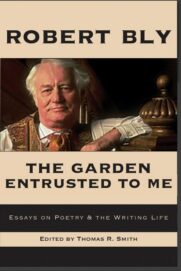
 Robert Bly
Edited by Thomas R. Smith
White Pine Press ($25)
by Joseph R. Hutchinson
Thomas R. Smith’s The Garden Entrusted to Me: Essays on Poetry & the Writing Life collects fourteen fugitive essays by Robert Bly (1926–2021), capped by an inspiring Paris Review interview published in 2000. Smith sorts Bly’s capacious material into four sections: “The Life of Poetry,” “Vocation and Disciplines,” “The Labor of Its Playfulness,” and “No One Writes Alone.” Bly ranges freely through ideas in the first three sections, but this book has intense unity because Bly’s concerns come together in the concluding interview. All this is bookended by Smith’s introductory essay, which is uniquely insightful because he served as Bly’s literary assistant for over thirty years, and by poet Jane Hirshfield’s afterword, “Remembering Robert Bly.”
The Life of Poetry
Despite being such a prominent public figure—by 1970 he was everywhere, performing, translating from multiple languages, editing, giving interviews—Bly was something of a mystery. His first book, Silence in the Snowy Fields (Wesleyan University Press, 1962), suggested he might be a “nature poet,” a midwestern Li Po or a free verse Robert Frost. But his second book, The Light Around the Body (Harper & Row, 1967), suggested a high-energy, socially engaged, political poet with a surrealist bent. How could these two poetic personalities exist in one person?
Bly’s first essay in this section, “Being a Lutheran Boy-God in Minnesota,” answers that question with a mix of self-deprecating humor and familial/cultural insight. There are details here that escaped even devoted readers, in part perhaps because Bly saw the world mythically the way poets like Blake and Yeats did; for them, each individual poet was an avatar of influences beyond his own biography. The “Boy-God” essay reaches beyond personal history to wrestle with some of the larger forces that shape us all, but poets and other artists in particular.
This “wrestling” conditions all four essays in this section, including the last one, in which Bly provides a close reading of his poem “Snowbanks North of the House,” moving through it line by line. It’s a tour de force of that kind of probing usually left to critics, which makes it refreshing—a detailed exploration of “the life of poetry” indeed.
Vocation and Disciplines
Critics who disliked Bly’s work sometimes mentioned his “lack of discipline”: his first sin being to walk away from meter and rhyme; his second, embracing “wildness,” which detractors often interpreted as a lack of craft. But this section’s essays show that Bly was devoted to poetic craft—just not the kind promoted by Cleanth Brooks, Robert Penn Warren, or Yvor Winters.
Bly’s sense of craft was rooted in his sense of vocation, which he found in the many poets he cites in this section’s first essay, “The Vocation of Poetry,” delivered as a conference talk. He identifies ten “labors” of the poetic vocation, each labor being the mastery of certain essentials. These include knowing the history of poetry in one’s own language and other languages, understanding “the Seven Holy Vowels” and how they relate to performing poems for an audience, and writing for one’s community—one’s “tribe”—instead of getting caught up in writing for the world at large.
Two more essays in this section, “Six Disciplines That Intensify Poetry” and “What the Image Can Do,” are similarly complex, re-readable, and illuminating for both makers and readers of poetry.
The Labor of Its Playfulness
The essays in this section show Bly at his most varied but also at his most disciplined in identifying the interconnectedness of poetic elements. Just a few of the titles may convey the variety and scope: “Educating the Rider and the Horse,” “Form in Society and in the Poem,” “Writing a Poem While Listening to Music.” These and the other four essays in this section capture a quality that came across in every live reading and performance by Bly: playfulness. This quality is crucially related to the labor of writing poems and reading them. We might even put it in an epigram: “No play, no profundity.”
The title of this book, Smith tells us, derives from a poem by the great Spanish poet Antonio Machado, translated by Bly:
The wind, one brilliant day, called
to my soul with an odor of jasmine.”In return for the odor of my jasmine,
I’d like all the odor of your roses.”“I have no roses; I have no flowers.
All the flowers in my garden are dead.”“Then I’ll take the waters of the fountains,
and the yellow leaves and the dried-up petals.”The wind left . . . I wept. And I said to my soul,
“What have you done with the garden entrusted to you?”
This rich collection gives us a glimpse of what Bly did with the garden entrusted to him. And it sets the bar high for us all, poets and readers alike—a fantastic gift.