
 Jordy Rosenberg
One World ($29)
by Clem McNabb
Within the first few pages of Jordy Rosenberg’s new novel Night Night Fawn, the voice of Barbara Rosenberg––matriarch, fallen starlet, and vicious critic of her trans son––worms its way into the reader’s brains, addictive and delicious. In her claustrophobic Manhattan apartment, Barbara slips in and out of an Oxycontin sleep, ruminating on when she “realized then and there that all of my dreams had died.”
A once ambitious drama student, Barbara is taking stock of her son, husband, house, and job, and finds them all disappointing. She blames her “daughter”—Barbara exclusively uses “daughter” and she/her pronouns to refer to her adult trans son, Jordy—for these disappointments, appalled by his embrace of “this golem of upside-down gender.” It’s not Jordy’s ideas and urges that bother her, she tells us, but his belief that he can actually “accoutre herself out of the misery of femaleness”; she is adamant that “it’s not so easy to give degradation the slip.” Night Night Fawn isn’t an account of a disappointed mother, then, but an embittered one. For Barbara, femininity is defined by sacrifice, and Jordy’s refusal to live as a woman tears open the carefully constructed circle she has drawn around her own life.
A complicated eroticism leaps out from Barbara’s rant, with her Oxycontin haze placing seemingly disparate memories beside each other. The second betrayal of Barbara’s life––the end of her friendship with Sugar Becker––plagues the book as much as her son’s; that betrayal, like Jordy’s, involves Sugar actualizing another life, one that regards Barbara’s life not as powerful and well managed, but as desperate and sad. The breakdown of the friendship reappears as if it is continuously happening, as do memories of Jordy’s childhood and her own early sexual encounters. There is an obsession with sexuality throughout the book, in fact, a fear of desire and pleasure as corrosive, unmanageable, and destructive. Barbara skewers Jordy’s college years, for example, as the nail in the coffin of her dreams, describing Jordy as having “one claw out the door & straight up the vagina of some lesbian at Wesleyan.”
Barbara relents only when Sugar helps her clean up after a bathroom accident—a moving and delicately woven passage that cannot be interpreted as closeted gayness. Rather, it reveals a release of control, an admission that everybody deserves to be in contact with bodily pleasure, “the joy of being touched, being cleaned.”
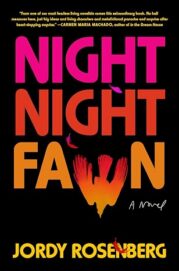
The mythical undercurrent of Night Night Fawn is the most disarming aspect of the novel. In Barbara’s dying stupor, her son appears to her as a sinister bird/man hybrid with a “a big, hawk like beak.” The sporadic episodes that constitute the novel’s “present” (Jordy’s caregiving and managing of Barbara), are steeped in this mythic language, where he appears to Barbara as a “person-sized bird.” The bird is not just a trans monster––that is too simple of a reading. There is tenderness underneath Barbara’s condescension, an acknowledgement that despite the horror his change evokes for her, Jordy as bird is recognizable, his feathers “the color of bargain suits,” (a callback to a long-coveted corduroy jacket that haunts Barbara). “My dear torturer, my terrible baby bird,” Barbara laments.
One of Night Night Fawn’s final chapters is titled “Vogelfrei,” a reference to the German Marxist word for exiles and outlaws who were “bird-free, free as birds, but also free of any means of support in this life.” Rosenberg’s novel is more interested in Marxism than it is transness––specifically Marxism as a critique of how capitalism creates the conditions under which ideologies of Zionism, homophobia, and transphobia are established and nurtured. So too, can it be employed creatively, breathtakingly, in the materializing of the Vogelfrei: Jordy’s birdman, taking flight, haunting Barbara like a Jungian dream-figure.
In the novel’s closing pages, Rosenberg writes of flying. Jordy is no longer hiding in jeans but has revealed themselves in full bird force; he picks Barbara up and flies her above the city, “against its breast and is beating the air with a wing.” Barbara, on her ascent in the mouth of her son, thinks of how she would have liked to live instead of dying: “Honestly she would just like to sit around with a bunch of other mothers and sip a Tab, ice snapping in a tall glass, smoking Camel Lights while little girls play at their feet.” Instead, Barbara is at the mercy of what is out of her control. Her son––the one with wings––gets to choose this time.
Night Night Fawn is a complex and tightly woven work, its manifesto-like quality encouraging readers to plunge in and out of intimacy with Barbara. That we feel both close to and repulsed by her is perhaps the most interesting effect of the novel. And while it deserves interest for its portrayal of trans family dynamics, it would be lazy to situate it solely within a canon of transsexual narratives or queer/trans authors. Instead, it confirms that Rosenberg’s imagination is vast, and his intelligence vicious enough to handle any subject matter.