
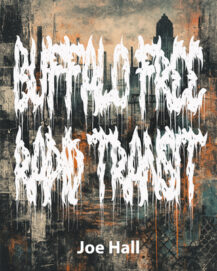
 Joe Hall
Black Ocean ($18)
by Greg Bem
The taste of starlight, of urinating for a thousand years, twisted and bowed
carried alone, between planets, in the well of years
care and how to learn what you can withstand as care
(from “Stars in My Pocket Like Grains of Sand”)
Joe Hall’s newest poetry collection, a close read of the city of Buffalo, offers an examination of place, and by extension our collective relationship to place. Buffalo Free Rapid Transit brings the brutish, the mangled, and the incoherent into focus and, for the poet, the sense-making that follows. It is uncomfortable, it is ecstatic. The collection is burst upon burst, often through pure survival, offering a beautiful commentary on humanity through suffering.
Hall’s seven-part collection focuses on the state of the American city of Buffalo, New York, from 2020 to 2023. As such, it’s thematically bound to the collapse of city-state norms due to the pandemic. Hall channels zones of entropy and extremity by way of seemingly endless horror. As national headlines reflected, Buffalo experienced police brutality, white supremacy, and the disintegration of services and humanity amidst inclement weather.
just the burning zodiac of now
in the future’s flaming throat
at the unemployment office
(from “Mechanical Separation”)
The book focuses as much on events derived from systemic injustices as the systems themselves. A commentary on capitalism, this is a book that renders two sides of dramatic inequality and breathes life into the daily grind of survival within the brutality of American life. The poet’s own relationships are balanced with observations of the kindness of strangers and public empathy.
But these moments of good merely seep through the cracks of Hall’s typical flood of grotesque and broken imagery. Buffalo Free Rapid Transit calls attention to the poet whose writing is flailing, who suffers like the rest of us. The gift of this poetry is tenuous and at risk of being extinguished completely.
tripping off this Zoom call, spooled in the coffee, fireballs, beers, & fists
of wine, asking for a raise when what I mean is I quit, the addict in me
ringing the doorbell again at 4 am and taking off, you turn in bed, think
of the lake as a whole city of loss . . .
(from “The Municipality of Daydreams”)
Hall directly recognizes the influence of Samuel Delaney in the book’s notes, and there is a familiar, creeping post-apocalyptic undercurrent to this book. The specter of apocalypse is embodied across frozen and fiery landscapes, the nearly endless alcoholic reliance, the escape from pitiless jobs, and the thin thread keeping Buffalo’s bus system running. This haunting is embodied in the juxtaposition of impermanence and the pressure of the present, in escape and confinement.
In a bleak end-state, one may question what to make of it all. In Joe Hall’s Buffalo, everything is monstrous and anxious, including the poet’s act of bearing witness. In this one finds truth, undeniable and constantly flickering and morphing, like shadows behind flames.
in the driver’s seat under the too-close stars of a parking lot,
in the recombinant currents, the water main burst what had been safe
into cataracts of fire, the burning rivers of time,
the burning lakes and hills of time, the jumble of letters and keys
millions of fingertips spatter into the dawn . . .
(from “Ekpyrosis, The Watershed”)
Buffalo Free Rapid Transit is a tough pill to swallow, and it’s a book that’s from a specific, nearly unbearable time and place, but one that isn’t without a vision forward. From the beginning, the poet leans into the power of the local rivers, and the central optimism of communion. Resilience is at the core of the poetry and at the core of the city.
In the quietest and loudest spaces, we still come together. In the most trying of times, a cup may be passed around or a person may be sleeping next to another. Like Delaney’s Dhalgren, the light may be dim and the world may be literally and figuratively a smoldering heap of rubble, but in the corners we find ourselves, together.
so many cities fall away when you leave, everything you needed
the city to be may stop bending to the light, a planet
thirsty for light, a tangle of threads, pulling
the fabric of the city: I wish I could describe
Buffalo’s weather like some soft container
that invites you to hold with care an intricate and accurate
machine . . .
(from “The Buffalo You Left”)
Catastrophe may come, but the people remain, holding each other up in mutual aid. With Buffalo Free Rapit Transit, Joe Hall has modeled for us an inspiring poetry desperate for justice and collective survival.