
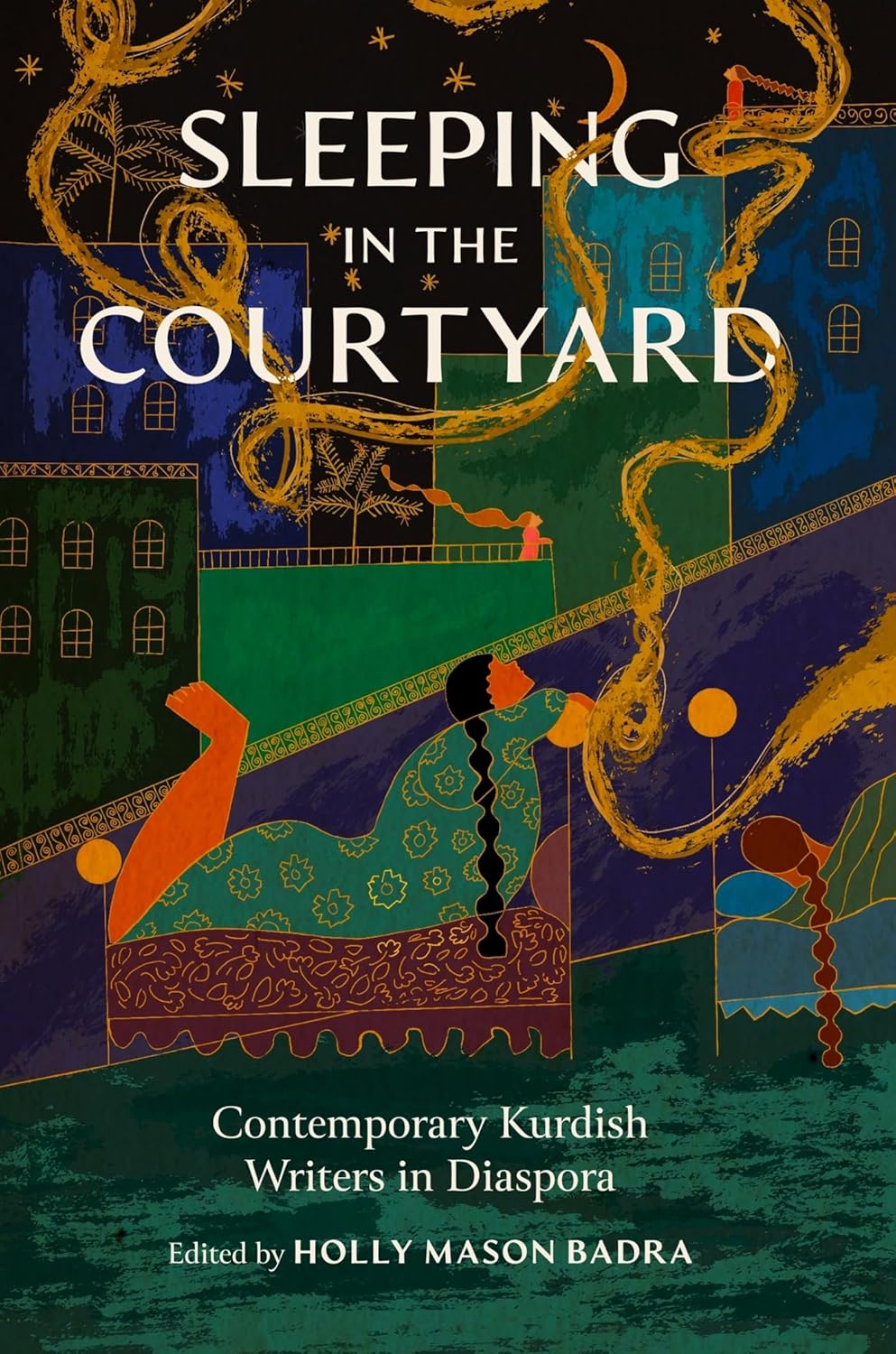
 Edited by Holly Mason Badra
University of Arkansas Press ($26.95)
By Alan Ali Saeed
While Sleeping in the Courtyard isn’t the first anthology to showcase the diversity and range of writing by Kurdish women, it is arguably the boldest. Varied in terms of both genre and geography—it includes writers from the Kurdish regions of Syria, Turkey, Iraq, and Iran, as well as the global diaspora alluded to in the subtitle—the collection presents work originally composed in Kurdish, English, and several other languages. The material has been judiciously selected by Kurdish-American poet Holly Mason Badra, who also supplies an adroit introduction that centers the anthology’s political nature; as Badra writes, “Exile and erasure are tools of the oppressor. This collection is the antithesis of erasure.”
While the works here are not organized by genre—Badra presents them fluidly in conversation, creating interesting juxtapositions—it should be noted that among the fiction selections are extracts from several important recent novels: Ava Homa’s Daughter of Smoke and Fire (Abrams, 2020), Gian Sardar’s Take What You Can Carry (Lake Union Publishing, 2021), Choman Hardi’s Whispering Walls (Afsana Press, 2023), and Balsam Karan’s Event Horizon (Feminist Press, 2026). Daughter of Smoke and Fire presents a compelling narrative of persecution from the point of view of a young child: “My five-year-old mind could not identify the map drawn on my father’s back and neck from the lashed scars of his time in prison.” Sardar and Hardi are American-Kurd and British-Kurd respectively; the portions from their two novels show, in unusual ways, how writers from the diaspora use stories about domestic relationships to explore the historical trauma of the Anfal, Saddam Hussein’s infamous attempt to commit genocide against the Iraqi Kurds. The extract from Event Horizon, a lyrical science fiction novel originally written in Swedish, shows outcast protagonist Milde’s view of all that is left for the socially dispossessed like her: “Sure, I can go to space and die, why not?” Though it may be tempting to see this as the Kurdish predicament transfigured into an existential situation, we should probably be wary of such an over-determined reading.
Memoirs and essays are well-represented in Sleeping in the Courtyard. Bayan Nasih’s “The Explorer Who Watched from a School Window” details her poor but happy life growing up in a Kurdish village, and it is engaging to see such a positive, warm account, while Meryem Rabia Uzumcu’s “Family Rashomon depicts the author and her mother discussing the differences between their respective experiences of migration to America.” Hero Kurda’s “Except for Poetry, Nothing Else Shields Me,” provides an honest perspective on what it is like to be a Kurdish poet living and writing in the contested city of Kirkuk, Iraq: “Except for poetry, nothing else shields me in this city, a city flooded with so many different religions, cultures, fire and war.” Maha Hassan’s In Anne Frank’s House, written in Arabic and not yet published in English translation, resulted from a year’s invited residency in which the Syrian-Kurdish author lived in Frank’s house. The tongue-in-cheek, Gothic episode relates vividly how Hassan feels and negotiates with the “ghostly” presence of Anne Frank: “You have the right to remain in this house, so do I. We each have to recognize the other’s right to be here. This is your home, I’m aware. But now your dead . . .” It is arguably a more humorous novel than many readers have taken it to be.
Poetry has always been the pre-eminent Kurdish literary genre; in the city of Sulaimani where I live and teach, our main street is named Salim Street, after one of the most beloved classical Kurdish poets—the equivalent of calling New York’s Fifth Avenue “Whitman Street.” It is therefore unsurprising that Sleeping in the Courtyard features a dazzling array of Kurdish women poets, many sensibly presented in a bilingual format. Some use traditional Kurdish forms while others prefer more contemporary Western experimental styles, and some hybridize the two. Most revel in visual imagery, which is central to everyday Kurdish idioms. They all share attention to the lived experience of being a woman in a patriarchal society, although they cover a variety of topics: love, grief, family relationships, politics, and the everyday life of women in Kurdish communities.
Take Zhawen Shali’s “Yesterday,” translated from the Sorani dialect of Kurdish. It seems at once a melancholy love poem to one who has left and an abstract lament for the lost dream of a Kurdish state. Like many Kurdish poets, Shali revels in nature imagery, but she also uses more startling metaphors:
I am the shadow of those days –
the days the sun forgot
to radiate through the windows.
I linked arms with the sky
and touched my lips to the flames of the fire.
Dreams are replaced with leaving
and poetry is revisiting a familiar cadaver
in an oppressive headline of news.
I am deprived of land
and tired of war.
While the tone here is dark, the continuity of female experience from generation to generation is also depicted as something worth celebrating, as in Jîla Huseynî ‘s “Question” (also translated from Sorani):
My mother’s worn scarf
does not leave my head alone.
It says: “I am your grandmother’s.”
Several of the anthology’s English-language poems also deal with more everyday domestic themes, such as Leila Lois’ “Tasseography,” about the Kurdish love of tea drinking and family stories:
Honey-drenched, rose-scented,
stories run through my mind like sepia,
her voice dark like tea as it steeps
Hiva Panahi’s “A Poet was Murdered” registers the trauma of sudden death in disruptive, fractured cadences. Panahi alludes to W. H. Auden’s 1937 poem “Spain” where politics fractures the realm of the aesthetic: “To-morrow for the young the poets exploding like bombs.” But she ironizes Auden’s rhetorical detail in her preference for the literal amid a world of car bombs and suicide bombers. The lack of punctuation in Panahi’s poem helps to emphasise the impact of this harrowing event:
The distances grow longer
everywhere The eyes scatter
everywhere
The sounds searched for you
everywhere Your eyes were found in
the streets Covered with snow
As an introduction to the wide variety of contemporary Kurdish women’s writing, this anthology fulfils its purpose, despite relying only on existing publications and translations. The work is of a high quality, and many important literary figures are represented. There’s much for readers to relish here, especially those new to Kurdish writing. A map in the introduction would have helped the reader to understand the geography of this large, stateless nation—comprising more than 40 million people— spread between Syria, Turkey, Iraq, and Iran. Were it not for the range of everyday and non-political issues in the selection of Kurdish poetry, the book might have been a rather solemn reading experience, erroneously suggesting that Kurds spend every waking minute feeling oppressed. In the end, however, Badra deserves to be commended: Sleeping in the Courtyard is a valuable, enjoyable attempt at surveying the field of Kurdish women’s literature.