
 Rachel White
Liverpool University Press ($160)
by Patrick James Dunagan
As the Elizabethan era sought to explain and enhance a broad understanding of the natural orders of the world, magic and science remained interchangeably blended under the broad umbrella of the occult, incorporating everything from astronomy to alchemy and beyond. Meanwhile, English poetry was struggling towards its own self-definition with the language itself in flux, still developing standards of spelling, pronunciation, and grammar. All compounded amid increasing nationalism with ambitions concerning territorial expansion of power. This is the richly rewarding moment of cultural history that Rachel White explores in her surprisingly accessible new book, Elizabethan Occult Poetics.
Bringing to light personal connections between poets of the era, White discusses the group referred to as the Areopagus in the correspondence of Sir Phillip Sidney and Gabriel Harvey, devoted to “evolving understanding of the role of proportion in English verse and their navigation of the blurred lines between music, maths, and poetry.” Edmund Spenser, Edward Dyer, and Fulke Greville were also key members of this literary society. Without making too much of just how active or widely known the group was, White utilizes the friendship among these poets—Greville and Dyer appear as hooded figures in a famed engraving of Sidney’s funeral procession—as a fruitful entry point into deeper engagement with what she terms “occult poetics.”
Although based upon White’s recent doctoral dissertation, Elizabethan Occult Poetics wears its erudition lightly, interrelating biographical connections between poets in a manner that brings the era to life. And there is certainly enough evidence to allow for revelatory commentary. For instance, the Italian Giodorno Bruno, burned at the stake for heresy in Rome in 1600, visited England during Elizabeth’s reign, and presented his then heretical ideas of cosmology (that space is infinite, the earth and other planets revolve around the sun, etc.) at a dinner hosted by Greville. Bruno’s philosophical dialogue The Ash Wednesday Supper recounts the event without relaying any comments by Greville; White demonstrates that sympathetic connections between the two authors can be found in Greville’s writing, while also reasoning why Greville may have been less willing than Bruno to risk direct expression of controversial thinking:
Though Greville engages with Brunian cosmology, he does so with an awareness of its theological ramifications, reinterpreting the infinite space of the universe not as the life-producing cycle of energy that Bruno sees, but as a space of absence, darkness, and isolation in which the position of God is unknown.
White acknowledges that engaging with the occult “without creating fictions or speculative narratives is difficult,” yet she skillfully maneuvers her way around spurious offramps while grounding her arguments with assiduous scholarship and placing the larger concern of England’s burgeoning prominence upon the world stage as the central backbone to her study. She states her thesis clearly:
In a world in which occult discourses are inseparable from science, magic, and religion, pervading everyday life and intellectual endeavors, the new poets experimented with how English poetics could come to possess the occult virtues and qualities that exist within the cosmos, making it powerful, efficacious, and a foundational part of nation-building and national identity.
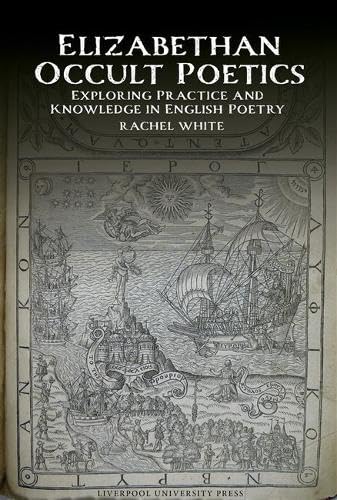
Because Queen Elizabeth herself “encouraged the pursuit of occult philosophy, including alchemy and astrology.” White follows the critical thread of her symbolic (as well as literal) power, be it “the figure of Elizabeth as an awesome, uniting body” witnessed by her infamous magus-advisor John Dee, or the use of Gloriana in Spenser’s Fairie Queen as “a talisman, a powerful sign which exudes occult forces through the astrological significance of its separate parts.” The nation-building thread is brought visually to life by an image from the title page of Dee’s General and Rare Memorials Pertayning to the Perfect Arte of Nauigation, where Elizabeth “sits in the stern of the ship identified as Europe”; the entire westward-oriented ocean scene is richly imbued with weighted nationalist symbolism and serves as the cover image on White’s own book.
Pulling together previously unconnected elements of the occult poetics behind Elizabeth’s reign, White offers an enriching tale here; better yet, her reading reveals fresh launching points for further engagement.