
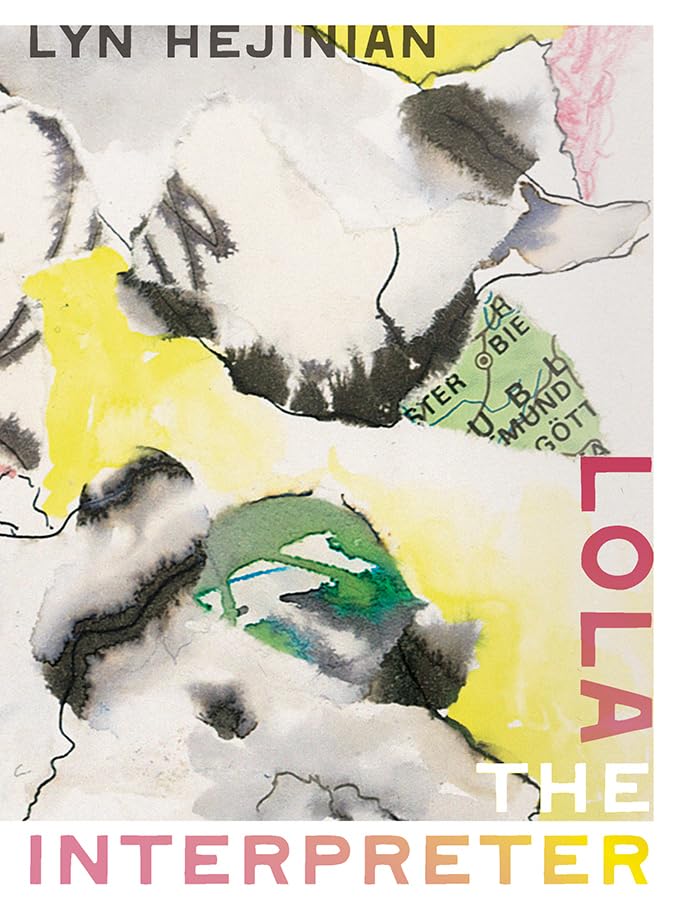
 Lyn Hejinian
Wesleyan University Press ($18.95)
by Luke Harley
Lola the Interpreter, the final work by Lyn Hejinian (1941–2024), stands as a crowning achievement of her career as an experimental poet. A sequel of sorts to Saga/Circus (Omnidawn, 2008), it continues her exploration of hybrid forms uniting poetry and prose, autobiography and fiction, and observation and citation—what Hejinian’s fellow Language poet Barrett Watten terms a “combinatorial poetics.” Structured in seven sections—each introduced by a color plate of Hejinian’s own design—the book arrives like a consoling breeze in today’s climate of political extremism. In its embrace of allegoresis, a literary strategy which Hejinian claims as a form of critique, it refuses to buckle to authoritarianism and the “technocratic takeover of reality.”
In Lola the Interpreter, the titular character is tasked with making sense of a destabilized world. First introduced in the “Circus” section of Saga/Circus as a bike-riding, book-loving child, Lola reemerges in this volume as a sharp-witted, affectionate, pragmatic adolescent—one playfully dressed in black jeans and a black Stetson, evoking the rebellious spirit of a literary cowgirl. Her transformation signals a shift from innocent observation to incisive critique as she confronts the “machinations of capitalism” and challenges a dystopian reality she deems “insufficiently artistic.” For Lola—a kind of muse for Hejinian—interpretation is resistance: her rationality and linguistic skill empower her to navigate (and subvert) the ideological structures that shape her world.
Like ours, the world that Lola inhabits is marked by “global interconnectivity, selective interconnectivity, changing urban demographics, extreme weather events, economic inequality, mass incarceration, homelessness, urban congestion, civic madness”; it is a world where eros has been “monetized” and almost every aspect of personhood is “weaponized for political ends.” Disillusioned, Lola and her friends yearn for lives of meaning and coherence. They seem to seek what Walter Benjamin, in his concept of Jetztzeit (now-time), calls the “mystical instant”—an allegorical moment that crystallizes into the “now” of historical consciousness.
For Hejinian, “allegorical thinking” offers a way out of the anxiety, fragmentation, and “dismal indifference” of contemporary life. In her essay collection Allegorical Moments: Call to the Everyday (Wesleyan University Press, 2023), Hejinian champions poetic strategies such as parataxis, digression, and syntactic disruption, deploying them to challenge conventional narrative coherence and resist closure. Her “wayward poetry,” grounded in material particulars of “adamantine specificity,” opens a space for imaginative flourishing—including in Lola the Interpreter, where Hejinian conjures a self-effacing “tumult of language” that sends “waves of polysemy rolling through even the most quotidian, banal, pedestrian, and seemingly inconsequential of situations.”
Hejinian’s focus on material particulars—the “paltry objects of quotidian life”—bears some resemblance to Wordsworth’s elevation of the ordinary, yet Hejinian is certainly not a Romantic poet in the conventional sense. Her work has been shaped more by Russian Formalism, pragmatist philosophy, and critical theory than by Romanticism; if Lola the Interpreter stages a dialogue between Romantic poetry’s idealism and Language poetry’s skepticism toward narrative and lyrical unity, it is one in which the latter usually prevails.
Nevertheless, Hejinian was influenced by a foundational text that introduced many in the American avant-garde to the collaborative ethos of German Romanticism: Jean-Luc Nancy and Philippe Lacoue-Labarthe’s The Literary Absolute (SUNY Press, 1988). Moreover, her recent writing contains flashes of unexpected Romantic ambition, as if reviving ideas that remain relevant amid the complexities of the Fourth Industrial Revolution. In Saga/Circus, for instance, the “Saga” section—comprising thirty-seven nonlinear free-verse segments—invokes Coleridge’s Rime of the Ancient Mariner through its metaphor of poetry as a sea-going vessel, navigating the unstable waters of perception and meaning. Similarly, her book-length poem-essay Positions of the Sun (Belladonna*, 2019) alludes to Wordsworth’s “The French Revolution as It Appeared to Enthusiasts at Its Commencement” (1789), echoing his claim that it is “not in Utopia” but only “in the very world which is the world / Of all of us” that we “find our happiness, or not at all.”
As in earlier works such as My Life (Burning Deck, 1980) and My Life in the Nineties (Shark Books, 2003), Hejinian is aligning herself with a tradition that locates moral clarity and fulfillment in lived experience rather than abstract ideals. Her engagement with Romanticism represents a sustained inquiry into the nature of human connection amid social fragmentation. Poetry, described in Lola the Interpreter as the “skeptic’s philosophy,” becomes a site of collective reflection and shared experience.
This anti-narcissistic ethos is conveyed through the rich intertextuality of Lola the Interpreter, where an eclectic ensemble of thinkers—among them Horace, Friedrich Nietzsche, Sextus Empiricus, Charles Baudelaire, Fred Moten, Michel Foucault, Clark Coolidge, Christa Wolf, Henry James, George Eliot, Albert Camus, Stan Brakhage, Sigmund Freud, Carla Harryman, William Blake, Louis Zukofsky, and Etel Adnan—are drawn into dialogue. Their presence evokes the “symphilosophizing” impulse of German Romanticism, inviting readers to become “lovers of linkage”: those who uncover unexpected connections and embrace a collaborative, expansive mode of inquiry. Through this polyphonic exchange, Hejinian celebrates the generative potential of shared thought, associative movement, and collective imagination.
Hejinian dedicated Lola the Interpreter—as she had nearly five decades earlier with A Mask of Motion (Burning Deck, 1977)—to her husband and fellow activist, avant-garde saxophonist Larry Ochs. The book’s architecture emulates the improvisational logic of Ochs’s music, particularly his long-standing work with the Rova Saxophone Quartet. Its open-ended sections engage themes such as skepticism, freedom, reason, beauty, time, memory, and dreams, unfolding them with the fluidity and unpredictability of a jazz composition. This improvisatory structure resonates with Benjamin’s concept of constellation, where meaning emerges through the relational configuration of fragments; much like Benjamin’s montage technique in The Arcades Project, Hejinian’s paratactic text resists narrative continuity, inviting readers to traverse “nodal singularities” that generate meaning through proximity, disjunction, and imaginative association.
In the book’s final section, Hejinian’s brief references to Tolstoy’s War and Peace and Susan Howe’s Frame Structures set the stage for a striking intertextual gesture: a quotation from “Mode Z,” the opening poem in Barrett Watten’s 1–10 (This Press, 1980), written for Rae Armantrout when she left the Bay Area for San Diego in 1978. In this poem, Watten calls for the erasure of society’s “imperious frames”: “Could we have those trees cleared out of the way? / And the houses, volcanoes, empires?”
Watten’s call to dismantle inherited structures evokes Marx’s philosophical imperative for a “ruthless criticism of all that exists,” suggesting a poetic and cultural tabula rasa from which the world might be reimagined. “Mode Z” thus initiates a kind of permanent revolution, confronting entrenched personal and collective mythologies and urging a break from received narratives. Hejinian echoes this impulse in the seventh section of Lola the Interpreter, offering a bold refutation of rising American conservatism: Conceptual frameworks are not immutable. Drawing on Gerard Manley Hopkins’s “Spring and Fall: To a Young Child,” she writes: “Are you grieving over the unleaving of the trees? They will fall.”
While Hejinian acknowledges profound grief over “the bigotry, the greed, the voluntary, willed stupidity, the passion for fascism” in today’s American conservative movement, she insists that sorrow must be transformed into critical engagement and imaginative resistance. Near the end of Lola the Interpreter, she returns to the theme of skepticism introduced in the opening section, and in a “precipitously disturbed” mood, she adopts an ambivalent stance: Skepticism may “KEEP YOU FREE,” but it can also lead to “hopelessness, impossibility,” offering “nothing but dead ends and fatigue.”
In the book’s closing moments, however, Hejinian strikes a more upbeat note, befitting the defiant utopianism that runs throughout her oeuvre. Drawing on Brad Giggs’s reading of Hume’s motivational skepticism, and writing in a present-tense voice reminiscent of Gertrude Stein’s “continuous present,” Hejinian calls on readers to recommit to activist inquiry—to remain critically attuned, imaginatively open, and politically responsive, even in the face of despair: “Skepticism requires refocusing, repurposing, reconnaissance, resistance, utilizing thought’s ‘capacity to be mobilized toward different ends.’”
Lola the Interpreter exemplifies Hejinian’s “late style” in Edward Saïd’s sense of the term—a “mature subjectivity” marked not by passive decline or neat closure, but by “intransigence, difficulty, and unresolved contradiction.” That Hejinian completed this formally daring and conceptually rich book while battling cancer speaks to her extraordinary resilience and creative force. Lola the Interpreter, in the end, is an affirmation and a continuation of Hejinian’s belief in language as a tool for reimagining the world.