 Robin Coste Lewis
Alfred A. Knopf ($27)
by John Ngoc Nguyen
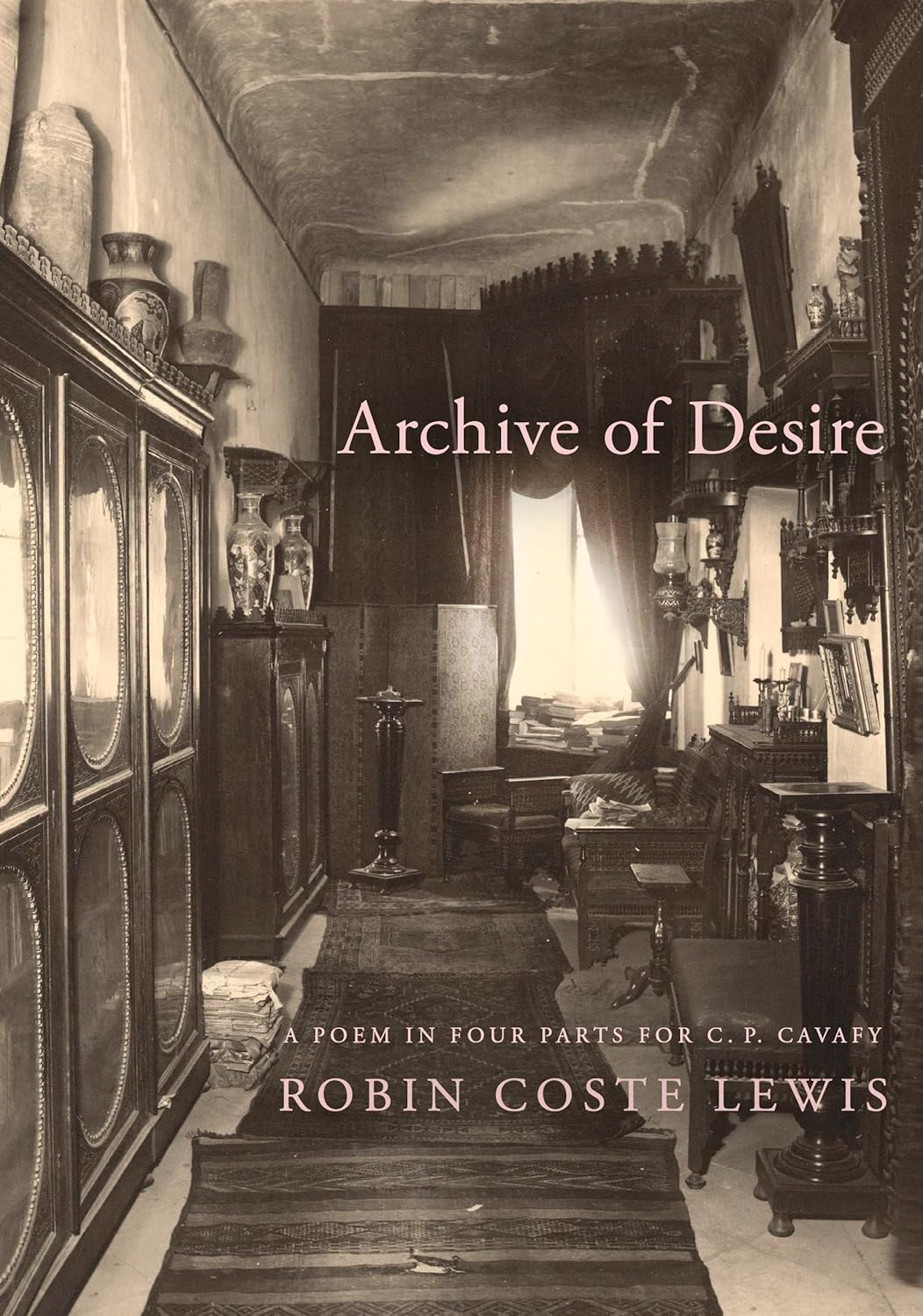
Robin Coste Lewis’s lustrous Archive of Desire hinges on a word it does not contain: “excuse.” The National Book Award–winning author’s third lyric performance opens with a handkerchief, an homage to that vital, charged piece of cloth from a poem of queer desire by C. P. Cavafy, “He Asked About the Quality.” In it, Cavafy’s speaker and a shopworker ostensibly make conversation about the handkerchiefs on display, “their only aim: the touching of their hands / over the handkerchiefs”—an excuse to do what is only natural.
Lewis revises these characters. Her autobiographical speaker stops by a clothing store, where skirts are on discount “(polyester, cheap),” and beholds the girl of her dreams on shift. Her “whispery voice breaking open // with desire,” the speaker pretends to be “looking // for embroidered handkerchiefs,” which she and the “shop-girl” go back and forth over, beneath their talk and burgeoning heat “a psalm of consent.”
In Lewis’s hands, the pocket-sized handkerchief experiences two sublime transformations. The speaker observes “a boat so casually navigating / the rough sea. // Its sail is / your unfolded, opened / handkerchief,” which is also, stanzas later, “a kite soaring // within my sky.” The handkerchief navigates land and water and air, not unlike the chorus Lewis summons: “We are the Goddess’s words— / Her bracelets, Her rings, // We are Her / intense and infinite wanderings.” As in her second book, To the Realization of Perfect Helplessness (Knopf, 2022), Lewis nods to the courage of ancestral, diasporic Blackness, adding her own precious stones, patiently cabochoned and faceted by her verse-thinking, to this begemmed birthright.
For all its epic making, Lewis’s book is about undoing, unlearning, being unapologetically unrepentant:
All the fallen
and broken
statues insidemy heart
. . . . . . . . . . . . . . . .
I am no longer afraid.
I will never again allow myself
to be afraid to be loved. Or to love you.
Cavafy, Lewis says in the lesbian bildungsroman that serves, too, as her epilogue, “was a god for Black, Brown, Red, Yellow, and all of that mixed together, for baby Queers . . . We were elegant in his lines.” She looks on her upbringing: formative was Ms. Paddington’s high-school debate class in Los Angeles. Wide open during lunch period, the classroom became a gathering place for “all the freaks, of which I was proudly one.”
Freakishness offers pain, pride, and—above all—humor, of which there is a trove in Lewis’s collection, an Ellisonian extravagance of laughter. “My father asked me one afternoon, affectionately and nonchalantly, ‘So, Baby, you a bulldagger?’ . . . And I laughed because he imbibed a word that was traditionally vulgar with such affection.” Lewis and her sister regularly accompanied their father to the garage, where he “constantly put tools in our hands . . . Soldering guns, the monkey wrench, tape measures, spackling.”
Lewis’s sweeping eye marries this “low” hardware with the “high” objects of her acropolis, which from the Greek translates to high city. A glass perfume bottle, small terra-cotta altars, the bones of a piglet, a hare-shaped baby rattle: these objects from the museum of Lewis’s acropolis, which doubles as a self-portrait, are “happily lost so that in the future—now—they can be regained. . . . Each of us broken, each of us emanating an earlier glory. A procession of winged selves parading constantly throughout our cells.”
These relics join the company of possessions from Lewis’s matriarchal family, her mother and grandmothers and aunts and female cousins, their “most gorgeous” bodies intimated by the garments and accessories they used as methods for beauty on earth: “Their handsewn frocks. Their holy rage. . . . Their rhinestone-studded pocketbooks and their mother-of-pearl pocketknives, the latter hidden inside the former—like their own interior weapons.” These last mementos call back to Cavafy’s vest pocket, where his handkerchief lies snug.
Lewis recasts Cavafy’s images via fragments and erasure in her lyric offering to the altar of multigenerational Blackness: an ebony divan, candles ticking off the years. Though the poet would “rather look / at things than speak // about them,” she describes them profoundly, her beloveds using “pearly combs to groom / our raven-black hair.”
Lewis’s poetics is balanced with the passion and play of youth, her development as artist, intellectual, lover. As a second grader, she was Cupid-struck for a peer, Bridget, whom Lewis, a precocious flirt and practitioner of mutual aid, would spare some change for lunch money. “Other girls had crushes on very cute but very stupid boys. Why should I not fall in love with the smartest person in Mrs. Larson’s class?”
Later, fleeing their racist public school system, a 16-year-old Lewis and her girlfriend would drive to Sisterhood Bookstore, their go-to: “It was here—among the ‘Sisterhood is Powerful!’ buttons, and the volumes of Our Bodies, Ourselves greeting us at the front door, as well as The Joy of Lesbian Sex (which made me blush hard), and Audre Lorde’s Zami—that I found a volume by the remarkable Greek poet Constantine Cavafy.” So marks the dawning of Lewis’s ardor.
To be a freak, to have membership in the freakdom, brings up Cavafy’s famous barbarians, so named by ethnocentrists of yore whose ideas are not unfamiliar, with Lewis writing her book against the backdrop of “my countrymen’s absurdity.” “[T]he barbarians? We are / their children.” Bestowing on each child the title of “Great ancestral palace,” Archive of Desire exalts “the little girls—all the brown little girls—whose bodies we buried in the Great Pit . . . the moment we looked to the horizon—the second we saw them coming,” in-groups and out-groups re-envisioned to indict power and its literally crushing notions of whiteness.
“The Earth and Sky still like to make love,” she writes. “They still give birth to giants.” Chiseling from life, history, and metaphysics another indelible work, Lewis is our lyric giantess.