
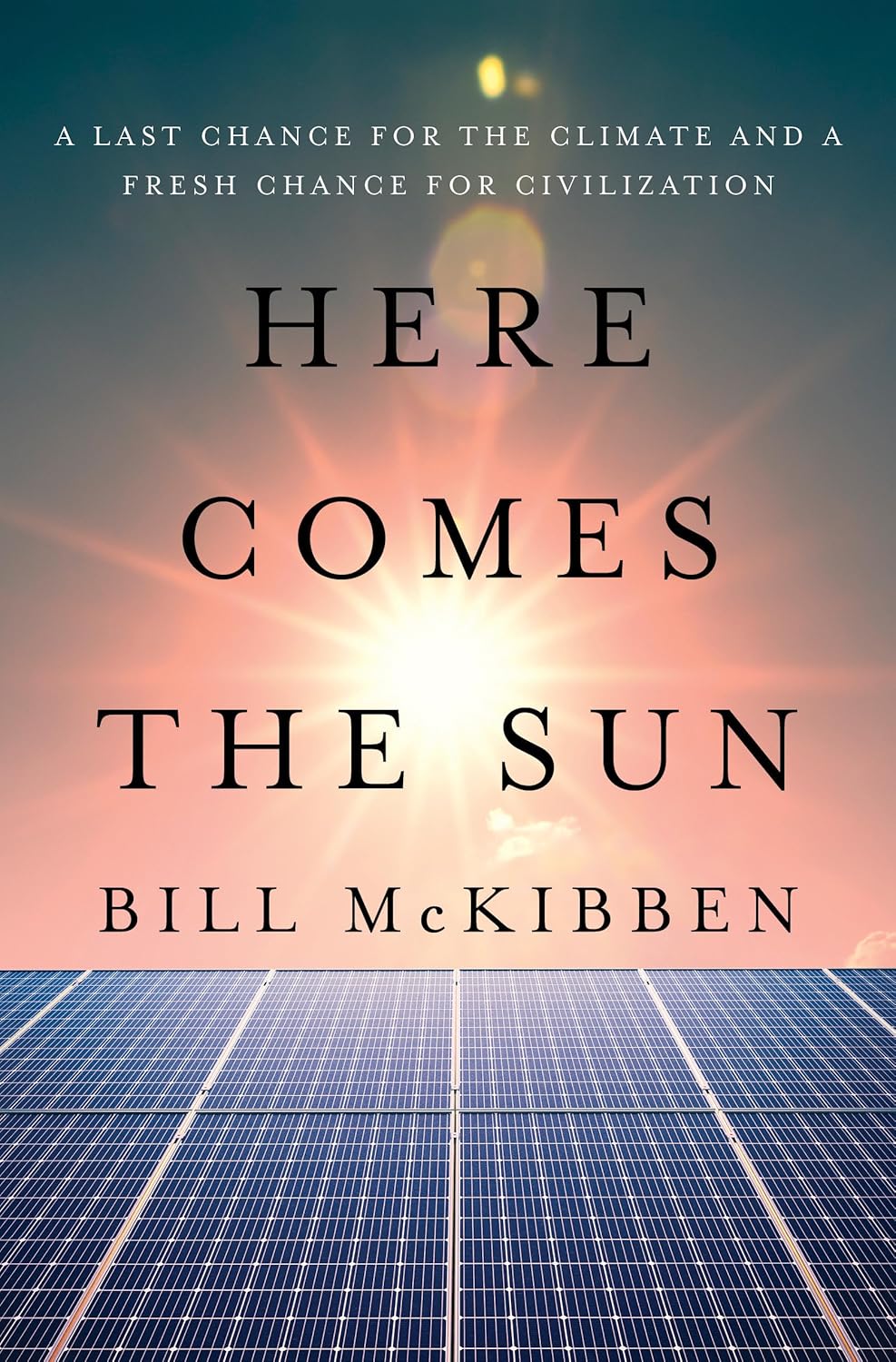
 Bill McKibben
W.W. Norton & Company ($29.99)
by John Abbotts
In the preface to our co-authored book The Menace of Atomic Energy (W.W. Norton & Company, 1977), Ralph Nader describes a 1974 discussion with Dr. Alvin Weinberg, former director of the Oak Ridge National Laboratory and “the person most identified with nuclear reactor development in this country.” When solar energy was suggested, Nader writes, “his response was unexpected. If solar electric could be brought down to a cost not exceeding 2.5 times that of nuclear,” then “he would favor solar” over atomic fission.
Even before a 1976 article by Rocky Mountain Institute co-founder Amory Lovins urged a “soft path” for a future energy system based on energy efficiency as the most economical alternative then, along with renewables over the long-term, nonprofit organizations were making similar recommendations.
Yet other scenarios are now in play. In Chelan County, Washington, east of Seattle and straddling the Cascade Mountain Range, the company Helion Energy is constructing for the Chelan Public Utility District a 50-megawatt atomic fusion power plant whose output will be dedicated to Microsoft data centers. Will it work? I have my doubts. In 2022, the U.S. Department of Energy announced a “breakthrough” in research on atomic fusion. At the National Ignition Facility in Livermore, California, an experiment delivered 3.15 megajoules of energy output from a 2.05 megajoules input, but the 192 lasers that produced that input required 300 megajoules of energy. As the organization Beyond Nuclear International noted, experts have always predicted that commercial fusion power is decades away; with that new data, this remains true for federal research.
In contrast, Bill McKibben reports that now, “We live on an earth where the cheapest way to produce power is to point a sheet of glass at the sun. The second-cheapest way is to let the breeze created by the sun’s heating turn the blade of a wind turbine. Beginning about the middle of 2023, we entered the really steep part of this growth curve that could define our future,” with installation across the planet of a gigawatt of solar panels every day. By the fall of 2024, that gigawatt of panels was being installed every eighteen hours. In comparison to the 50-megawatt uncertain hope for fusion power, a gigawatt is 1000 megawatts; yet the hype for fusion obscures the solar reality across the globe.
2024 was also a significant year for the state of California: For most days of the year, renewable sources produced more electricity than the state needed; at night, batteries that had stored energy during the day often became the biggest source of electrical supply to the world’s fifth-largest economy. By the spring of 2025, California used forty-four percent less natural gas to provide electricity than it had consumed just two years earlier. Moreover, McKibben reports, “in February 2025 the energy analysts at the Rocky Mountain Institute reported that renewable energy was growing twice as fast in the developing world of the Global South as in the developed world of the Global North.”
Back in January 1978, in an article for Solar Age titled “Letting the Sun Shine,” Nader noted that “Solar energy has the inherently democratic capability of bypassing energy companies and electric utilities, going directly to consumers.” But he also noted that powerful commercial interests were threatened by renewable energy, and were erecting obstacles to its advancement.
Of course, thanks to a U.S. Supreme Court of former corporate lawyers and right-wing operatives that designated money as “speech,” we now have a political system run by legalized bribery. Moreover, President Donald Trump, an electoral loser installed through vote suppression, only exacerbates the power of moneyed interests against renewable energy, calling global warming/climate chaos a “hoax” while promoting uneconomical energy “losers” such as coal and atomic power; demolishing federal agencies that monitor greenhouse gases, and revoking grants for green energy projects that Congress authorized during the Biden-Harris administration, among other crimes of corruption.
McKibben recognizes these forces of regression and repression, noting that “the addiction to fossil fuels and all its accomplices” runs deeper in the U.S. “than anyplace else; it will be a fight to turn the American page.” Yet he is ready for that fight—he has worked with other activists to organize Sun Day 2025, a day of action on the autumn equinox to promote clean energy—and offers hope that “Our species, at what feels like a very dark moment, can take a giant leap into the light. Of the sun.”