
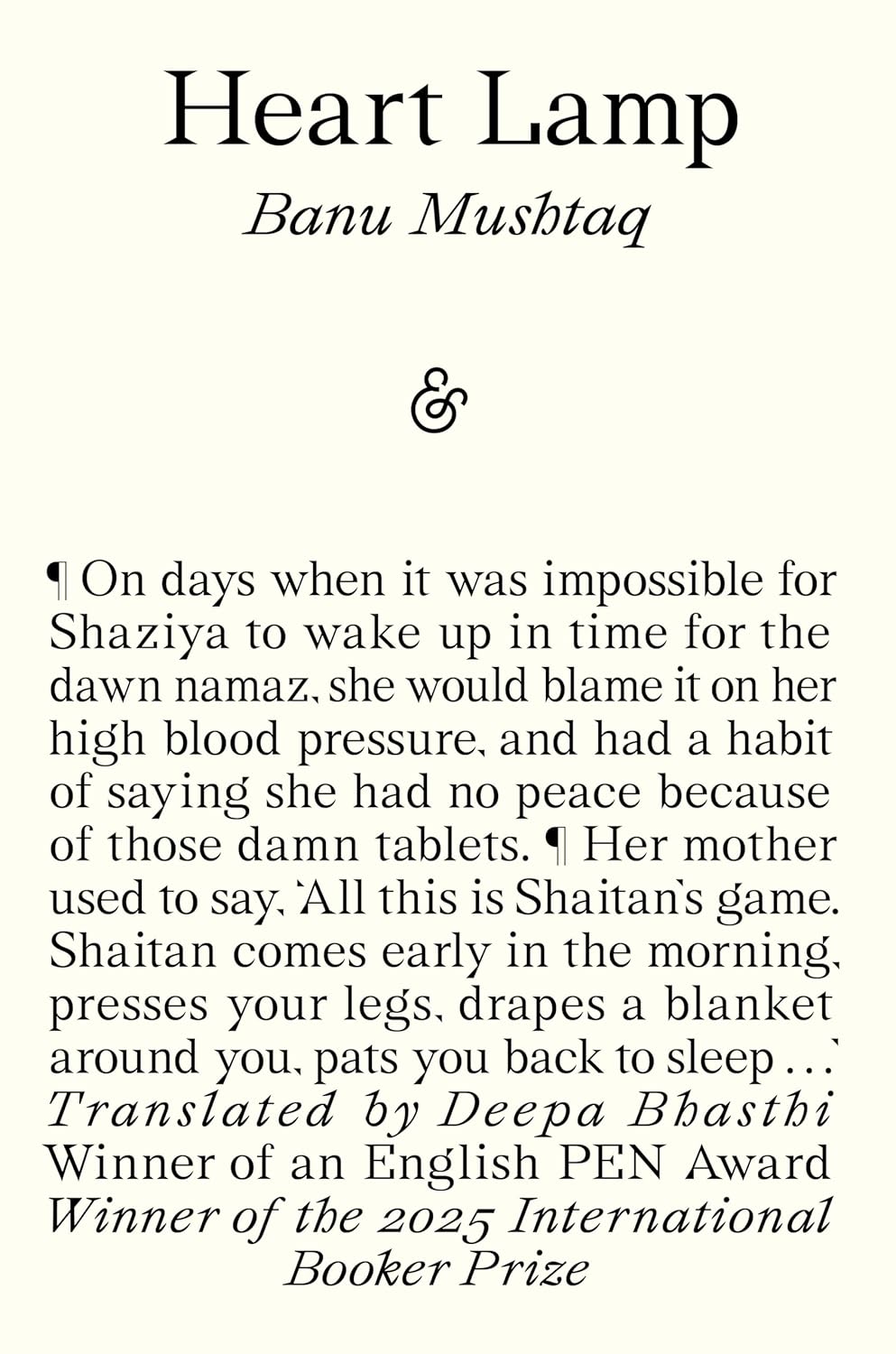
 Banu Mushtaq
Translated by Deepa Bhasthi
And Other Stories ($19.95)
by Damhuri Muhammad
Banu Mushtaq’s Heart Lamp: Selected Stories draws from six collections of fiction published in India since the 1990s; the first book by the Kannada-language writer to be published in English translation, it netted Mushtaq and translator Deepa Bhasthi the International Booker Prize in 2025. Mushtaq has worked as a lawyer and journalist, and the stories reflect a lifetime of working for social justice.
The title story, a poignant narrative about a Kannada Muslim woman obscured by shadows of sufferings endured in her life as a housewife, suggests a darkening perspective. Mehrun, a mother of five, expresses grievances to her family about her husband’s cheating, but nearly all of her family members side with the husband. (Her brother tells her: “He is a man, and he has stamped on some slush, but he will wash it off where there is water and then come back inside. There is no stain that will stick to him.”) Instead of expressing concern for the suffering she endured, her brothers returns Mehrun to her husband’s house in the city. Inayat threatens that, if Mehrun’s resistance were to push him to declare a divorce (talaq), then “In one single breath—one, two, three times—I’ll say it and finish this off, tell her. And tell her that after her talaq, see if she is able to get her younger sisters and her daughters married off.” One evening, as Mehrun switched on the lights in her home, a lamp that had consistently lit up the space in her heart was now dimmed. With this soul-sustaining light extinguished, Mehrun contemplates ending her bleak existence by igniting herself. She soaks her body in kerosene, but her daughter intervenes.
Tolerance of the unjust treatment of women is also a prominent theme in “Black Cobras.” In this story, however, the basis isn’t familial pride, but Islamic religion. Aashraf has repeatedly petitioned the Mosque to request financial responsibility for her husband, Yakub, who has engaged in polygamy. The Mutawalli—a religious authority responsible for addressing local Muslim family issues—consistently defend Yakub’s decision, even citing the Quran: “Do you know that there is a Sharia law that says he can get married to four women? Why are you getting jealous of that?” Aashraf endured Yakub’s insults regarding her role as mother of three daughters while he abandoned his responsibilities and enjoyed himself with his new wife, but her struggle to assert her rights as Yakub’s first wife conclude in a more tragic way than Mehrun’s. Her husband also deprived another wife, Amina, of the right to undergo a procedure to prevent childbirth. “I am the mutawalli; if people get to know that I got the operation done for a woman in my own house, I will have to be answerable to them,” he reasoned.
A similar refusal is expressed by Iftikhar to his wife in the collection’s opening story, “Stone Slabs for Shaista Mahal,” but Iftikhar’s decision is rooted in his understanding of a husband’s financial obligations. “Why are you worried?” he says to Shaista. “Thanks to God’s grace, I earn enough to look after all of them well.” In fact, with no one available to babysit their six children, he makes his teenage daughter, Asifa, leave school to look after her younger siblings and handle all the house chores. “I made her stop studying because girls do not need much education. A high school certificate is enough. There is no need for her to roam around in Mysuru for college. We can get her married off next year,” Iftikhar reasons.
Heart Lamp: Selected Stories exemplifies India’s progressive literary movement Bandaya Sahitya (“rebellion literature”), which seeks to address injustices arising from caste and gender hierarchies; Dalit writers such as Mushtaq who have been marginalized by the caste system are reshaping the Kannada literary landscape by incorporating a spirit of resistance and protest into their literary tradition. In story after story, Mushtaq vividly illustrates how the social disparities caused by caste systems and religious puritanism lead to injustice, particularly for women. Here’s hoping we get to read the author’s novel, poetry, essays, and other short fiction in English translation before too long.