
Graphic Novel & Comics Reviews

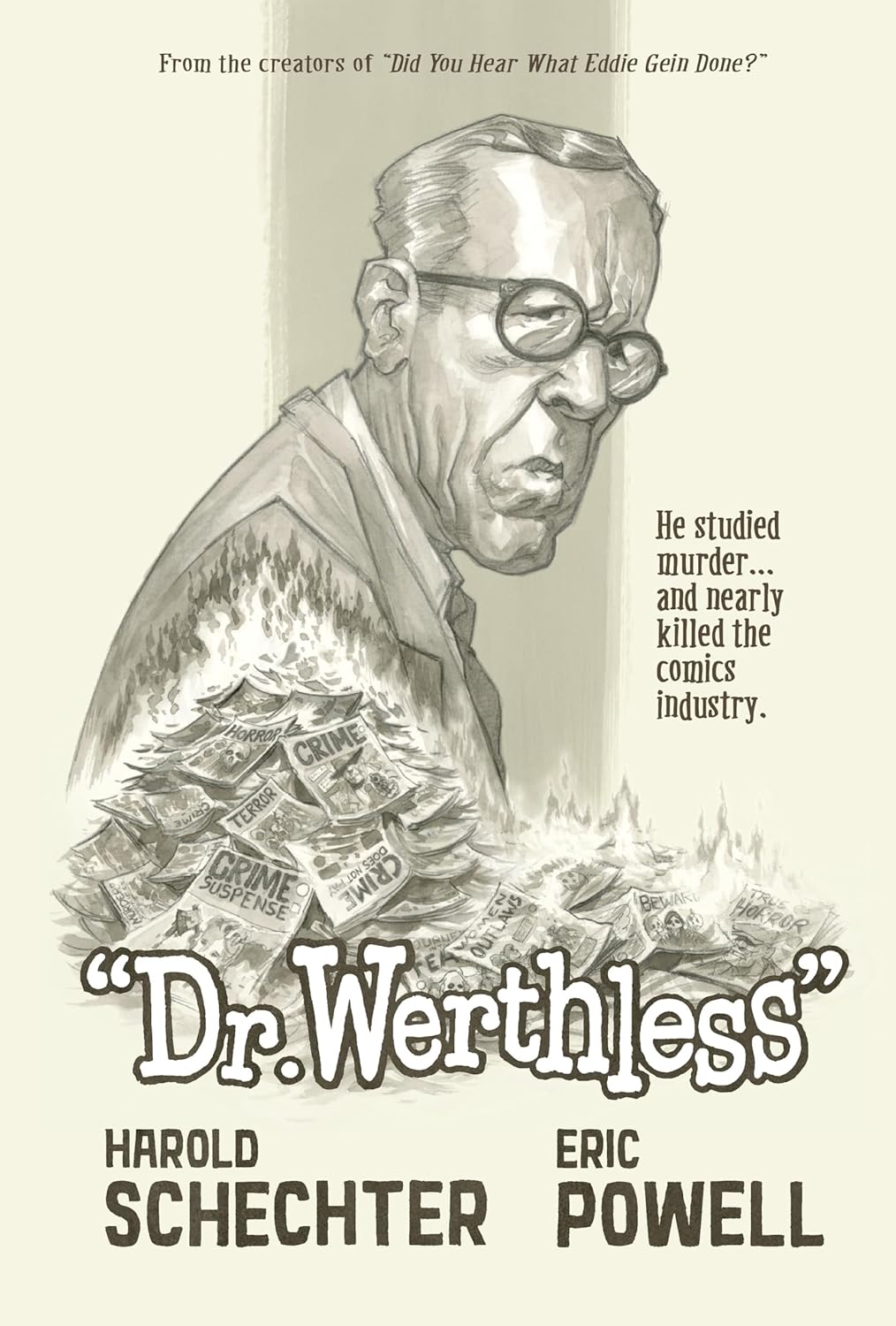
Dr. Werthless

Harold Schechter and Eric Powell
Dark Horse Books ($29.99)

by Hank Kennedy


“He ruined comics”—or at least that’s the story countless books, articles, and documentaries have told about the damage Dr. Fredric Wertham did to the art form. Parent-Teacher Associations, members of the clergy, and even J. Edgar Hoover had all voiced their opposition to comics as well, but by claiming that comics caused juvenile deliquency—a claim the German-American psychiatrist made through articles in Ladies’ Home Journal and Saturday Review, his 1954 book Seduction of the Innocent, and testimony before Congress later that year—Wertham became the face of the anti-comics campaign in the United States.


Dr. Werthless, a graphic biography written by Harold Shechter and illustrated by Eric Powell, tells a more nuanced story than the one most comics fans are used to hearing—in fact, only the last quarter of the book is dedicated to crusade against the medium. Wertham had a long career before he turned his attentions to comics, so readers who know him only as a moral scold will learn much about his involvement in notorious murder trials, the Civil Rights Movement, and even the study of comics fandom.


Powell’s Eisner-Award winning comic series The Goon contains a healthy amount of black comedy, but there’s little comedy of any kind to be found in this book. Constantly frustrated at the perceived slowness with which his career advanced, Wertham was as undiplomatic as he was intelligent, so other physicians found him vain and difficult to work with.


There are also no laughs in sight when Albert Fish, a notorious rapist, child molester, and serial murderer who killed at least three children, enters the story. Shechter is a renowned true crime writer (he wrote a book on the Fish case, among many others), and he avoids the genre’s most egregious pitfalls here, taking care not to glamorize the killer nor blame his victims for their own deaths. Wertham testified for the defense in Fish’s murder trial, stating that Fish was insane and needed to be studied in a mental hospital—to no avail. Due to the brutality of his crimes, the jury found Fish guilty and sentenced him to death by the electric chair.


Powell’s EC Comics-influenced style aids him in recreating the comics that so offended Wertham. His work evokes EC greats Jack Davis and “Ghastly” Graham Ingels, which serves him well when he reproduces covers and interior art from the period. And he is clever with his storytelling—for example, he conveys the tale of Wertham’s first book Dark Legend: A Study in Murder, which appeared in 1941, in Golden Age style, complete with Ben-Day dots. (Though not every similarity to the Golden Age is positive: When the book relates the role EC Comics publisher William Gaines played, the layouts begin to resemble EC’s famously text-heavy ones, forcing Powell to cram his drawings into the small amount of space left over.)


While Schechter and Powell give due space to Wertham’s history beyond his attack on comics—he opened and ran a low-cost clinic in Harlem to treat Black children, for example—they unfortunately omit what doesn’t fit their thematic glue. In one chapter, they dramatize a letter to Wertham from a gay barber who asks for help with his “condition”; the doctor responds sympathetically, leading readers to think Wertham to be tolerant, even ahead of his time, in his treatment of gay people. The truth is altogether different: Seduction of the Innocent reveals that Wertham viewed homosexuality as a social contagion children must be protected from; he somewhat famously opined that Batman and Robin were “the wish dream of two homosexuals living together” and Wonder Woman was “the lesbian counterpart of Batman” whose “strength” made her “unwomanly.” Shechter and Powell excise this context, but given the large amount of research they did (there’s an extensive bibliography in the back of the book), it seems unlikely that they weren’t aware of Wertham’s true stance.


Wertham’s sin, to the authors of Dr. Werthless, is to have believed in the possibility of improving human behavior. They place Wertham in a category of those who “deny that we are natural-born killers” and instead think “murderers are the products of harmful social influences they are exposed to as children. They believe if young people could only be shielded from violence in media, juvenile crime would cease to exist.” But doesn’t this draw the contrast too starkly? Are our only choices to censor violence in media or to believe in a historically determined, unchanging, inherently violent human nature?


Shechter and Powell would hardly be alone in this pessimistic and arguably conservative view of humanity. Evolutionary biologist Richard Dawkins wrote of “the selfish gene”; to zoologist Desmond Morris, humanity is nothing more than a “naked ape.” Yet this is not as settled as the above would have it. Canadian anthropologist Richard Lee, a winner of the Anisfeld-Wolf Book Award, has written that primitive humans were marked by a “generalized reciprocity in the division of food” and “relatively egalitarian political relations.” Clearly, human nature, such as it is, is fluid.


Wertham’s greatest fault was not to believe in improving the human condition—rather, it was that he wasted so much of his life on the blind alley of censorship. It was this that so diminished his professional legacy, turning a respected doctor with good intentions into the “Dr. Werthless” comics fans mock today. 
Click below to purchase this book through Bookshop and support your local independent bookstore:

Rain Taxi Online Edition Winter 2026 | © Rain Taxi, Inc. 2026

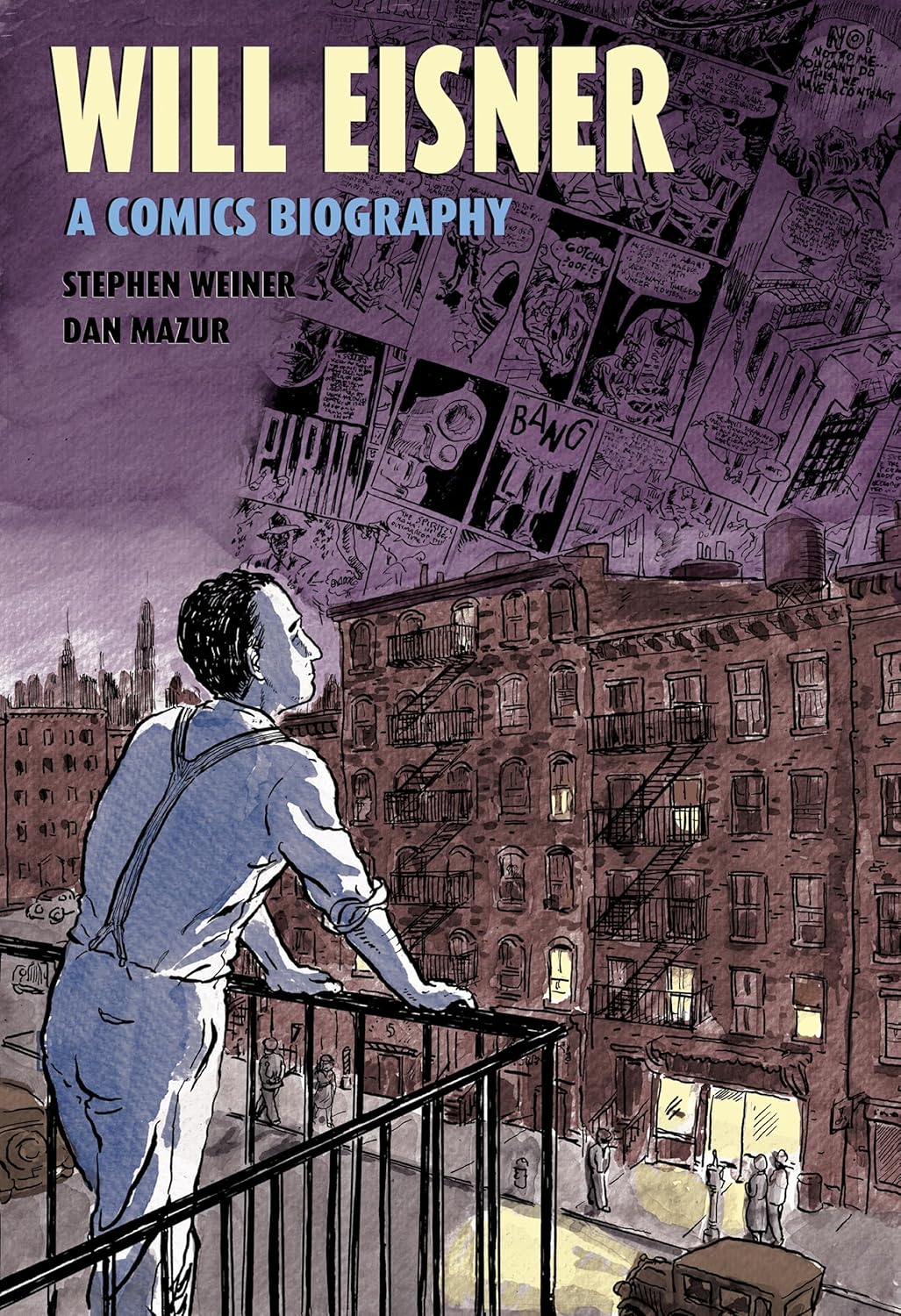
Will Eisner: A Comics Biography

Stephen Weiner and Dan Mazur
NBM ($29.99)

by Paul Buhle

It is perhaps not so surprising to learn that the real story of a hugely popular 20th-century comic art form has slipped into a seemingly distant past, even as a densely theoretical, university-based comics scholarship emerges. Even now, the medium’s foremost artists are mostly viewed as visual entertainers; their real-life stories, from their studios to their private lives, gather little of the attention given to artists by the museum world.

Will Eisner is surely a case in point. Creator of “The Spirit,” Eisner reset the visual standard with his cinematic innovations and snappy plot lines. An innovator who ran his own studio, he founded a unique comic-within-the-newspaper that reached millions of news-hungry readers of the 1940s—among them young Jules Feiffer and Wally Wood, employees of Eisner’s studio and future comic stars in their own right. Eisner was a businessman and an artist; he had no real successors in the press or the comic book industry.

As rendered by the writer-artist team of Stephen Weiner and Dan Mazur, Will Eisner: A Comics Biography seeks to wrap this story around the life of a fanatically hard-working youngster who evolves with the times. Much of the wider context of comics, as both an art and a business, has been squeezed down in the telling, but we see here at close range the real misery of the comic artist, fighting poverty sans respect or sentimentalization of the historic suffering-artist kind. The book closes with an older Eisner making a startling comics comeback, evidently shifting from a dog-eat-dog individualism toward a better understanding of the world.

To return to the beginnings: Eisner’s immigrant father, a sometime set-designer in pre-World War II Europe, is shown to experience all the frustrations of life in the impoverished Bronx and Brooklyn of the 1920s and ’30s. Hounded by unemployment and ethnic prejudice, the family moves repeatedly. By 1927, ten-year-old Will is already thinking about comics as a way to make a living and escape the household where the patriarch is a demoralizing failure.

Newspaper comics, created for semi-literate urban audiences of the 1890s and full of humorous one-liners, had become a family-oriented genre by the 1920s. Pulp magazines, with lurid fiction leaning toward pornography, offered a different angle on popular culture, and from this seemingly unlikely quarter, the comic book publishing world emerged. From the first glimpses of Superman, created by two Cleveland counterparts to Eisner, boys across the country raced to the newsstands with dimes for vicarious fulfillment. Meanwhile, Eisner’s acquaintance and rival Bob Kane was in the process of inventing a less-supernatural, visually darker hero: Batman.

Some of the most agonized pages of Will Eisner reflect the artist’s desperate effort to make a living at the lowest level of comics, pulling all-nighters to write and draw strips himself to fulfill pulp production quotas. In the process, we are shown the creation/production process, and reminded that still-young Will invented “Sheena, Queen of the Jungle”—she has never quite left popular culture—as a result. He is already managing a team of creators at the age of twenty-three when he comes up with The Spirit.

Obviously handsome, dashing, and a modern hero, The Spirit wears an eye-covering mask; he has a secret identity. But the important thing is the comic page-and-panel world that he moves through. Arguably, Eisner’s creation changed what is often called the “visual vocabulary” of comics by shifting the perspective of the viewer from page to page, relying heavily upon suspense, slapstick humor, and an occasional serving of cheesecake in the long and shapely legs of dames who turn out, often enough, to be spies or criminal accomplices. In ways that neither comic books nor comic strips could manage, Eisner’s micro-comic, inserted into Saturday newspapers, told a coherent and entertaining story to an audience more grown-up than the newsstand buyers, and The Spirit was a hit.

Eisner was drafted when the war came, and during his service, he created educational comics within the Army, unknowingly preparing for his post-Spirit days. Meanwhile, the insert continued; by 1945, he had learned to turn over more and more of the weekly grind to his staff. Beyond comics, noir films filled movie screens between 1946 and 1950; Eisner, a patriot and mostly humorous anti-Russian Cold Warrior, would not have guessed how many of the best noir films were written by Communists or near-Communists who saw postwar America through a glass darkly. His darkness was not theirs, exactly: He did not blame the rich and powerful, nor did the Spirit go after racists and anti-Semites, as some leading films dared to do. Eisner’s female characters, good or (more interestingly) bad, lacked any real volition, and the Spirit’s Black assistant was a throwback to racial stereotypes shifting for the better during wartime. But the darkness that artists of all kinds felt after the war years actually improved Eisner’s art, as it made him take more chances with narratives even as he drew a phase of his life to a close.

In 1950, Eisner, then a prosperous suburban homeowner and happily married businessman, launched a company that promised educational, instructive comics. The Army was immediately his best, though by no means his only, client. He closed out The Spirit officially in 1952 and seemed to have abandoned popular entertainment, the telling of fictional stories through comic art.

Only in the last few pages of the book do we learn that underground comix publisher Denis Kitchen persuaded Eisner to return to the medium decades later, first through reprints, then a brief Spirit revival, and then onward to new graphic novels. During the 1980s and ’90s, Eisner turned out almost two dozen books, from graphic art instruction to novelistic narratives of many kinds. In 1988, the Eisner Award, blessed annually at the San Diego Comic-Con, made clear his lasting fame. (I am happy to have shared one of these awards for The Art of Harvey Kurtzman [Abrams, 2009], Eisner’s younger friend of the 1950s and later.)

Writer Stephen Weiner and artist Dan Mazur have inevitably skipped over large chunks of comics history for a compelling bildungsroman of economic, family, and personal drama. Businessmen made a lot of money, but artists experienced extreme exploitation. Among his personal or moral weaknesses, Eisner did not—apparently could not—see the need for unions of comics workers, from efforts in the 1930s to a heroic if failed struggle during the early 1950s. In later years—as he was seeking to make amends on racial matters—he even began to see the wrongs of the Vietnam War, though he never quite grappled with the Israeli/Jewish dilemma of being at the wrong end of a particular suffering humanity. Eisner was always the consummate artist—and in that regard, this book captures his best self.

Click below to purchase this book through Bookshop and support your local independent bookstore:

Rain Taxi Online Edition Fall 2025 | © Rain Taxi, Inc. 2025

The Bomb

The Weapon That Changed the World

Didier Alcante and Laurent-Frédéric Bollée
Illustrated by Denis Rodier
Translated by Ivanka T. Hahenberger
Abrams ComicArts ($29.99)

by John Bradley

“In the beginning, there was nothing. But in this nothing . . . was everything!” So begins this graphic book on the development of the first atomic bombs. Not only is the Biblical opening a surprise, but the speaker here is the element uranium, who offers other such chilling comments in this well-researched (with a selected bibliography) and expansive (459 pages) volume, which concludes with the U.S. bombing of the Japanese cities of Hiroshima and Nagasaki in 1945.

Although a history of the bomb might sound like an odd fit for a graphic book, the three authors—with Alcante and Bollée providing the research and writing and Rodier the artwork—make the medium seem ideal. The book feels like a storyboard for a film, given its use of varied locations (Africa, Norway, Japan, Germany, and the U.S.), a vast cast (short biographies of the central figures are included at the back of the book), and intrigue, complete with a scientist-spy. The authors must be commended for their extensive research into the development of the bomb, especially as regards the story of the Hungarian physicist Leo Szilard, the first scientist to see the potential of splitting the atom—it was he who pushed the U.S. to develop an atomic bomb before the Nazis did, though once the weapon neared completion, Szilard did everything he could to stop its use. He foresaw a nuclear arms race, as well as the moral stain of the U.S. being the first nation to rain such hell on cities filled with civilians. On many occasions in the book, Szilard and General Leslie Grove, in charge of the Manhattan Project, argue passionately. By foregrounding the story of Szilard, the authors weave into the narrative a moral dimension sometimes missing in historical accounts of the bomb that view it more as a scientific breakthrough.

Another thread in the saga that is often missing in much of U.S. nuclear history is the secret testing done on civilians. One such individual was Ebb Cade, an African-American worker at the Oak Ridge facility. Driving to work one morning, on March 24, 1945, Cade accidentally drove off the road. When he woke, he found himself in a hospital with a host of injuries. “We’re going to take good care of you, Mr. Cade,” an anonymous doctor tells him. “You can trust us.” Later, this same doctor injects Cade with an unknown shot. The reader soon discovers that this “human product,” as the officials call Mr. Cade, was injected with plutonium, though he was never asked if he consented to be involved in an experiment to learn about the effect of plutonium on the human body, nor was he informed later. The officials casually discuss how Cade lost fifteen teeth due to the shot, but this is quickly rationalized—“He suffers from acute gum inflammation anyway”—before they offer the ultimate excuse: “But it was in the interest of science!” The book includes one other “human product” who is injected with plutonium, but there were many others. Eileen Welsome’s book The Plutonium Files: America’s Secret Medical Experiments in the Cold War (Dial Press) broke this story for the first time in 1999, and Alcante and Dodier make effective use of Welsome’s research.

Not only is the text of The Bomb engaging—and translated so well by Ivanka T. Hahenberger it feels as if it was written in English—but the illustrations keep the eye engaged as well. Bollée, who has published dozens of graphic novels in his native France, provides the expected “BOOOM” and “SCHBAM!!,” but the artwork shows great variety and versatility in technique. At one point we see a nightmare had by Klaus Fuchs, who spied on the Manhattan Project for the Russians; the hallucinatory style of the art here deftly conveys the terror of Fuchs’s dream. The depictions of bodies in Hiroshima set aflame by the atomic bomb are also vividly disturbing—as they should be.

While a graphic book might not be the first choice of a reader who wants a detailed history of the creation of the atomic bomb, The Bomb would be a good place to start for those who want a stirring and factually accurate (except for the creation of a Japanese family in Hiroshima) account. And should anyone think that our atomic history no longer concerns us, consider the words of uranium that close the book: “And so, you think this is the end of my story? What if it’s only the beginning?”

Click below to purchase this book through Bookshop and support your local independent bookstore:

Rain Taxi Online Edition Fall 2023 | © Rain Taxi, Inc. 2023