
Brian Gyamfi
University of Pittsburgh Press ($20)
by John Bradley
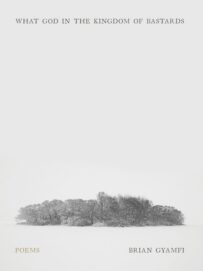
“I was made in Kumasi, Ghana,” states Brian Gyamfi in What God in the Kingdom of Bastards, his stunning debut book of poetry. This is no mere autobiographical detail, for the author’s African heritage is a source that continually enriches this collection’s thirty-five poems. It’s difficult to believe that this is Gyamfi’s first book, as his work exhibits both strong confidence and an original voice.
The very title of the book reflects this originality. While most poetry collections feature a title drawn from a poem in the book, nowhere in these pages will the reader find Gyamfi’s titular phrase. The poem “Kingdom” comes closest, and it does deal with religious matters, though in surprising ways: “It is said, Jesus killed fleas to save his dog. / Even a boy must perform acts of sadism.” The leap between those lines is thought-provoking to say the least. Later in the poem, the speaker tells us, “I once shoved wind into my brother’s mouth, / whispered in his ear, ‘the kingdom of God is a wild animal.’” There’s nothing cliched or reassuring about religion in this book.
Though Gyamfi’s poems are often visionary, they are not romantic, as can be seen, ironically, in “Our Romantics.” In this playful poem, “The earth shivers and a crowd of poodles / urinate by the streetlight.” Note how the initially cute image of the poodles is undone in the next line. Other unromantic images populate the poem—a cat chasing beetles, someone swallowing a sword—yet a woman in the poem “blooms as a daylily.” Paradoxes abound in Gyamfi’s work.
In “The Tree Carries Water,” set in New Mexico, we hear of a boy rescued from a river. The action is ambiguous but always evocative:
—I write this to understand the sorcerer in Benin:
the breaker of mountains, a heavy voice
in the story of a gardener fetching a boy from the river,his hand under the heavy current, a beetle climbing a tree
Benin, a West African country not far from Ghana, is known as the birthplace of voodoo, and the poem has the hallucinatory quality often associated with that religion: The relationships between the sorcerer in Benin, the gardener in New Mexico, the voice, the beetle, all seem to shift as the rushing water threatens the boy’s life. Later in the poem, another layer of complexity is added: “in my thoughts, the sorcerer in Benin is the river.” Rather than confuse, however, the ambiguity adds depth and mystery.
Gyamfi is unafraid to challenge the reader. The longest poem in the book at twelve pages, “Praxis of Being,” uses a form that resembles a notebook, with entries separated by a dash, and it continually evokes Nobel-Prize-winning Nigerian writer Wole Soyinka, not only in an epigraph but in direct references throughout, such as: “Soyinka’s words dictate anger is not a pomposity for justice, you / say, fidgeting.” You should know Soyinka’s work, Gyamfi implies.
While allusive, “Praxis of Being” is also highly personal. Some of the most moving lines in the book can be found in this poem: “In 2013, I detangled mother’s braids, brushed them out gently / and braided them again. I kissed her long fingers.” The tenderness of this recollection follows the news that “mother will soon lose her memory.” Gyamfi’s most devastating observation, though, might be this double-barreled one near the end of the piece: “We are all just lonely. That’s a quiet sentence.”
Gyamfi’s many Ghanian cultural references can be confusing at first for readers not already familiar—in “New World,” for example, we hear, “The word petrichor does not exist in our language. / There’s no equivalent in Ewe or Ga”—but the poet’s multilingual engagement with sense and meaning making ultimately pays off. “I am a person in many languages,” Gyamfi reminds us later in the book. Like Whitman, his poetic identity is expansive, and his poetry is affecting not despite its complexities, but often because of them. What God in the Kingdom of Bastards introduces an exciting new voice in American poetry, with the promise of more ground-breaking work to come.