
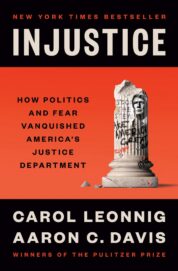
Carol Leonnig and Aaron C. Davis
Penguin Press ($32)
by Robert Zaller
The original Congress Building of the United States was destroyed by British forces during the War of 1812. It was threatened by a Confederate army during the Civil War. And it was stormed and partially sacked on January 6, 2021, with attendant loss of life and wounded limb, while Congress was seated to confirm the newly elected president and vice president of the country. The attack was instigated by the sitting president, Donald J. Trump, who thus became the nation’s first chief officer to attempt the overthrow of the government he led.
While working on the story of January 6, two investigative reporters for another now-imperiled institution, The Washington Post, realized how America’s prime instrument of law enforcement, the Department of Justice, had been turned into a mockery of itself by its failure to initiate a timely response to the insurrection. This larger story, the saga of the failure of one presidency and the corruption of another, would bring us to the crisis of American democracy we face today. Carol Leonnig and Aaron C. Davis relate that story in Injustice: How Politics and Fear Vanquished America’s Justice Department.
The immediate response to January 6 was that of Congress. While Trump still sat in office, Speaker of the House of Representatives Nancy Pelosi pushed a bill of impeachment through a divided House. Since only a week remained of Trump’s term, the trial in the Senate could only take place after he had left office, and the only punishment available would-be disbarment from future office. Senate Majority Leader Mitch McConnell argued that Citizen Trump would soon be subject to more sweeping action in civil courts, rendering Congressional judgment superfluous, and the impeachment failed.
Further federal action fell to the Justice Department, whose new Attorney General, Merrick Garland, was a seasoned prosecutor and judge. As Leonnig and Davis point out, Garland made a category error from the beginning: While trying and convicting more than 1,500 of those who breached the Capitol on crimes ranging from criminal violence and conspiracy to simple trespass, he left the principal actor untouched. It may fairly be said that this was the greatest misprision of justice in the country’s history, and Leonnig and Davis do say it in crushingly mustered detail. The fault lies, they assert, with Garland himself and his employer, President Joseph R. Biden. Biden’s mistake lay in thinking that, with the country shaken by a lawless regime capped by attempted rebellion and its worst pandemic in a century, the public longed for what a predecessor in not dissimilar times (Warren G. Harding in 1920) had called a “return to normalcy.” But Biden hadn’t reckoned with the political resilience of Donald Trump, who had escaped two impeachments and would now evade punishment at the hands of the state he had nearly overthrown.
This did not mean that Biden and Garland paid no attention to Trump. The bipartisan House Select Committee on January 6, set up at the urging of Pelosi, received much material gathered by the FBI to begin its own investigation. But the Committee had no judicial authority, nor any effective power to compel testimony. What it did do, however, was rivet the public’s attention as no Congressional committee had since the Watergate hearings some fifty years before—which left Biden no choice but to respond to it. Biden also could not ignore the growing pressure both within and outside the Justice Department to deal directly with Trump. When asked whether it should tax those who had defied the Committee’s subpoenas, he answered affirmatively. Less than two hours later, Garland shot back the reply that the Department would make all charging decisions on its own. The lid on Trump had been clamped shut again, and with it, as it turned out, all efforts at holding him to account for January 6.
Garland’s response was predicated on his understanding with Biden that the Justice Department would, after its politicization under the Trump administration, act independently of any outside influence, including the White House. But to have crossed the President in such a manner at the same time challenged Biden’s own responsibility to enforce the laws of the land. His own blunder in speaking publicly was compounded by Garland’s intemperate response. Each man had tied the other’s hands. By the time Garland finally appointed a special counsel, Jack Smith, to investigate Trump, the clock was already timed to run out, and Biden’s forced withdrawal from his reelection race opened the door to Trump’s return to power.
Leonnig and Davis trace in rich detail the systematic evisceration of the Justice Department during the first year of the second Trump administration. Smith, having finally assembled his case against Trump, was forced to scuttle it. All pending state actions against Trump were dismissed or rendered moot. On Trump’s first new day in office, the convicted January 6 rioters were summarily pardoned—and from that point, the general dismantling of democratic practices and institutions that has undermined the republic was under way.
Injustice is told with novelistic speed and at times breathless complexity, marred only by the occasional colloquialism. So many figures are introduced that a chart of dramatis personae would have been useful. The grit and courage of many within the Justice Department who resisted the travesty it has become deserve chronicling, however, and point to the hope of its eventual restoration.