 Jarrett Dapier and AJ Dungo
Ten Speed Graphic ($24.99)
By Hank Kennedy
Censorship, Robert Heinlein once remarked, is “like demanding grown men live on skim milk because the baby can’t eat steak.” Nevertheless, there have long been those who want to ban books. Comics have often been a prime target for censors, from the 1950s anti-comics crusade that resulted in congressional hearings to current challenges at schools and public libraries.
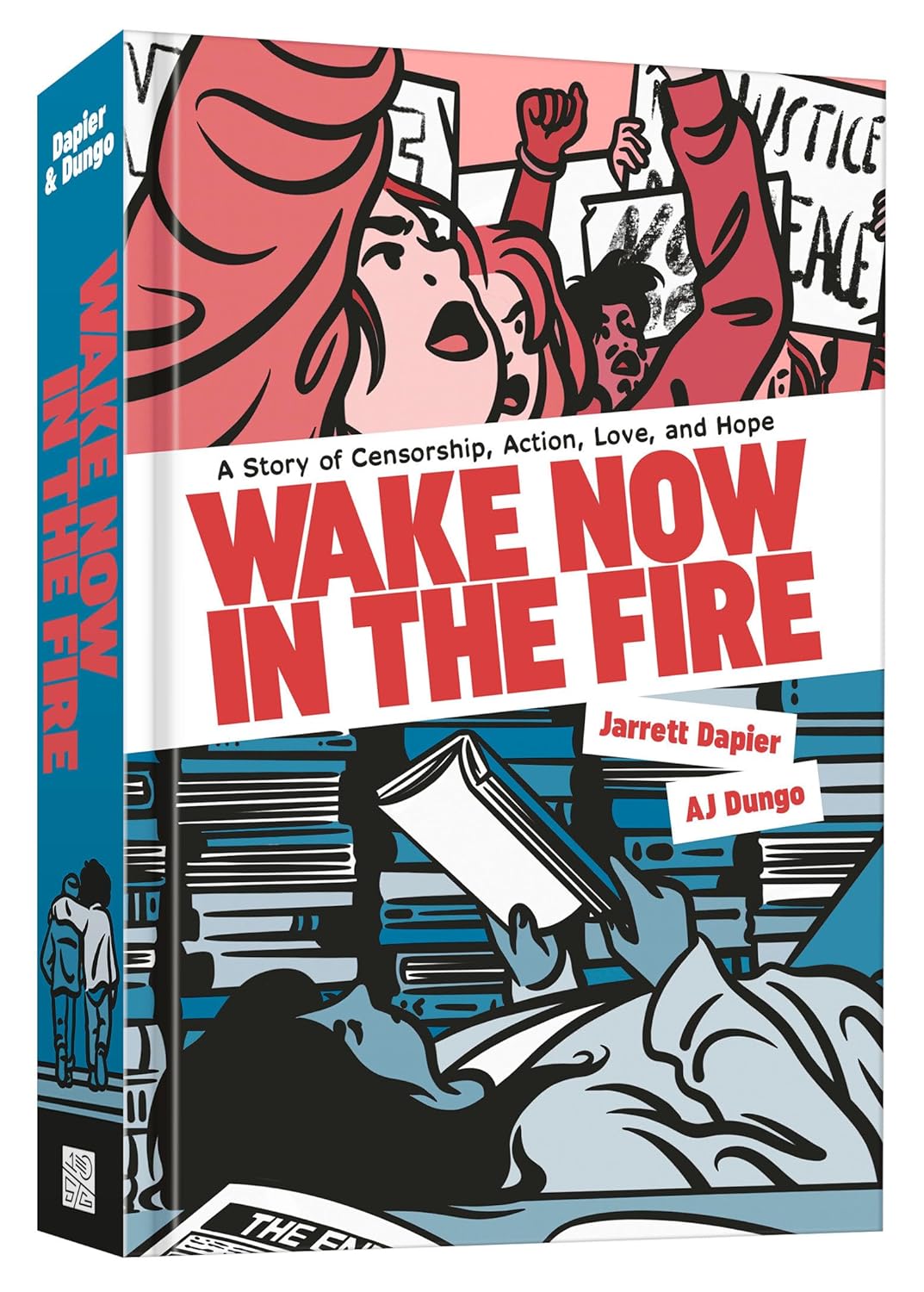
Jarrett Dapier and AJ Dungo’s Wake Now in the Fire fictionalizes the real-life banning of Marjane Satrapi’s graphic memoir Persepolis from Chicago Public Schools in 2013. Offering a comic book counterblast to CPS’s stance, this well-wrought graphic novel showcases the folly of censorship and the power students can have when they actively defend their freedom to learn and read.
Dapier, a real-life librarian, was inspired to write the book by research he did while in graduate school. That he conducted interviews with participants in the protests and sent Freedom of Information Act requests gives his fictional events the air of authenticity. Chicago’s political and social issues are depicted clearly in this context: for example, in the book, CPS claims the ban “sounds like something made up by the teachers union,” which scans as accurate considering that Chicago’s teachers had just gone on strike the previous year. Clearly, there were still bitter feelings.
The students are active in asserting their rights to read: They organize a demonstration, a read-in, and a mass meeting, and the school newspaper’s sleuths try to get to the bottom of who ordered Persepolis’s banning. To humanize the main characters, the creators weave the struggle against the book ban with more conventional YA drama: Aoife’s father is an alcoholic in denial; Weston’s cousin is missing; Didi worries about fulfilling the educational aspirations of her parents. This gives the story variety and prevents it from getting too one-note. Dapier and Dungo never lose sight of the fact that these are kids, going through the process of maturing into adults.
There are multiple sequences showing the unintended consequences of censorship. By banning Persepolis, the school administrators have created a forbidden fruit: When the book is returned to the school’s libraries, students clamor for it, wanting to see what all the fuss is about. The same has happened with more recent book bans, as when schools in McMinn County, Tennessee banned Art Spiegelman’s Maus: A Survivor’s Tale, only to see the book top sales charts decades after its release.
Despite the heroic example set by Chicago students, there have been further attempts to ban Persepolis from other school districts; California, Oregon, Pennsylvania, and Texas have all been sites of challenges to the book. Perhaps the release of Wake Now in the Fire will discourage further bans. It’s also possible that this title may end up banned itself, given its language and challenges to authority. If that happens, it will be in good company. The protest sign used by one of the story’s students will then find new life: “Give me books or give me death.”