
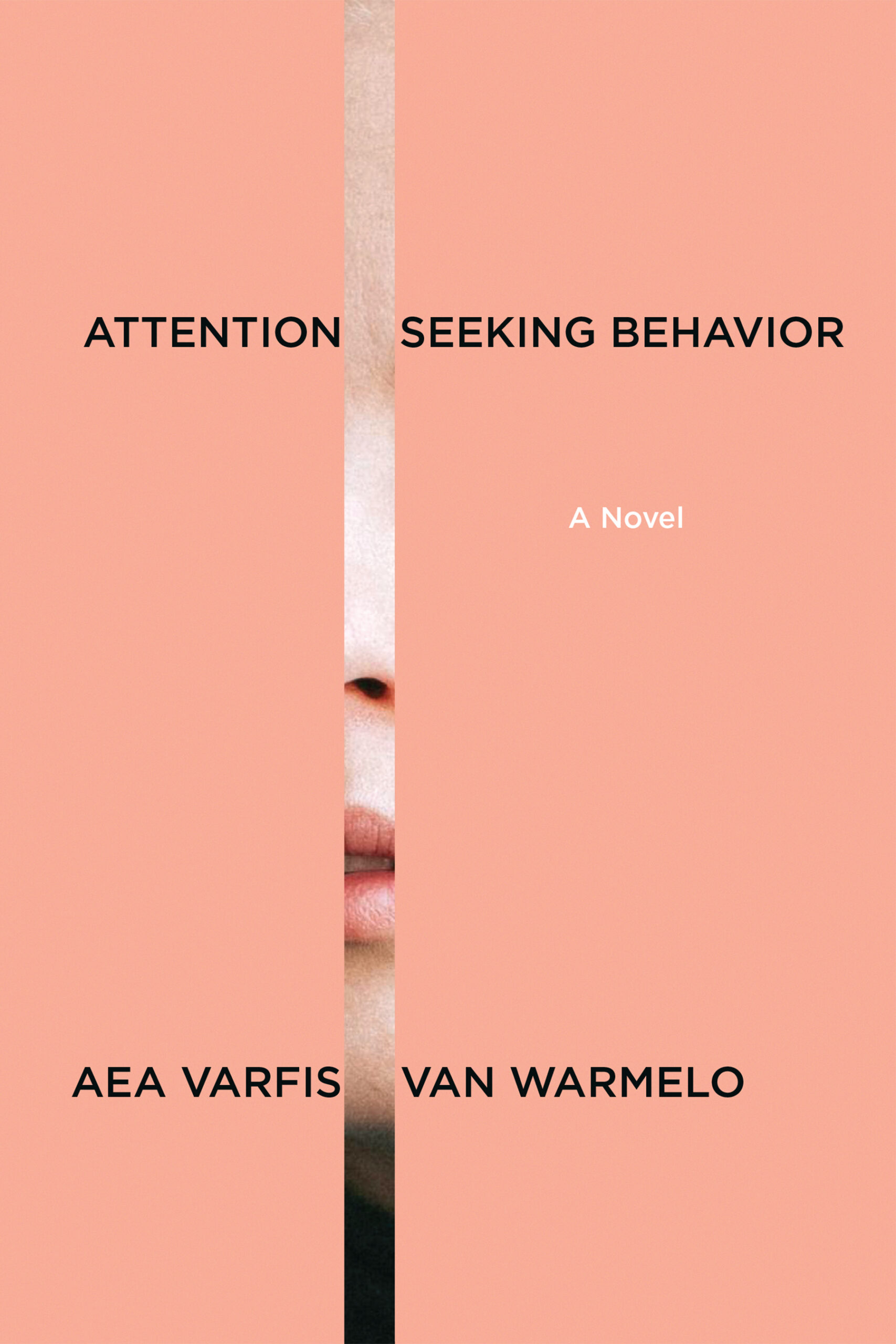
 Aea Varfis-van Warmelo
Graywolf Press ($17)
by Zara Karschay
The narrator of Aea Varfis-van Warmelo’s debut novel Attention-Seeking Behavior is emphatic in her account of how she once found a man dead in the snow: She was first on the scene, she tells us, but this event has left no enduring mark on her life; she even managed to eat her croissant on her journey home. She is emphatically lying, however, and she wants us to know that, because soon after the opening scene, the narrator gives another account of the body she found, only now it is entirely changed—different place, different death.
Through the eyes of this fascinating antihero, Varfis-van Warmelo explores the lure of a fictional life over lived reality. Attention-Seeking Behavior takes on “truthiness” with a sprightly wit, moving beyond the belligerent screed that facts don’t care about your feelings and towards the even bleaker premise that “facts are very often irrelevant.” The novel’s narrator gestures towards the simpering advice offered by erstwhile academics turned social media commissars and body-language absolutists to underscore her point; she holds a particular fascination for the real-life psychologist Paul Ekman (1934-2025), a divisive but nonetheless powerful figure in the study of emotions whose much-debated work came to influence U.K. and U.S. police interrogation techniques.
Outside of these preoccupations, the novel’s protagonist tries to live the “normal” life of a woman in her mid-twenties. The result is invigorating; Varfis-van Warmelo has a clear eye for parsing the exploits of the emergent creative class. Her protagonist accumulates writing and “research” jobs where she is at the mercy of opportunists making the most of a post-COVID, libertarian world in which tasks are outsourced to the lowest bidder. Interactions with others are transactional—a string of lovers who fill a need; friends in ephemeral chat groups.
Somewhere along the slip-slide of pseudo-science, zero-hour contracts, and social obligations, our protagonist finds that, at best, her lies require pristine project management to operate smoothly. At worst, though, they might dismantle her blossoming relationship with “Normal Ben,” a man she regrets having wrapped in her untruths. And yet, she pathologically keeps returning to the lies that give her life structure. All this hints at a hidden trauma on the verge of coming to light, but Varfis-van Warmelo spares us any sentimentalism either way—her protagonist is unashamedly circuitous and absolutely compelling as a result.
Attention-Seeking Behavior takes a long look at the act of detection. “You should know,” the narrator’s refrain, is a double play, suggesting a contract of confidentiality between reader and narrator while also scolding the reader for their lack of awareness. As we attempt to cobble together a version of the truth, given what we know about our shifty protagonist and the shaky girders of police interrogation, the narrator sets a clear boundary—“the lyric I is not a documentary I”—goading the reader into facing their own voyeurism and inviting the question: Are we looking for the truth or for a confession?