
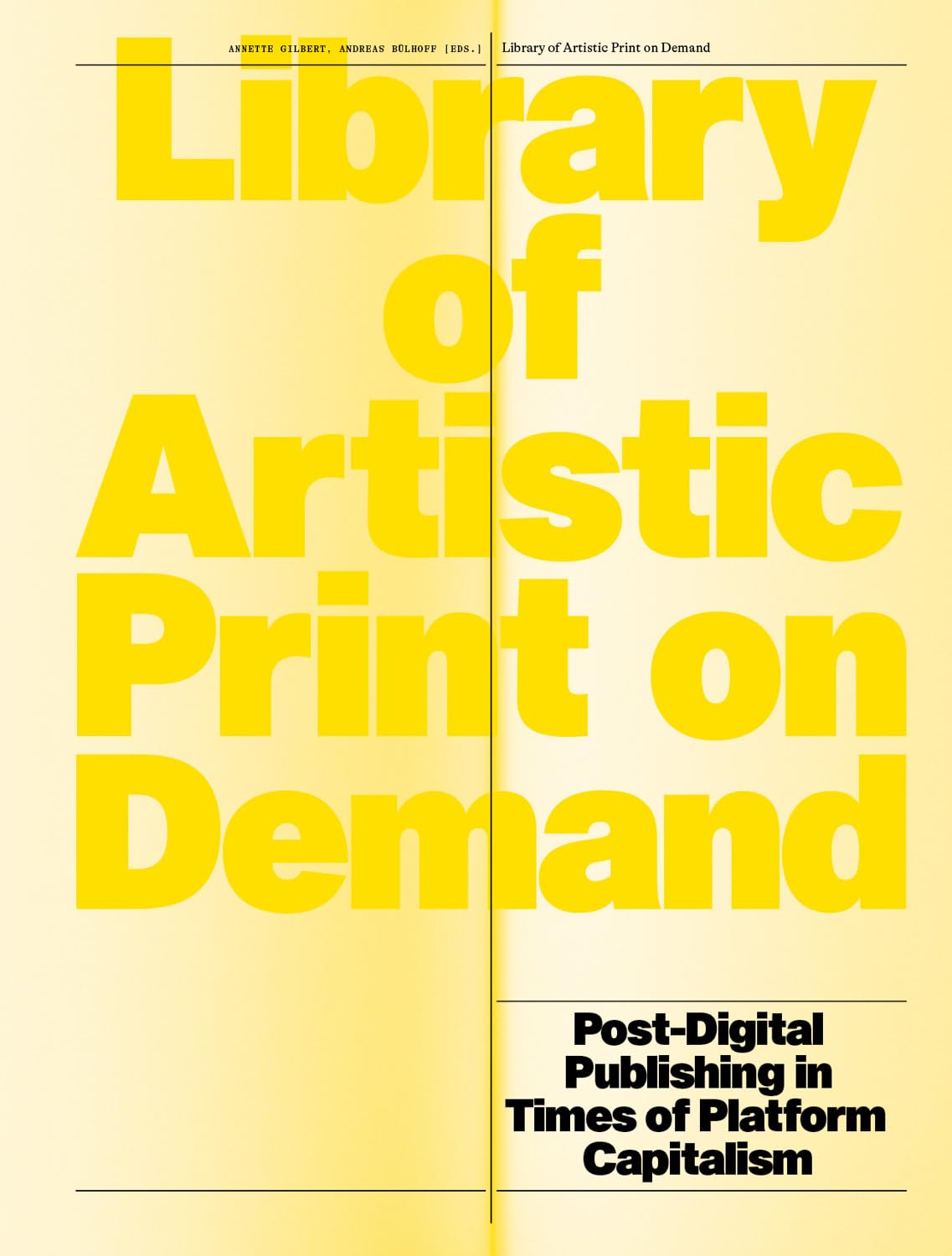
Post-Digital Publishing in Times of Platform Capitalism
Edited by Annette Gilbert and Andreas Bülhoff
Spector Books ($60)
As a publishing technology new to the 21st Century, Print on Demand (POD) enables a smaller book publisher (or a self-publishing author/artist) to print one bound copy at a time for a reasonable cost, in contrast to the traditional “print run” that requires larger quantities of copies to get lower production costs per book. Although I still publish nonfiction with traditional publishers, I started favoring POD some fifteen years ago to self-publish my highly experimental literature, work that wouldn’t otherwise get into even small-press print. As an author then in my seventies (and now in my eighties), I wanted to put into the public arena every text I think belongs there, and POD allowed me to realize that.
Now this brick of a book, roughly the size of an old telephone directory and with tiny print on large pages to boot, offers a plethora of highly imaginative moves that artists, writers, and publishers around the world are doing with POD. Although clumsily subtitled, the book does take a wide view as to how this technology intersects with the currently collapsing “post-digital” marketplace. As the publisher explains: “Today an entire subculture is exploring print on demand in search of new economies and publics, while also critically negotiating our digital present. The Library of Artistic Print on Demand maps this experimental field for the first time.”
The “mapping” metaphor gestures to both the internationalism of the essays and the terrain of ideas covered in the essays. Here are just a few examples of some of the holdings of this unique library:
• Michael Mandiberg, a CUNY media professor, has audaciously made PDFs (files prepared for printing) of the entire contents of Wikipedia, which he makes available as files for customers to print on demand (even if few actually do). I suppose this qualifies as an early masterpiece of a new genre, one I would call “Unprinted POD Literature.”
• Working in the tradition of the book arts and “Artists’ Books,” the theoretically inclined Italian artists Silvio Lorfosso and Giulia Ciliberto offer Blank on Demand (2011), in two volumes no less, with detailed specifications for all the sizes and formats available on the popular POD company Lulu. The absurdity of sending blank pages through a POD process is indeed a fitting indictment of “platform capitalism.”
• Eric Doeringer, a U.S. artist whose work acknowledges (some might say “copies”) modern masters, has taken a set of Sol LeWitt book-making instructions (initially used by LeWitt for a single edition of his 1974 The Location of Lines) and has realized them differently for eight different formats available on POD. Doeringer expands on a canonical modernist work in a fruitful direction: while LeWitt’s “content” is always the same, the look of each Doeringer edition is appreciably different.
Dozens of other remarkable book projects get at least a single page in this catalog. Each presentation includes précis, footnotes, keywords, printer, “platform,” “materialities,” and other relevant attributes—a crediting departure that I venture will become more popular.
The avatar of Library of Artistic Print on Demand is Annette Gilbert, a Berlin-based professor of literature who researches experimental forms of writing, artists’ books, and conceptual art; she is also the author of Literature’s Elsewheres: On the Necessity of Radical Literary Practices (MIT Press, 2022). Her co-editor Andreas Bülhoff, we are told, “works both artistically and academically at the intersection of text and technology.” The pair began the library as an academic project funded by the German Research Foundation, and the collection is now housed at the Bavarian State Library in Munich—and in the pages of this worthy book, which constitutes a publishing avant-garde insufficiently covered in my own otherwise compendious Dictionary of the Avant-Gardes (Routledge), the third edition of which came out in 2018. With this review I begin to make amends.
Click below to purchase this book through Bookshop and support your local independent bookstore:
Rain Taxi Online Edition Winter 2026 | © Rain Taxi, Inc. 2026