Uncategorized

Thought Interruptions:
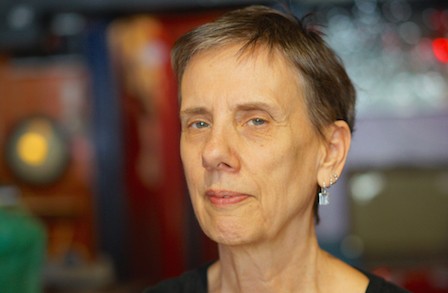
An Interview with Barbara Henning

by Jim Feast

Before Barbara Henning moved to New York City in 1984, she already had a reputation in Detroit as a poet. Her first reading in NYC was at St. Marks Poetry Project, and her first collection, Smoking in the Twilight Bar, was published by Lewis Warsh (United Artists Books, 1988). Recently, United Artists also published Digigram ($16), which like Smoking in the Twilight Bar is a collection of prose poems, but that’s where the similarity ends. The poems in Smoking are slow paced, almost like tiny films of Detroiters in the 1960s and 70s, while the poems in Digigram are fast paced, more interior, a mind reporting on multi-faceted layers of life.

Henning has also written six other collections of poetry and five novels, as well as interviewing and reviewing many poets. She’s also an editor and has taught for Naropa University and for Long Island University in Brooklyn, where she is now Professor Emerita. After raising two children as a single mother, she left the East Village and lived and travelled widely in New Mexico, Arizona, the Upper Peninsula of Michigan, and in Mysore, India, where she practiced yoga and studied with Shankaranarayana Jois while writing her novel You Me & the Insects (Spuyten Duyvil, 2005). I met Henning in 2015 at a reading for one of Lewis Warsh’s classes, having previously known her only through her writings, and am pleased to discuss Digigram with her in the following interview.
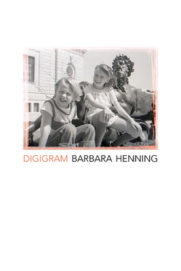

Jim Feast: Your Digigram poems are made up of bits and pieces woven together: thoughts, incidents, descriptions of city streets, snatches of the daily news, and, significantly, encounters with random people. The inclusion of these encounters suggests one purpose of the book is to take the temper of the time.

Barbara Henning: I live in NYC and I like talking with and observing strangers. Because I’m concerned about social justice, I’m interested in people who are ignored, on the sidelines, passed by, left out. While I was writing this book—as with A Day Like Today (Negative Capability Press, 2015)—I kept a daily journal where I recorded incidents of all types, as well as moments of serenity in the midst of our sometimes-chaotic NYC life—at least the life that we used to have before Covid, before we became afraid of each other. We live in neighborhoods affected by those who are nearby and far off and in this global world, we affect others often without even realizing it. If something happens on the other side of the world, reverberations and variations occur here, too. I’m trying to be inclusive in these poems of the near and the far. In both A Day Like Today and in Digigram, I think I’m also celebrating the dissonance and harmony of our daily NYC lives and I’m trying to see and understand my life in the greater context.

JF: Anthropologist James Scott’s writing makes clear that those who seem to be completely without power have ways to resist and maintain their dignity through solidarity, collective ritual, and spiritual practice. Much in your book records similar strategies used by those in less advantaged positions. Would it be correct to say you are highlighting these moments, underlining how people are coping with the current reactionary political climate?

BH: I care deeply about what is going on and so it will show up in my poems, stories, observations, and in the collaged material I select. I have practiced yoga for 25 years, lived in India, and the individual and collective responsibility is part of yogic philosophy. What we do and how we talk affects those who are around us. One of the yoga sutras that has been extremely helpful to me is “When you are thinking negatively, think the opposite.” Of course, you have to determine what the word “negative” means. It doesn’t mean you can’t be critical or make judgments. It means that you can flip the thoughts that are destructive to your wellbeing and the wellbeing of those around you, see more clearly, and thereby take thoughtful action. This is something I try to practice; of course, I am a stumbling human being like everyone else, but I try. This thinking exercise has become a way of making sense of my world; you might see this in the poems. I might in fact be working on my mind by writing my poems.

For many years I have experimented with material that I recorded in my journals. In Digigram, I selected words, then went to The Times archive for the days in question and searched for the same words in other contexts. These collaged phrases, usually just a few words, interrupt my ordinary way of thinking and bring in a wider context. Since 2016 when I started these poems, the country, the whole world has been in shock. The global and local news is on the lips of everyone and this affects the way we collectively think, talk, and even sleep. And so, when I was sitting on the subway taking notes, it all worked together—my experience, their experience, the wider context. We are a community. I think of these poems as digital thumb prints of the city and the times (of course, filtered through my consciousness).

JF: Poems such as “In A City Like This” in A Day Like Today seem quite close to those in Digigram; yet, as you mention in a note, Digigram was particularly inspired by the writings of Elsa von Freytag-Loringhoven. Could you talk more about her and discuss how your encounter with her changed your poetry in this volume?

BH: What makes Digigram very different from A Day Like Today is that the political and economic worlds in which we live changed radically almost overnight. At the time Trump was elected, it felt like everything crashed at once. The entries I was making in my journal reflected this; I couldn’t write the same. I was shocked and angry. The news changed, too. At the same time, I was reading Body Sweats, a collection of poems and art by the Dada Baroness, Else von Freytag-Loringhoven. She is outrageous, raging against public taste and modesty, taking to task any possible pretension, living her life as art, ecstatic, celebrating improvisation and madness as a preface to poetry. She was one of the most published women poets in The Little Review, and then after she died, she was pretty much forgotten, a poem published here and there. I was very happy to find this collection by Irene Gammel and Suzanne Zelazo. The poems that I was really drawn to are the prose poems and her crazy use of dashes. It’s like her mind speaks notes, fragments of thought that stream along, full of emotion.

I picked up on the speed of the poems and her use of dashes, but because I used a lot of dashes does not mean I dashed them off. First, I’d write a poem in lines and work on collaging, and then I’d translate it into a fast-thinking digigram. The improvisational moments came first in the journal and then with the translation; it was like the poem was suddenly speaking to me.

Years ago, I read an essay by Mikhail Bahktin called “Speech Genres.” He was writing about how language is passed from one to another through small phrases; he, of course, didn’t describe it this way but that’s how I remember it. Bahktin’s ideas about literature and language became a part of my poetics; he saw the novel as a chorus of voices, and even though he didn’t see the same possibility for poetry, a poem can definitely be that, too. After I wrote these poems, I realized that I was probably also influenced by Alice Notley’s epic poem, The Descent of Alette. Notley used quotation marks to stop the reader from reading so fast, to highlight speech genres, to bring the language forward. Her poem is a long narrative and Alette defeats the tyrant. Digigram is not a fictional narrative; it is a collection of fast-moving, autobiographical poems.

JF: In a work you are doing about your mother’s life, you combine extracts from letters, photos, reconstructed dialogue, newspaper clippings and other historical material. Can we see this prose book as taking collage techniques developed in the poems for use on a more complex canvas?

BH: While writing my last two books of poetry, I was also working on a hybrid-biography of my mother’s life, Book of Ferne. Like most of my poetry (but not necessarily my novels), with this project, I worked with various methods of collection and disruption. I collaged larger pieces of text, fictionalized stories and memories as well as photographs and news clippings. When I began the project, I had only the photographs and memories of an eleven-year-old girl. To understand the historical period, I went to the archives of a newspaper that was popular with the working class, The Detroit Times, a Hearst newspaper, in existence almost the same span as Ferne’s life. Mostly, I read issues that were published on her birthdays and other important days in her life, selecting clippings that were important to women and families. So, yes, to answer your question, I used very similar methods, but with images and on a larger scale. Now I have to find a publisher and it’s nothing like anything I’ve ever written before, 280 pages, half images.

JF: In “Now and Again,” you mention Walter Benjamin. When, just now, you talked of “the whole world . . . in shock” over the current political situation in the U.S., it made me think of some of Benjamin’s reflections. In his book Walter Benjamin: An Aesthetic of Redemption, critic Richard Wolin says that during the Nazi rise to power, “Whether or not autonomous art could be salvaged seemed to Benjamin an entirely otiose, scholastic question. All prevalent tendencies pointed, in his view, to such art’s imminent demise and the incorporation of its dying vestiges into the fascist program of self-glorification.” Certainly, we are not in the position Benjamin wrote from in 1936, but if you look to the horizon, do you see a similar marginalization and erasure of non-mainstream writing? If not, what are the prospects of alternative writing?

BH: In our culture, writing can become commercialized, less radical, less truthful, even within an experimental framework that is no longer experimental; sometimes it’s more about careerism. Even with the left, we can move toward rigidity and start setting up expectations that limit artistic expression, similar to what happened with social realism. I think it’s cyclical though; I don’t see the future demise of non-mainstream art; visual and word artists keep changing and evolving new forms and presentation as the culture shifts.

Years back when I was involved in reading more theory and critical writing, I read many of Benjamin’s essays. I mention Benjamin in two poems in Digigram, in reference to his miniatures in Berlin Childhood. These pieces by Benjamin are personal and lyrical, and yet for the most part he avoids an emotional or nostalgic view. Instead, he brings us into the child’s awareness of places and people in Berlin in a world that had already disappeared. At the time he was writing, Hitler’s party was coming into power and Benjamin was in exile from his home. One of the miniatures he had eliminated from his collection, “The Moon,” is, to me, the most beautiful of all: the moon suddenly expands in an apocalypse taking the past with it. I think he may have eliminated this miniature because of the emotion expressed. I was drawn to it for that same reason; this book became part of the landscape of my daily life while writing Digigram.

JF: While most of the poems describe “our sometimes-chaotic NYC life,” in some poems you go back literally or in memories to Detroit; yet you write of it as, “my place, my childhood—never to return.” In talking of the past in conversation, Lewis Warsh remarked that it seems to promise more than it delivers. While Digigram acts to preserve the present moment, it seems also, particularly in pieces about Detroit, that there is doubt about whether this is really possible.

BH: The poem “Room to Run” is about a dream, blending into memories, and memories are part of the present. They are how we write history, but in poems and other literary works, memories take on added resonance, getting us closer to the lived experience. But the replay, as Lewis says, can never get quite close enough. Here I am an eighteen-year-old who just ran away from home, a working-class suburb of Detroit, now living in the city and taking the bus to downtown for work. Jefferson Avenue and most of Detroit at the time was a vibrant city still full of shops. In 1967, after the racial violence and subsequent white flight, the city changed dramatically. I left for New York City in 1984. When I return now, it’s hard to recognize that world. It’s gone. But it was there, and I lived through that time. It’s important to understand where you’ve been.

JF: To continue on this point, Benjamin argues fascism can only prosper by negating the past. As he wrote, “Like every generation that preceded us, we have been endowed with a weak Messianic power, a power to which the past has a claim.” This claim is for a liberated, equalitarian society, which is in touch with nature. Would you say your work can be construed as supporting this tendency, fighting to preserve the special heritage of positive impulses?

BH: Yes, even if we can’t actually reach the goal of a “liberated, equalitarian society, in touch with nature,” it is part of my aim as a writer, citizen, teacher, mother, neighbor to work toward it. When we give that up, I think we are in trouble. A lot of us realize now that we had been taking for granted some progressive advances we had made, and we weren’t aware that a fascist undercurrent was in fact rising. Instead of functioning in a framework of gloom, anger and constant frustration, I hope my poems and writing reflect my own struggle to stay with the positive in my interactions with friends and strangers.

JF: The poems play with a speaker who is at times a narrator observing and at others intervening to help the have-nots; at still others, she joins the have-nots, as when she is forced to give up her apartment due to a rent rise. Do you see this variation of roles as significant for the book?

BH: I’m not thinking about this as I write. I’m just writing about my day in NYC. I’ve experienced struggle. I wasn’t born with a golden spoon. I grew up in a working-class family at times very hard up for cash, left home at 18, worked my entire life, was a single parent for many years, put myself through college, helped my children, and just recently at 71 paid off my student loan. I don’t own an apartment or a house and as an older person, I still worry about the future. However: I’ve never been homeless, I have two children, a very small retirement account from LIU, and I’ve always felt confident that I could find work. I see people around me in NYC who have given up, perhaps with dire childhood experiences and a lack of hope for the future. I talk to students with major problems in their lives, some who were abused, some who are caring for parents, grandparents and large families. All these people are everywhere in my life (and probably in your life too), and so they appear in my poems.

Click here to purchase this book
at your local independent bookstore
indiebound
Rain Taxi Online Edition Summer 2021 | © Rain Taxi, Inc. 2021

The Bass Rock

Evie Wyld
Pantheon ($27.95)

by Josh Steinbauer

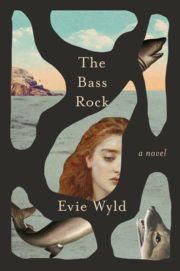
Evie Wyld is an author and bookshop owner in London whose latest novel, The Bass Rock, follows three women on the coast of Scotland over the centuries. Sarah, accused of witchcraft, is on the lam in the 1700s. Ruth is a 1950s housewife, married to a widower and step-mother to his two sons. And in the present day, Viviane has travelled from London in the shadow of her father’s death, to prep the family home for sale.

The Bass Rock opens with the dead body of a woman on the beach, but this doesn't feel cliché so much as it feels like commentary on the “dead girl” trope itself. While the book isn’t a murder mystery, Wyld does well by setting the stage with a murder, creating an implied invitation for the reader to play detective as the novel cuts across three unraveling stories. There are very few intersections at first—a house connects two of them when it's revealed that Ruth is Viviane's step-grandmother, but their stories move along independently. The through-line isn’t the similarity of the women or their connection to this house, so much as the commonality of the men in their lives who are utterly failing them. In an interview, Wyld said: “It was really when #MeToo happened that I saw I was writing about the same thing. The same problem, just a slightly different shape, I suppose.”

What develops is a mugshot of male entitlement—violence, as observed by the three main characters, that hasn't changed much over the centuries. Wyld draws red threads of connection from misogyny in advertising to creeps in parking lots and from a date's gas-lighting to a husband's institutionalization of his wife. As minor condescension crescendos to major brutality, the book begins to question what is at the core of these failings. Wyld’s delving doesn’t only concern the effects of toxic masculinity on women, however. One of the most poignant passages depicts a father confronted with the abuse of his sons at a boarding school. As we realize that he is all too familiar with the abuse his sons are suffering, we sit with him in the moment of choice between rescuing (or even empathizing) with his children or resolving to ignore the abuse as simply part of what turns a boy into a man.

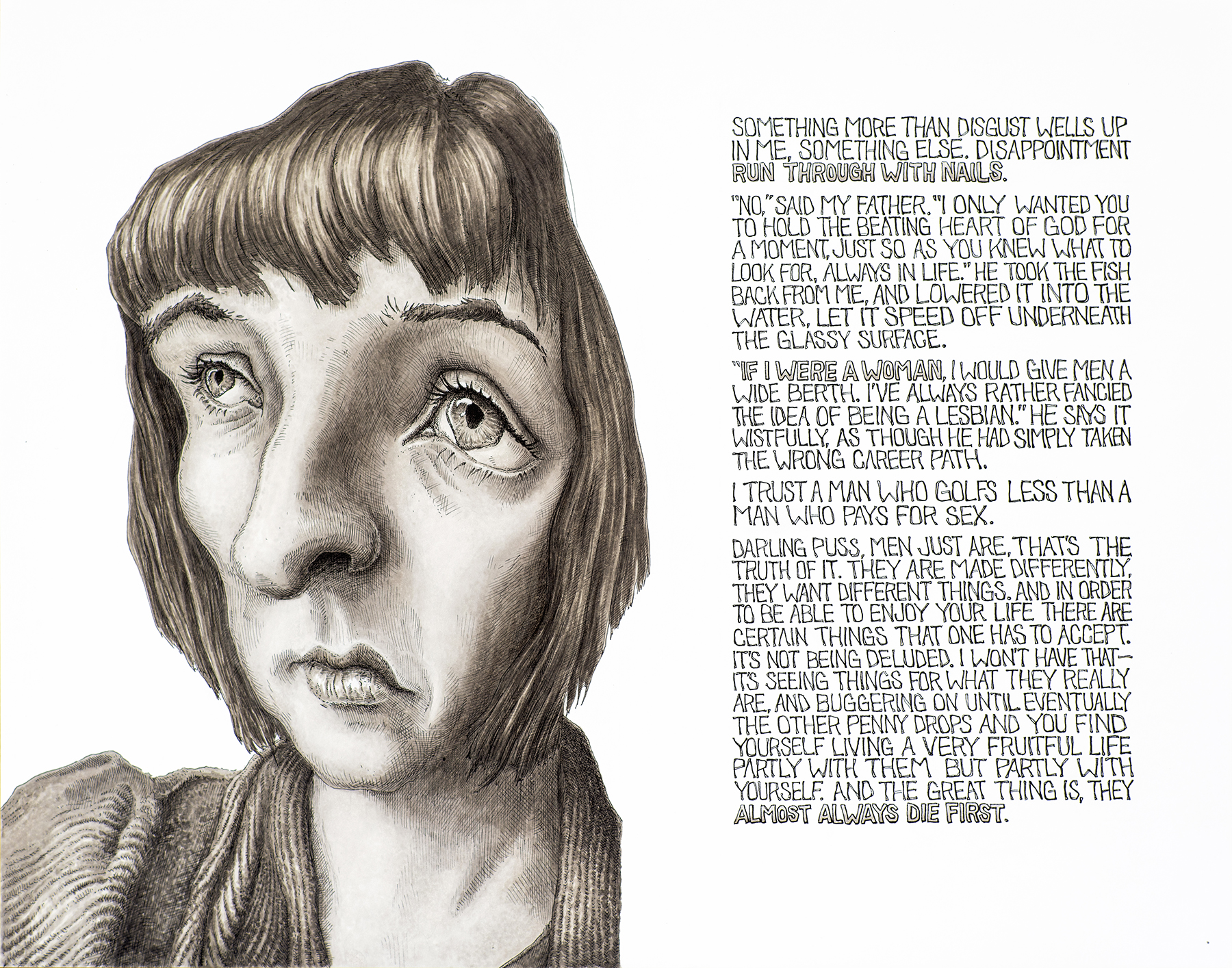
Art courtesy of the reviewer, one in a series of renditions of writers alongside their words featured on his Instagram (@joshsteinbauer).

Wyld's indictment of toxic masculinity is cut with humor, as if coping with it is an artform best practiced through sardonic observation and lancing wit—a kind of Sylvia Plath meets Fleabag. One of the most notable side characters is Maggie, a homeless sometimes-sex-worker whose give-no-fucks take on the patriarchy initially comes across as madness. Under scrutiny, though, she's simply the only one who feels free enough to say what they're all thinking. Maggie speaks in raw gems like, “I trust a man who golfs less than a man who pays for sex.”

The Bass Rock works particularly well as an audio book. The sweet nectar of Scottish accents shepherd the reader through stretches of danger and dread as they come full circle to the body on the beach. The great murder mystery is femicide itself. No one cracks the case, though Wyld’s women testify to the buried weight of patriarchy, with Bass Rock at the forefront of her symbolism—a small island where long ago a castle was built that over time became a prison.


Click here to purchase this book
at your local independent bookstore
indiebound
Rain Taxi Online Edition Summer 2021 | © Rain Taxi, Inc. 2021

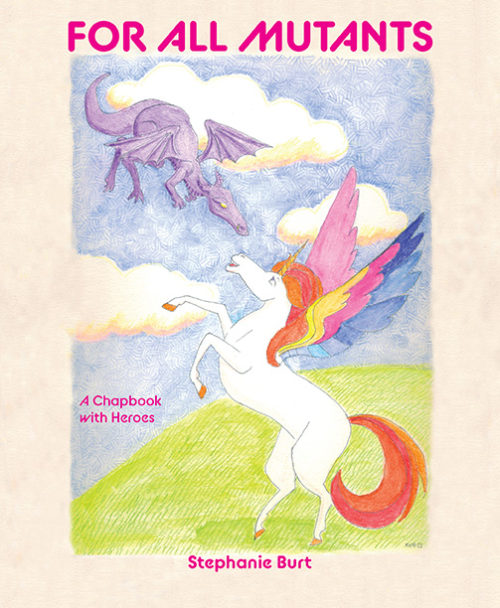
For All Mutants

by Stephanie Burt

Poet, literary critic, and professor Stephanie Burt presents poems inspired by X-Men, pop culture, and more to explore love, romance, queer identities, fan cultures, powered-up princesses, red queens, pirates, retcons, and the spaces between the stars. Burt says, "As well as taking general excitement and inspiration from comic book superheroes and their cousins in film and TV, all these poems are transformative works: they describe, refer to, or speak for individual heroes and their stories." Cover art by Mara Hampson. Published 2021.

$10, plus $4 for shipping in the U.S. 44 pages, perfect bound

For international shipping, please email orders [at] raintaxi [dot] com for an invoice including up-to-date shipping costs.

Works by Paul Celan

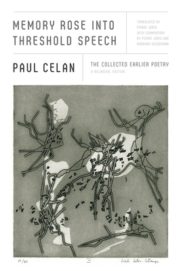
Memory Rose Into Threshold Speech
The Collected Earlier Poetry
Paul Celan
translated by Pierre Joris
Farrar, Straus and Giroux ($45)

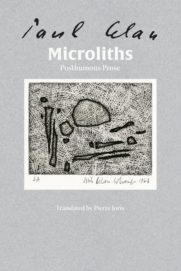
Microliths They Are, Little Stones
Posthumous Prose
Paul Celan
translated by Pierre Joris
Contra Mundum Press ($26)

by John Bradley

These two volumes, a bilingual (German and English) translation of Celan’s early poetry and a translation of much of his prose, offer a tribute to an author that many, including translator Pierre Joris, consider “the major German language poet of the period after 1945.” Memory Rose into Threshold Speech completes Joris’s translation of Celan’s poetry, accompanying his Breathturn into Timestead: The Collected Later Poetry (Farrar, Straus and Giroux, 2014), a major literary accomplishment.

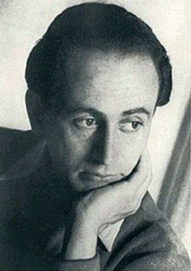
Celan was born Paul Anchel in Czernowitz (now Chernivtsi, in Ukraine) in 1920. His parents were murdered by the Nazis during the Holocaust, a personal as well as historic tragedy that lurks behind much of Celan’s poetry. In 1947, he changed the Romanian spelling of his last name into Celan. After dealing with “psychic turmoil,” as Joris puts it, Celan died in 1970 by jumping into the Seine.

Reading Celan’s earlier poetry offers a chance to study his evolution as a poet. This statement from Microliths They Are, Little Stones offers a key to that development: “Not the measured verse, but the unmeasured, where the lyrical and the tragical meet and cut across each other, is what makes a poem a poem.” Looking at the three books of Celan’s gathered in Memory Rose into Threshold Speech (Poppy and Memory, Threshold to Threshold, and Speechgrille), the reader can easily see that Celan began by writing poetry that put more emphasis on the lyrical and then gradually converted to put more emphasis on the “tragical.” The very first poem in this collection, “A Song in the Desert,” shows just how caught up in the lyrical and romantic Celan was: “I pulled my black stallion around and jabbed at death with my rapier.” In another early poem, entitled “For Naught You Draw Hearts,” he begins: “The Duke of Stillness / recruits soldiers in the castle courtyard.” But even in these more lyrical poems, the surreal can be found, as the next line in this poem attests: “He hoists his banner in the tree—a leaf that blues for him when it autumns.” That use of “blues” and “autumns” as verbs shows the future path Celan would follow, bending language in new ways.

Perhaps the most famous of Celan’s early poems is “Deathfugue,” which was first published in Bucharest, May 2, 1947, under the title “Death tango.” Already Celan had found his voice and style, blending and balancing the lyrical and tragical, as can be seen right from the opening lines:

Black milk of morning we drink you evenings
we drink you at noon and mornings we drink you at night
we drink and we drink
we dig a grave in the air there on lies at ease
A man lives in the house he plays with the snakes he writes
he writes when it darkens to Deutschland your golden hair Margarete
he writes and steps in front of his house and the stars glisten and he
whistles his dogs to come home
he whistles his jews to appear let a grave be dug in the earth
he commands us play up for the dance (43)

This hypnotic mix of surreal language and repetition creates a deep emotional resonance.

Some readers, however, including a major German critic, denied that the poem related to any historical event, such as the Holocaust, considering “Deathfugue” instead “a gorgeous dreamlike surrealist fantasy with no reference to the actual world.” This denial of his evoking the historical led Celan to a more austere style in his next book, Threshold to Threshold, a style that would employ more of the tragical, as can be seen in “By Twos”:

The dead swim by twos,
by twos, girdled by wine.
In this girdle of wine,
the dead, they swim by twos.

They braided their hair into mats,
they live toward each other.
You, throw once more your die
And dive into the two’s eye.

It’s hard not to think of Celan’s dead parents when reading this poem, and hard also not to think of Celan’s dive into the Seine.

Another aspect of this more austere style is Celan’s use of compound-word neologisms. These compound words, which German seems particularly suited to, add a complexity and at the same time a specificity for Celan, a way both to expand the possibilities of language and to narrow his focus, as in the opening stanza of “Windtrue”:

Tablewall, gray, with nightfrieze.
Fields, windtrue, square after square
empty of writing.
Lightipede climbs past.

The compound words here allow for a more intense description of the scene, culminating in “lightipede,” which suggests a kind of centipede, its legs bristling with light, one of his most unusual—and nightmarish—neologisms.

Celan’s distinctive use of language, though, wasn’t merely a stylistic discovery. Rather, it gives the sense of a writer trying to create a new poetic after the Holocaust. Often that struggle with language culminates in a kind of prayer, such as in “Psalm,” from NoOnesRose:

NoOne kneads us again of earth and clay,
no One conjures our dust.
Noone.

Praised be thou, NoOne.
For your sake we
want to flower.
Toward
you.

A Nothing
we were, we are, we will
remain, flowering:
the Nothing-, the
NoOnesRose. (263 & 265)

These three stanzas of “Psalm” illustrate the tension between an intimate address to a higher power and a deep skepticism that this entity exists. Joris’s translation brilliantly captures this tension right from the opening line, with “kneads” evoking the word “needs.”

Joris has not only masterfully translated Paul Celan’s poetry, but also his prose in Microliths They Are, Little Stones. While this volume is not a complete collection of all of Celan’s prose, at 294 pages it certainly gives the reader a full-sized window into the mind of Celan. This window begins with the title of the book, which comes from the following entry:

Microliths they are, little stones, barely perceptible, tiny xenocrysts inside the thick tuff of your existence—and now you try, word-poor and perhaps already irrevocably condemned to silence, to read them together into crystals? You seem to wait for reinforcements—say, where should these come from?

This collection of prose writings do indeed feel like “little stones,” consisting of aphorisms, quotations from readings, short narratives, notes for a conference presentation, and drafts of letters. Celan was a skilled aphorist, much like his surrealist predecessor Franz Kafka: “Teach the fish the language of fishing hooks”; “He who really learns how to see, closes in on the invisible”; “Another name for love: patience.” These writings are not frivolous, however. One letter written by Celan offers this painful disclosure: “the hand that will open my book has perhaps shaken the hand of the one who murdered my mother.” The past never loosened its grip on Celan.

While Microliths offers some general insight into Celan, this prose volume will be of interest mainly to the Celan scholar. The section entitled “Texts on the Goll Affair,” for example, helps the reader to better understand an event that deeply scarred the author. The German poet Yvan Goll died in 1950, and shortly after that his widow, Claire, accused Celan of plagiarizing her husband’s work. Though this was completely untrue, she persisted in her claims, even creating false documents to support her charges. Particularly hurtful was her claim that Celan’s parents were not actually murdered by Nazis. In a letter about Claire Goll’s charges, Celan writes: “For this whole matter is in no way a literary affair, it is only [Celan’s italics] infamy.” Claire Goll unleashed such trauma in Celan that her false charges were, according to Joris, “one of the triggers of his suicide.”

With the translation of all of Celan’s poetry completed, as well as most of his prose, Pierre Joris notes that this concludes his “fifty-year involvement with translating Paul Celan.” It is quite an accomplishment. The care Joris has taken in translating Celan can be found in the notes, entitled “Commentary,” for Memory Rose into Threshold Speech. In the 153 pages of notes, the reader will find information on when and where a poem was composed, who it may have been written for, previous versions of a poem’s title, pertinent excerpts from Celan’s letters, references to other poems by Celan, as well as allusions to other poets, and references to various myths. There’s even a diagram for one poem, “Shroud,” to illustrate “the dense web of words in this poem.” It’s no wonder that Joris’s translations of Celan seem to radiate clarity while preserving Celan’s complexity.

This complexity relates to a comment by Celan on why he wrote in German—he felt he had to “cleanse his mother’s high-German of all the poison injected into it by her murderers’ ideology.” To purify a language of its history, of its misuse by the speakers of that language, Celan’s poems—to quote from his poem “Speak, You Too”—“grow thinner, more unrecognizable, finer!” The poem concludes:

Finer: a thread
along which it wants to alight, the star:
so as to swim further down, down
where it sees itself gleam: in the swell
of wandering words.

Celan must take us down deep into the roots of language in order for it to shine. His poetry, thanks to Pierre Joris, will continue to shine for English-speaking readers amidst “the swell / of wandering words.”


Click here to purchase Memory Rose Into Threshold Speech
at your local independent bookstore
indiebound
Click here to purchase Microliths They Are, Little Stones
at your local independent bookstore
indiebound
Rain Taxi Online Edition Summer 2021 | © Rain Taxi, Inc. 2021

HONORÉE FANONNE JEFFERS

in conversation with Lissa Jones-Lofgren

Wednesday, August 25
5:30 pm Central — FREE!
Crowdcast

An award-winning poet, Honorée Fanonne Jeffers now joins the front ranks of American novelists with The Love Songs of W.E.B. Du Bois (Harper). Already hailed as one of the most anticipated books of the summer by publications from Ms. and People to the New York Times, this majestic epic follows a family from the colonial slave trade through the Civil War to our own tumultuous era. At heart it is also the story of what the great scholar W. E. B. Du Bois called “Double Consciousness”—a sensitivity that every African American possesses in order to survive. At this special event, Jeffers will be joined in conversation with Twin Cities-based radio and podcast host Lissa Jones-Lofgren. Free to attend, registration required. We hope to “see” you there!

“This sweeping, brilliant and beautiful narrative is at once a love song to Black girlhood, family, history, joy, pain . . . and so much more. In Jeffers' deft hands, the story of race and love in America becomes the great American novel.”
—Jacqueline Woodson

A copy of the book, including a special bookplate signed by the author, can be purchased in advance using the button below! Books are provided by Magers & Quinn Booksellers in Minneapolis; purchasing here helps support them AND Rain Taxi’s virtual event series—thank you!


About the Participants

Honorée Fanonne Jeffers is the author of five poetry collections, ranging from The Gospel of Barbecue (2000), selected by Lucille Clifton for the Stan and Tom Wick poetry prize, to The Age of Phillis (2020), a dazzling deep dive into the life and times of the 18th-century African American poet Phillis Wheatley. Her work has been published in numerous magazines and anthologies, and her many honors include fellowships from the National Endowment for the Arts and the 2018 Harper Lee Award for Alabama’s Distinguished Writer of the Year. For her scholarly research on Early African Americans, Jeffers was elected into the American Antiquarian Society, a learned organization to which fourteen U.S. presidents have been elected. She teaches creative writing at the University of Oklahoma, where she is an associate professor of English.

Lissa Jones-Lofgren is the host for the podcast Black Market Reads and the creator, executive producer, and host of Urban Agenda, the longest continuously running program on KMOJ Radio, Minnesota’s oldest Black radio station. She authored “Voices of the Village,” a column in the Minnesota Spokesman-Recorder, and is a frequent presenter on the intersection of Black history and present-day thought.
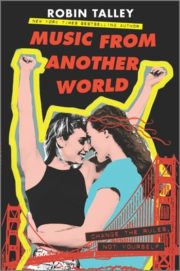
Music From Another World

Robin Talley
Inkyard Press ($18.99)

by Helena Ducusin

Tremendous progress has been made in the past several decades in the realm of LGBTQ+ rights and representation. Because of this, it can be easy for younger readers to feel disconnected from the history of overt discrimination against the LGBTQ+ community. Robin Talley’s historical fiction novel Music From Another World engages present readers with its dynamic characters who navigate social pressures while grappling with feelings of isolation. Such desire for belonging persists in present time, and Talley’s novel resonates shockingly well, connecting readers to a history they may not know.

Music From Another World traces the letters of two teenage pen pals, Tammy and Sharon, as they decipher their identities in their surrounding religious communities. Tammy is a lesbian and has not told anyone, especially not her Baptist and actively homophobic family, while Sharon’s brother confided in her that he is gay and made her swear not to tell their devoutly Catholic mother. The girls are matched as pen pals through a school assignment, and at first, they’re exactly that. They exchange favorite TV shows, hobbies, and follow the list of questions on the assignment sheet. That is, until, Tammy suggests a pledge of honesty—no crossing words out, no rereading before you send, and no sharing with anyone else. Sharon agrees, and the two enter into a more intimate friendship.

As the book progresses, Tammy and Sharon each seek out places where they feel at home and people around whom they can genuinely express themselves. Their experiences are unique, so they are able to grow individually while sharing their experiences with each other. The author’s choice to alternate between their letters and entries in their personal diaries further enriches their characters and allows the reader to intimately experience the layers of secrecy each girl is grappling with. “The two ultimately show different ways of finding yourself when your surrounding community isn’t accepting of you.”

When Tammy and Sharon both become engulfed in the political campaign of civil rights activist Harvey Milk, they face the consequences of dissenting from their families’ beliefs. Similar homophobia and rejection is still very much present in some conservative or religious communities today, and presenting this dynamic to a young demographic is likely to enable queer and questioning readers to feel accepted and heard, even if their own communities reject them.

This novel continues Talley’s streak of writing captivating stories that depict the queer teenage experience and provide LGBTQ+ youth with complex, empathetic characters in historical settings not typically represented in mainstream media and education. Tammy and Sharon are characterized as young women who actively seek to understand themselves and their beliefs while forming meaningful friendships with people who support them and encourage them to express their true selves. Tammy writes in her diary a question that many queer people have wrestled with in their lifetime: “I want to be proud of who I am, the way you are, but how? How do you make yourself feel something when everyone around you believes the exact opposite?”

Talley’s novel emphasizes the universal desire for belonging, while also illuminating much-needed LGBTQ representation in historical fiction. Young adult readers are sure to be enthralled by the depth of Tammy and Sharon’s friendship, their active fight for equal rights within their communities, and their inner battles between the values of their childhood and their identities.


Click here to purchase this book
at your local independent bookstore
indiebound
Rain Taxi Online Edition Spring 2021 | © Rain Taxi, Inc. 2021

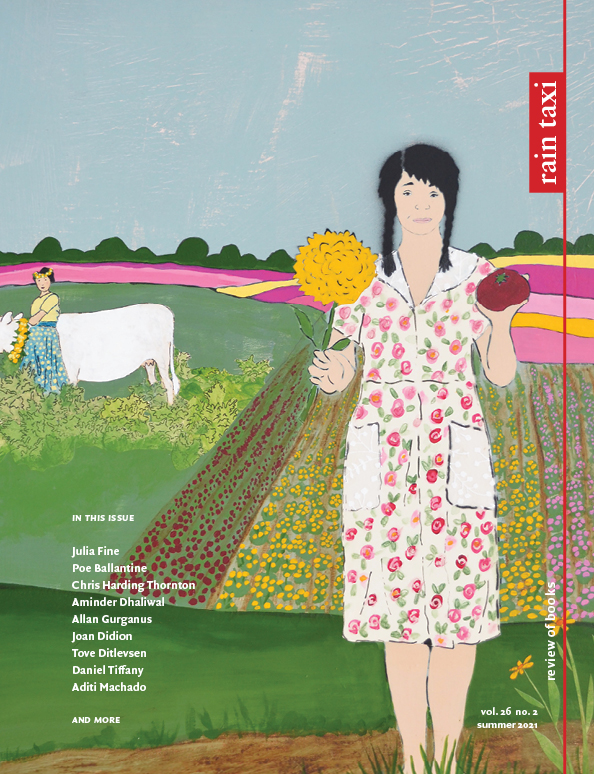
Volume 26, Number 2 Summer 2021 (#102)

To purchase issue #102 using Paypal, click here.

INTERVIEWS

Julia Fine: Goodnight Nobody | interviewed by Rachel Slotnick
Chris Harding Thornton: Nebraska Intersections | interviewed by Allan Vorda
Poe Ballantine: Beauty, Truth, Meaning, Laughter | interviewed by Scott F. Parker

FEATURES

The New Life | a comic by Gary Sullivan
Victor Frankl: 75 Years of Linking Hope, Imagination, and Meaning During Suffering | by Rodney Dieser
Chapbook Review: The End | Aditi Machado | by Graziano Krätli

PLUS:

Cover art Amy Rice

FICTION / COMICS REVIEWS

The Uncollected Stories of Allan Gurganus | Allan Gurganus | by Julian Anderson
A Bright Ray of Darkness | Ethan Hawke | by Mark Massaro
The Big Baby Crime Spree and Other Delusions | Darrin Doyle | Christopher Linforth
The Copenhagen Trilogy: Childhood; Youth; Dependency | Tove Ditlevsen | by Poul Houe
Piranesi | Susanna Clarke | by Ross Kilpatrick
Impurity | Larry Tremblay | by Rick Henry
Milk Blood Heat | Dantiel W. Moniz | by Annie Harvieux
Cyclopedia Exotica | Aminder Dhaliwal | by Annie Harvieux
The Snow Fell Three Graves Deep: Voices from the Donner Party | Allan Wolf | by Linda Stack-Nelson

NONFICTION REVIEWS

The Walker: On Finding and Losing Yourself in the Modern City | Matthew Beaumont | by Patrick James Dunagan
Breath Taking: The Power, Fragility, and Future of Our Extraordinary Lungs | Michael J. Stephen, MD | by Heidi Newbauer
Let Me Tell You What I Mean | Joan Didion | by Grace Utomo
The Fall of America Journals, 1965–1971 | Allen Ginsberg | by Christopher Luna
No Hierarchy of the Lovely: Ten Uncollected Essays and Other Prose 1939–1981 | Robert Duncan | by Patrick James Dunagan
Plague Literature: Lessons for Living Well during a Pandemic | Dustin Peone | by John Toren
Tattoo Histories: Transcultural Perspectives on the Narratives, Practices, and Representations of Tattooing | Sinah Theres Kloß | by Mark Gustafson

POETRY REVIEWS

Cry Baby Mystic | Daniel Tiffany | by Alexander Dickow
The New Mélancholia & Other Poems | Gerard Malanga | by Djelloul Marbrook
Broadway for Paul | Vincent Katz | by Jim Feast
Sparrow Envy: Field Guide to Birds and Lesser Beasts | J. Drew Lanham | by Thomas Rain Crowe
The Mouth of Earth | Sarah P. Strong | by Gale Hemmann
Owed | Joshua Bennett | by Beth Brown Preston
Gunpowder for Single-Ball Poems | Alan Britt | by Mish Murphy
Deluge | Leila Chatti | by Tara Ballard
In the Blink of a Third Eye: Poetry, Flash-Fiction, Drawing-Collages | Valery Oisteanu | by Stash Luczkiw
OYO: The Beautiful River | Mark B. Hamilton | by Greg Bem

Amy Rice

I use nontraditional print-making methods--including hand cut stencils and a Japanese screen printing toy called a Gocco printer--as a starting point for original mixed media pieces. I use spray paint, acrylics, gouache, and inks, and print on a variety of surfaces including wood, fabric and antique papers (preferring handwritten love letters, envelopes, journal pages, sheet music and maps).

I am most satisfied when I can make a tangible or visceral connection between the materials used and the image rendered. My work is deeply layered, often both literally and figuratively. My imagery--nostalgic and wistful--is largely biographical and reflective of my pensive nature.

I am as inspired in my art as much by childhood memories of growing up on a Midwestern farm as I am the urban community in which I now live. I am influenced by bicycles, street art, gardening, and random found objects, collective endeavors that challenge hierarchy, acts of compassion, downright silliness, and things with wings.

Visit her website for more information.

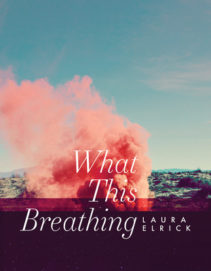
What This Breathing

Laura Elrick
The Elephants ($15)

by David Brazil

In an interview about the 1979 film Alien, director Ridley Scott stated that he understood the events of that film to be set in the same world as the urban dystopia of Blade Runner. With such classics of science fiction and apocalyptic cinema feeling especially relevant during our pandemic times, this observation regarding the convergent catastrophes of corporate cupidity in deep space and the unlivable environments left to rot down here on earth feels like a key to reading Laura Elrick’s What This Breathing. The space of the book is one of multiple overlapping disasters through which we navigate. The title itself, stripped of a verb that would animate the fragment into a sentence, might be asking “What [is] this breathing,” what is the nature of life right now? But it might also be asking, in the manner of “What, me worry?” (the tagline of Mad magazine mascot Alfred E. Neuman), “What, this breathing?”

The book’s first text, “Mouth Starts,” is titled in the table of contents but not on the page where it appears, signaling that it is intended as a sort of overture. With our mouths we breathe, speak, eat, and sometimes vomit:

tremblingly my muscled mouth my uncontrolled control

is ownerless, my botanies, when it arcs it

or actual my mouth

starts many-ownered over

From the start the poem stages the question of what belongs to us and what is common or taken away by degraded collectivities. The possessive pronoun “my” is obsessively repeated in the text, perhaps because the speaker perceives that it is both “ownerless” and “many-ownered.”

A similar drama attends the deployment of the first-person pronoun, which sometimes functions grammatically as though it were third-person: “I begins to dance?” or “just tell me how much I owes.” The speaker’s estrangement from a language into which we are supposed to fall without reserve (we aren’t supposed to think about whether we are “I” when we say “I”) makes the mask of even what should be the most intimate, evident. As the physical environment is polluted by industrial waste and nuclear disasters, so the linguistic environment becomes toxified by the degradations of language that are its analogues and concomitants: “to be the lie repeatedly, day after day.”

Having seen the world and the word smashed, and being ourselves smashed, it seems that the right response might be to smash back:

You say: the state, police state, patriarchy and its breaks, broken backs and the tanks, bank windows, white power networks, official and unofficial, pharmaceutical capitalists misogynists and terfs, excessive feelings of fear or vulnerability, refugee camps, excessive feelings of power and self-righteousness, museums, cartesian space linear time, putting the brakes on, no brakes and no breaks

Elrick’s voices—for these poems are speeches, as surely as Browning’s are—find the solace of “her whom I loved” even in the battery of an MRI chamber. And since poets are, as Shelley says, “mirrors of the gigantic shadows which futurity casts upon the present,” it’s no wonder that a text preoccupied with emergencies should prefigure much of the tonal center of pandemic life: anxiety, confusion, isolation and broken communication. There are even mysterious visitors “from the epidemic / Center.”

In a short poem, “Slurry Pump,” which may be the book’s ars poetica, the speaker takes a break from wading “through sludge, toward the hull of a rusting ship rent / in half” where they live, to reflect on a past whose “lessons (guppy, minnow, porpoise, shark)” (the grades in YMCA swimming classes) “could have prepared you / for this type of breathing. A poem for the future then.” It is a poem that remembers a world before the devastation and brings that memory into relationship with what breathing is now: airways choked by methane seas, respiratory contagions, and cops. “The Great Dying will nevertheless be lived through / An intersubjective space.” In the midst, the task of speaking and naming abides.


Click here to purchase this book
at your local independent bookstore
indiebound
Rain Taxi Online Edition Spring 2021 | © Rain Taxi, Inc. 2021

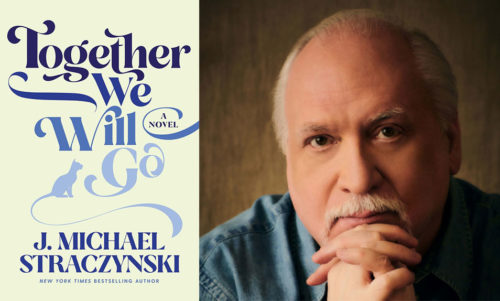
J. MICHAEL STRACZYNSKI

Book Launch for Together We Will Go

Tuesday, July 6
5:30 pm Central — FREE!
Crowdcast

Known for his groundbreaking work across television, comics, films, and more, award-winning and bestselling author J. Michael Straczynski joins us to celebrate the publication day of Together We Will Go (Gallery/Scout Press), his stirring first foray into literary fiction. A powerful tale of a struggling young writer who assembles a busload of fellow disheartened people on a journey toward death, Together We Will Go grapples with the biggest questions of existence while finding small moments of the beauty in this world that often goes unnoticed. As Straczynski’s travelers cross state lines and complications to the initial plan arise, it becomes clear that this novel is as much about the will to live as the choice to end it—and that it’s a book readers will remember for a lifetime.

Free to attend, registration required. We hope to “see” you there!

Books can be purchased either during the event or in advance from Magers & Quinn Booksellers in Minneapolis; just click the button below. Fun Fact: Any and all books you purchase when you start at this link help support Rain Taxi’s virtual event series—thank you!


About the Author

J. Michael Straczynski is the widely acclaimed creator of Babylon 5, co-creator of Netflix’s Sense8, and writer of Clint Eastwood’s Changeling, which earned him a nomination for a British Academy Award for Best Screenplay (BAFTA); other film work includes being one of the key writers for Marvel’s Thor (in which he also has a cameo) and the apocalyptic horror film World War Z. In comics he has written celebrated runs of The Amazing Spider-Man, Fantastic Four, Superman, Wonder Woman, and other iconic series, as well as original comics works such as Rising Stars and Midnight Nation. His 2019 memoir Becoming Superman (HarperVoyager) was praised as “remarkable” (The Wall Street Journal), “harrowing and triumphant” (Entertainment Weekly), and “everything good storytelling should be” (NPR.org), and he has also recently released the nonfiction book Becoming a Writer, Staying a Writer: The Artistry, Joy, and Career of Storytelling (BenBella Books). His work has frequently appeared on the New York Times bestseller list, and his extensive list of awards includes the Hugo Award, the Ray Bradbury Award, the Eisner Award, and the GLAAD Media Award. And seriously folks, this just scratches the surface!