
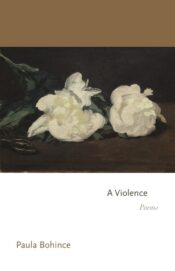
 Paula Bohince
Princeton University Press ($17.95)
by Erick Verran
The patchwork story of A Violence, Paula Bohince’s fourth collection of poetry, is one of being “no longer anonymous.” Out of “a bosom / of incense and secrecy,” we’re thrown into a world of disordered nerves and trauma, where a therapist drives “to Jawbone in her Honda” at the beck of voices and insurance agents with cameras hide in the grass. (In winking acknowledgement, Bohince throws in The Conversation, Francis Ford Coppola’s psychological thriller about a paranoid surveillance expert.) Seeking calm in a wifi-connected society, Bohince nods off under a canopy of digital rain. Through the wreckage of her brain, images dart to and fro like damselfish:
An ultraviolet urchin (plantary,
local) was lulling unaware
in waves eternalwhen Mari’s email turned to
stardust, touching a satellite’s face
for a nano, thencrystallizing on Earth
in the absolute blackness
of a laptop’s clamshell,in zone difference. The Pacific
tugged its trash as I
dreamt, as the crabawoke shameless, shrugging
off its burial, beginning again.
Bohince’s sympathy has a wide cast, with a soft spot for down-and-outers and the heartbreak of those who perform thankless labor, such as barmaids mothering drunks (“our charges, sealed in / submarine darkness”) or the aunt “who kept house / for a family and got to visit the cape once / a year to mind the children.” Her use of enjambment is quietly devastating, as are her still lifes, evocative arrangements composed of animal and mineral: rain-soaked donkeys waiting amid the shriveled blooms of “druidic elderflowers” in a darkened barn, an octopus at the bottom of the Atlantic that “cradles / itself to sleep in all of its arms.” In a disgusting bucket, bony xylophones dangle from fish heads, their eyes—like ours, seeing too much too soon—permanently shocked open.
Bohince also has an ear for sayings (“sobs of snow,” “ignorant as sunshine”) that feel age-old, handed down, as durable as the peals of a sixteenth-century bell:
Motes
now, my people, but a melody guided us
as it once brightened the edge of a Slovenian lakewhere a girl held her hem
and waded in, our lives
inside of her and inside of him, the one
who held out his hand, the husband.
That vanished colony of adults, wiped out like Roanoke by the usual diseases, haunts its lone survivor. “Sure, I was eternal,” Bohince admits, floating through “tipsy polka,” rhubarb, wild carrot. There’s humor, too, and the promise of new beginnings: when a friend breastfeeds a newborn, the speaker coos at it in Gaelic. But the poet is at her recollective best when she allows herself a certain breadth to say things at length instead of condensing. A lot in A Violence is as thick as Campbell’s soup:
Was a swell commandant: drink up, sleep. She’d
relinquished the vampy black and absconded to her toddler
color (muddy sunset) as we, one from each grief stage,
commissioned to flock her, petal’d her pale strapless,
pressed the appliqué along her spine with dancer’s glue,
all funds sunk into that silk, hence the wan hors d’oeuvres,
sheepish flasks, White Album on a loop.
While the weeping in A Violence may be copious (“then the world ordered Weep, and I wept”), one discovers there is no end to experience, scavenged from the macabre and quotidian in equal measure. Even simulacra can instruct, like a gold-plated earring tarnished “from its season in Hell” or when flakes land unfeelingly on the iris of a taxidermied deer. Bohince’s tender, Lowellian blend of family lore and remembrance comes together in “The Skunk,” a poem about her late mother, with stunning pathos:
I went wild,
memorizing her the way others did Ozymandias.One Christmas, when I was grown, I wanted to cook for her
the meal of a lifetime. To say, Mom, This is living. This is love.
Feel it. Flakes of salt on closed lips of asparagus,
duck limp-necked on a secondhand platter.She kept her head down and ate fast, with shame, and gave me
before leaving melted together wedding rings,
hers and my dad’s. Amulet for I don’t know what.
Pain-medallion. Coin for the underworld.In the New Year, I flattened beneath
the dentist’s lead apron and thought of her (I’m always
thinking of her), her red pilled sweater, how she looked around
at the candles, her face scorched from crying.
Like Proteus “in a high-up cave,” Bohince seems to carry within her a range of avatars, from “shirtless carpenters . . . on their summer jobs, / oiled as horses,” to Diego Velázquez and named lambs. Except, despite an homaging parenthetical to Elizabeth Bishop, Bohince more often resembles a less ornate version of Gjertrud Schnackenberg, whose gilded touch occasionally treats a beloved memory as grandparents used to a pair of baby’s shoes. Still, it’s undeniable that Bohince has a knack for writing disaster. Trying to mollify “the past, whatever that is,” she has been grieving in reverse, sketching whatever’s left of yesteryear in a manner that, however nostalgia-tinged, is mostly stoical—meaning “lighter, rinsed of those associations” which mattered profoundly once upon a time.