
 chaun webster
Graywolf Press ($18)
by Walter Holland
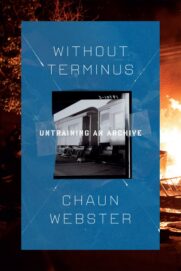
In his brilliant new nonfiction work Without Terminus: Untraining an Archive, poet chaun webster tells us that “the black historical is already the hauntological.” Ostensibly a memoir about his maternal grandfather Reginald Jerry Clark, who worked as a porter for the Great Northern Railroad for twenty-five years, the book becomes a kind of ghost story, a history of an absence, by following this insight.
An inquisitive, empathetic thinker, webster explores the paradoxes of writing about his grandfather, who remains a mystery to him except for a few artifacts. Setting out on this archival trail, webster entangles us in a broader context of Black genealogy, history, and identity. A sleuth, historian, sociologist, semiotician, and intimate memoirist all at once, he asks at the start of the book:
what does it mean to be gone? or to have so much difficulty in proving the here-ness of my kin? when history has arrived to me fractured already my instinct it to engage in a recovery mission. but I am unsure if this is one.
With continuous self-inquiry, webster employs digressions ranging from etymological inquiries to critical spatial discourse analysis to revisualize and restore his grandfather’s missing history. One such digression involves the word that underlies his grandfather’s work as a porter, an obliging role that demanded endlessly long hours without a break, thus tiring his body, ruining his health, and basically sacrificing his life to raise his family:
to com port as intransitive verb is to be fitting, often in terms of behavior: the porter comports to the directive. its prefix com-with, the Latin word comportare meant to bring together. coincide, cohere, correspond, rhyme. and what is forcibly being brought together by language? what happens when the body is inconsistent with the container it is violently being required to correspond with? when it will not comport . . .
webster, who has previously published two award-winning poetry collections, displays an especially imaginative virtuosity in Without Terminus, showcasing his skill at word graphics and visual rhetoric. Perhaps the most visually arresting part of the book is a series of pages in which webster analyzes the only written account of his grandfather he can find. Clark’s obituary in the local newspaper is headlined “St. Paul Man Dies After / Illness of Short Duration.” He took ill on a streetcar on his way to work where he had been employed for some time as a red cap, and he was taken to Ancker Hospital where “he died an hour later. Mr. Clark was well-known throughout the Twin Cities and had many friends. The cause of his sudden death has not been determined.” webster responds with the following two-page spread:
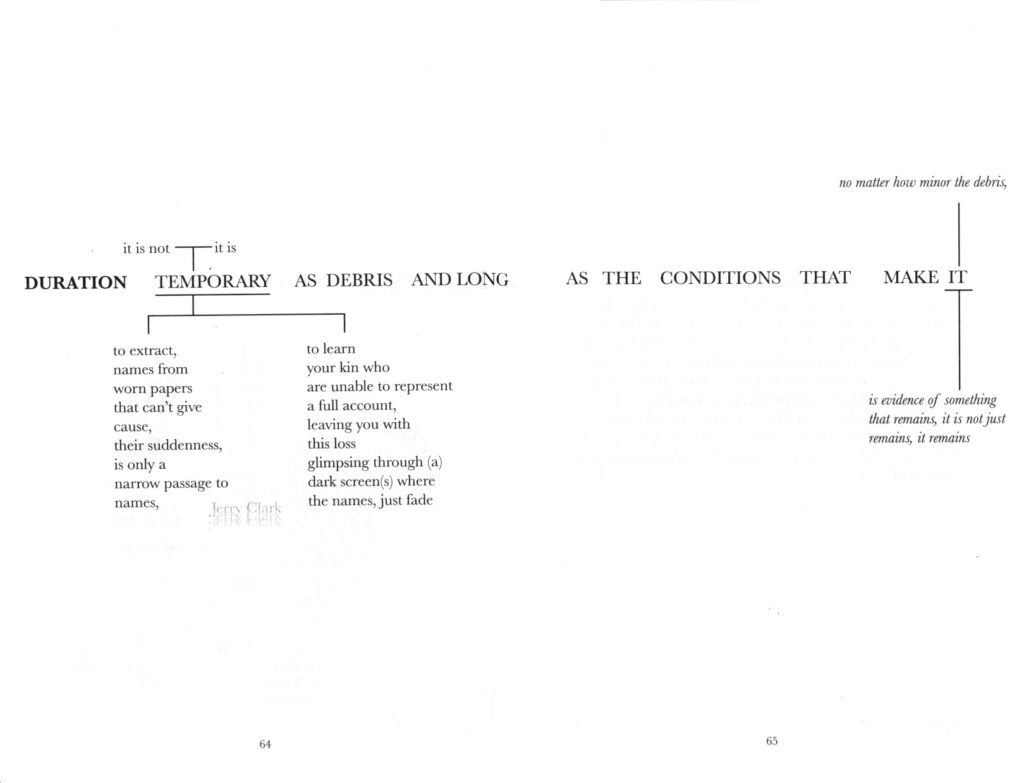
webster’s process involves repetition and reexamination from myriad textual angles and typographical approaches, as if to create engrams of his conflicted memories and abiding yearning for familial closure and belonging. Toward the book’s end, he explains what compelled him to write this work: “the holes in your memory, your memory being against narrative composition, discontinuous threads you’ve attempted to braid and tear apart again. what do you remember? what don’t you remember?”
Form and content in Without Terminus are so complexly aligned that patient rereadings will illuminate the cultural codes and social conventions that have historically created Black American identity. Meanwhile, chaun webster is to be commended for having broadened the conversation.