
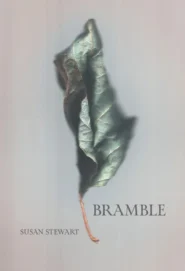
 Bramble
Susan Stewart
University of Chicago Press ($22.50)
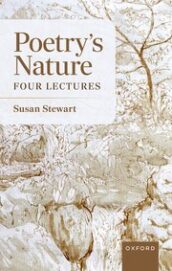
Poetry’s Nature: Four Lectures
Susan Stewart
Oxford University Press ($36.99)
by Matthew Valades
Poetry readers will count themselves lucky to have two new books from Susan Stewart in the past year. Bramble is her first poetry collection since Cinder: New and Selected Poems (Graywolf Press, 2017). Poetry’s Nature collects her 2023 Clarendon Lectures at Oxford University that skillfully demonstrate how poems enact ideas from philosophy and science. Both books add to her decades of impressive work in poetry and criticism.
As promised by the title, Poetry’s Nature considers how poetry possesses qualities that can be observed in the natural world. Over four lectures, Stewart compares birdsong and non-semantic sound, lyric time and the seasons, motion and water, the senses and wilderness. These erudite and awe-inspiring lectures add dimension to the poetry Stewart has written throughout her career, including in Bramble.
The first section of the collection, titled “Mirror,” features poems of roughly even lines that have window-like clarity, while the verse in the subsequent sections, “Briar” and “Channel,” tends to cascade down the page with a looser structure that is nonetheless precise and musical.
Poetry’s Nature and Bramble are most clearly connected by their interest in water’s motion and mutability, embodied in the recurring artwork “Waterfall Near Corchiano” by Justin Bradshaw. The drawing serves as the cover image for Poetry’s Nature and reappears in Bramble as the subject of “Waterfall near Corchiano: pen and wash.” The poem emulates the motion of water in thrilling, vital passages:
the dark bank, eroding as we watch, and
the water’s frothing spill, which from
this perspective is wholly light on water, speeding
down, down, and off the frame at the lower
right, the pulse gathering so that there is no
stopping place, and the moving image
that is time itself is living, alive, ongoing—here.
The mutability of water figures again in “Channel,” a long poem based on a river’s movement that expands to include rain, ocean, and tears. Divided into brief, unnumbered sections that build over nearly thirty pages, it begins:
Sweet runs the water ever
out of spring and meadow,
frothing low, rising,
weaving through
the sodden grass.
Silver line, transparent flow,
zigzag
and shine and
swerve
“Channel” sustains lyric intensity over its entirety and is an entrancing achievement, weaving between focused description of the natural world and industrial landscapes with equal deftness, sonic confidence, and glittering attention to detail.
One of Stewart’s notable qualities as a poet and critic is her generative relationship to the past. The poems discussed in Poetry’s Nature range from Middle English songs to Theodore Roethke; the philosophy spans Aristotle to contemporary physicist Carlo Rovelli. Bramble draws from older poetic sources as well. For example, Stewart’s “Psalm Octets” condense many of the same Penitential Psalms translated by 16th-century poet Thomas Wyatt, who also provides the epigraph for “Channel.” In stark contrast to the looser, more flowing poems in Bramble, “Psalm Octets” boil down to single stanzas of eight mostly end-stopped lines, creating distilled contemporary versions.
Stewart is no stranger to the tension of intricately crafted verse on unlikely subjects. The bulk of the poems are part of larger sequences approaching a theme from many angles. Another series in Bramble, “Plague Octets,” draws quick thumbnail sketches of subjects as various as Lucretius, Mister Softee, and daily life during the Covid-19 pandemic. This sequence––along with “Minor Musics” and “Simple Machines”––stands out for its mix of registers, contrasting the traditional lyric vocabulary more common in her work with references that touch on pop culture and the political, a range that gives the book a taproot in the everyday.
Poetry’s Nature and Bramble make illuminating companion books. In the lectures, Stewart explores the insight that we do not impose order on experience but emerge from it, already threaded into its relationships. In Bramble, a meditative poem about returning a beached horseshoe crab to the sea moves from admiring observation to startling realizations and is as much about perception as it is the limits of knowledge. The poet walks along a beach turned “battlefield of fragments,” soon discovering that one creature is still alive while marveling at its many limbs and eyes. She completes the frame established at the poem’s beginning of death and life among the wreckage by returning the crab to the “fierce enormity” of the sea at the end. In emphasizing the vastness before birth and after death, this frame also reflects the negative space around the poem, creating a symmetry between the poem and a life, which makes its ending a reflection on the unknown. This matches Stewart’s discussion of wilderness in Poetry’s Nature where she connects it with the inexpressible. Such complex relationships course between the poems and lectures. In Stewart’s hands, the effect is a subtle intensity that rewards rereading.