

by Claude Peck
Books about terrible, horrible, no good, very bad childhoods are not exactly scarce. From Dickens to Genet, Frank McCourt, Dorothy Allison, and Stuart Douglas, we read about orphans and outcasts, the abused, destitute, bullied and neglected. To this robust literature of misery, we can now add the work of a skinny queer provincial French boy with bad teeth who was determined to rise out of poverty, receive the finest education his country had to offer, and seek his revenge through plain yet piercing words. In a remarkable series of books, Édouard Louis recounts growing up in Hallencourt, a working-class village in northern France rife with unemployment, homophobia, racism, and violence.
Louis’s books have been appearing in English translations over the past decade (see list above for details of translators and years of US publication). First was The End of Eddy, originally published in 2014 when the author was just twenty-two; the book quickly sold a whopping 300,000 copies in France. Most critics praised it for baring a side of French life so at odds with the country’s reputation for égalité and liberal sophistication; some raised questions about its accuracy, and whether it should be marketed as fiction or memoir. Regardless of the disputes, it was a finalist for the prestigious Prix Goncourt in the debut-novel category and has been translated into twenty languages; Louis has given talks and readings all over the planet in its wake.

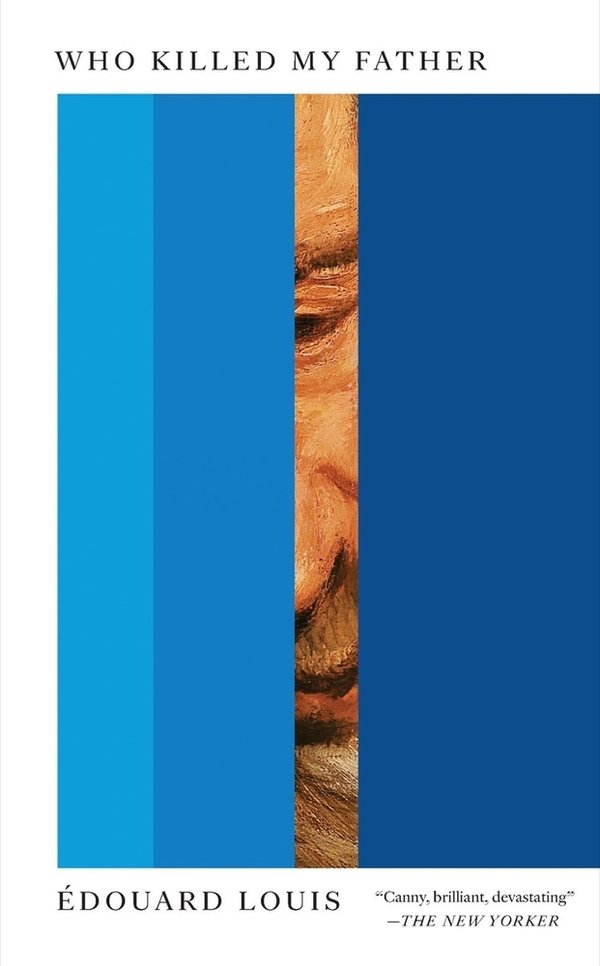
Louis went on to devote a book to his father (Who Killed My Father) and one to his mother’s midlife struggle to free herself of abusive, alcoholic men (A Woman’s Battles and Transformations). In the fascinating accretions of Change, published in France in 2021, Eddy leaves his childhood and village behind to attend lycée in Amiens and wins admittance to the prestigious École Normale Supérieure in Paris. Born Eddy Bellegueule, he fancifies his name to Édouard Louis, alters his too-loud laugh, straightens his teeth, attends the theater, and hangs out with a series of wealthy gay men, socialites, writers, and intellectuals—all to “gain worldwide recognition” for his books. The rags-to-riches arc of Change hints at such gradualist classics as Knut Hamsun’s Growth of the Soil and Edith Wharton’s The Custom of the Country.
With the English translations of Collapse, which concerns the early death of his older brother, and Monique Escapes, about helping his mother achieve independence after a string of bad relationships, Louis returns us to the squalid village of The End of Eddy. But wait: Do we really want to go there? To experience his dead-end brother’s alcohol-fueled violence against women? To relive the brothers’ woebegone mom, seemingly trapped in a cage with a series of insulting, domineering men? Also, why call these novels, when they are so clearly autobiographical?
Louis dismisses those who find his books repetitive: “I’ve been told that literature should never repeat itself, but I want to write only the same story again and again,” he tells us in A Woman’s Battles and Transformations, “returning to it until it reveals fragments of its truth, digging hole after hole in it until all that is hidden begins to seep out.”

Monique Escapes, however, doesn’t repeat much of the story of his mother told in previous books. As it opens, she is in her mid-fifties. (The writer, twenty-eight, is already a celebrated author, in Greece at a writing residency.) She calls her son from Paris, where she has been living for seven years with a man she met after she gave the boot to her chauvinist husband (Eddy’s father). Old patterns die hard, however; the new guy gets drunk nightly, calls her a whore and fat cow, and insults her “faggot” son. Fed up, she is determined to leave, and when she seeks her estranged son’s help, he throws himself into abetting her escape.
The mother-son dynamic here shifts dramatically from Louis’s long disregard for her, the family, and the town where he grew up. His mother, as young Eddy came to learn, abandoned hopes for a culinary career when she dropped out of school, married in her teens, had children, and embarked on a dreary life of scrimping, cooking, cleaning, and putting up with a verbally abusive, alcoholic husband. She mostly embraces (or fails to object to) the far-right, antigay, anti-immigrant politics of her husband and the town. Cowed, she rarely defends her effeminate young son from insults and attacks by bullies. She is prone to guilt-tripping and self-pity along the lines of “why can’t I have even a small measure of happiness?”
The author’s mother initially resents him for writing about her and his miserable childhood in The End of Eddy: “But paradoxically it’s because I’d written that book, and the ones that followed, that I’d earned the money we could now spend on her.” Even as he praises and reassures her, even as he provides her with money and temporary housing, Louis recalls her failures as a mother, wondering, “Why did I feel such a deep need to help her?” and concluding that it’s “because my hurt and hers are linked.”
In all his books, Louis laces his personal story with philosophy and social theory. Monique Escapes offers a class and feminist critique, especially about poor women in abusive relationships, for whom the possibility of escape is thwarted by financial constraints. “How many women would change their lives if they got a check?” he asks. He traces parallels between his childhood and that of his friend and mentor, the writer and philosopher Didier Eribon, who also grew up gay and poor, and wrote about it in his 2009 memoir Returning to Reims (Semiotext(e), 2013, translated by Michael Lucey).
When encountering “The Guy” his mother was ditching, Louis has a revelation reminiscent of the sort of moral inversion common in the works of his countryman Jean Genet: “I suddenly began to think that maybe this man was neither guilty nor responsible for what he had done,” but was rather “the element through which a violence had passed . . . the violence of male domination.” He and his estranged sister reunite to help their mother find and furnish a suitable place to live; she will also need money for groceries and living expenses. Louis praises Virginia Woolf for postulating a century ago, in A Room of One’s Own, that “freedom is not first and foremost an aesthetic and symbolic issue, but a material and practical one.”
With her children helping her, Monique blossoms into a new life where “no one’s going to walk all over me anymore.” She delights in trying new things, wearing makeup, fixing her hair, walking her dog, cooking for one. When she is featured in a German theater production based on Louis’s writing about her, she is invited to the opening; the journey marks her first time in an airplane and her first trip outside France. The director brings her onstage to applause at the curtain call, concluding on a joyous note for mother and son.
More than an upbeat happy-ending story, Monique Escapes is about rapprochement and metamorphosis. It reflects on Eddy’s own escape from his painful childhood, described in Change, as he sought revenge through education and hoped-for fame. It embraces a feminist ideal for a working-class woman. Near the end of Change, Louis entertains, for the first time, doubts about the values of the bourgeois life he has so doggedly pursued, combined with an ounce or two of nostalgia for the village life he left behind—for his mother’s humor, her pluck, her dreams so long deferred.

Throughout his oeuvre, Louis has argued that violence, homophobia, and racism in the town where he grew up must be seen as socially determined—a result of systems of class, economics, and masculinity that advantage those in power, even progressives, and not just in tiny Hallencourt. “By writing about my small town, I can put light on certain mechanisms that you can find everywhere in the world,” he told Interview Magazine in 2019.
“I write to shame the ruling class,” the self-described “class defector” told the New York Times in an interview. Louis seems thus to occupy a foggy space between revenge (against small-town bigots and gay-baiting bullies) and the thirst for vengeance (for a father and brother buffeted by post-industrial economic decline and systemic misogyny). This becomes overt in Who Killed My Father, where Louis names a series of French leaders whose politics, he argues, were responsible for turning many in his hometown into supporters of the far-right presidential candidate Marine Le Pen.
A brother’s death
Louis’s older (by seven years) half-brother died of alcohol-related illness at the age of thirty-eight. “I received the news as one would receive information on the weather,” writes Louis, who had avoided his brother for the preceding ten years. In Collapse, as he helps his mother and sister with funeral arrangements, he combines his own recollections with stories from interviewing his brother’s friends and lovers.
When not drunk, the brother (never named) could be kind, generous, loving, a good listener. He barely knew his birth father, which gives the boy a lifelong sense of being abandoned. As a teen, he begins doing drugs, drinking, lying, stealing. He drops out of school, which to Louis seems to be a masculinist impulse. His brother, along with his male peers, views school itself as feminine, even faggy, not something that “real males” would consider valuable when they followed their fathers into factory work.
When he does ponder his future, the brother is grandiose. At twenty, he announces to his parents that he would learn the meat trade and become the finest butcher in all of France, or he would work with a crew restoring historic cathedrals for the glory of the republic. His adoptive father laughs in his face to it all and turns back to the ever-on television. “It was the size of his dreams,” Louis writes, “and the mismatch between their dimensions and all the impossibilities that had shaped his life, the misery, the poverty, the north of France, his destiny, I think it was all these contradictions that made him so unhappy.”
The brother is suicidally depressed, fixating on being abandoned by his birth father; he is also cruel, selfish, and violent. He beats women. He gets in bar fights. When he hears about Eddy’s gayness, he sets out to kill him, armed with a baseball bat. Louis, however, begins to find sympathy for his largely unlovable brother. Their father should have been more supportive. There was no vocabulary in the working-class town for mental illness; no one ever talked about depression, trauma or therapy. Psychiatric care was a luxury for those with money and education. His brother self-medicated with alcohol. He grew up around violence and used it himself to feel more powerful.
As Louis gained access to a more privileged world, first in the provincial city of Amiens and later in Paris, he saw that fuckups like his brother might have had better chances to heal and prosper if they were born into wealthier families where missteps were not terminal. “Injustice,” he writes in Change, “is nothing but the difference in access to attempts.”
And consider that if his straight older brother was “of” his village, Louis, being gay, was “apart” from Hallencourt from a young age. This helps explain why Louis, like so many smalltown gays, escaped to the city: In Paris, he was able “to finally live, even more radically and easily than in Amiens, to have what I had desired since my birth, the feeling of bodily freedom and of entering, thanks to sexuality, myriad new universes.” The quintessential pop anthem of this phenom is Bronski Beat’s 1984 single “Smalltown Boy” which asserts “the answers you seek will never be found at home.” But for Louis, unearthing home’s hurt is the key to finding painful truths and paths forward.