
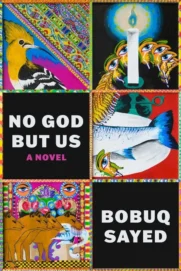
 Bobuq Sayed
Harper ($30)
by Zara Karschay
Bobuq Sayed’s deeply compassionate debut No God But Us takes us ten years back, the tragedy of critical distance apparent on every page. Distance—of time, place, nationality, race, sexuality, and gender identity—is essential to Sayed’s protagonists. Mansur and Delbar meet by chance in Turkey at a political turning point for the country. Through the dual perspectives of these two queer Afghans—one a refugee, the other an American citizen and closeted trans woman—Sayed creates a swirling narrative of intersectionality, a vortex within which their sharply drawn characters must negotiate the world at large.
The novel opens with Delbar’s story in 2015. A recent college graduate, they are heading to a party hosted by their mother Qandul but are instead apprehended, due to a surfaced photo showing them working at a drag club (where they also hope to perform one day). To spare them the family’s judgment, Qandul’s progressive sister Yosra gets Delbar on a flight to Istanbul, where she herself works as a professor.
Mansur takes a very different journey to Turkey. His story begins in Tehran in 2013 among a shadow class of migrant laborers, a perilous journey from Kabul already behind him. Life in Iran, however, is full of social inequities, and when Mansur’s sexuality is discovered, his lover, who lives in the capital’s wealthy north, helps him flee to Istanbul. But the work Mansur finds in Turkey—on roads, in kitchens, as a rent boy—isn’t much better; as Sayed puts it, “the weaker man met the needs of the stronger one.” Refugee status makes life difficult at every turn: Dispersal policies force many to live in rural areas, making urban jobs untenable, and many on the nebulous, slippery path toward asylum have already spent years in legal limbo, waiting for their papers to be processed while they keep out of trouble—including not joining protests where they’d otherwise find community. In the novel’s most tragic story arc, an Iranian trans woman is arrested at a pride march and finds that her new criminal record has devastated any chances of her being granted asylum.
Both Delbar and Mansur strive for a dignified, free life while finding belonging and stability as refugees. Through Yosra’s contacts, Delbar is offered an internship with Leif, a German “Anderson Cooper looking dude” who runs PeaceMeals, an aid program for queer and transgender refugees. While Delbar senses a performative dimension to Leif’s allyship, they also recognize an opportunity to help those with similar experiences. Mansur, despite his memories of western aid groups exploiting people in his homeland, is drawn to the degree of protection that Leif offers, whether it be from racial profiling, case worker distrust, or other refugees’ assumptions that being from Afghanistan makes it easier for him to apply for asylum.
Leif soon adopts an underhanded manner of domination. When he and Mansur become lovers, Leif controls every aspect of their relationship, from their apartment to their sexual partners, and he expects Mansur to reject his Afghan background. But No God But Us spares us the western cliché of the “good immigrant” who shucks the trammels of their past and supplicates to their white savior, focusing on human striving and the desire to be needed instead. Mansur confronts Leif after hearing him tell another aid worker he is “modernizing” the Afghan, and he later resists cultural erasure with a quiet dignity.
We know Delbar and Mansur must meet, and when they do, Sayed’s prose crackles with energy. Delbar describes intimate moments with phrases that seem plucked from the Persianate literary tradition, e.g., “fondling an ivory wildflower, gazing up at the same forked branches I was staring into, touching me without any point of contact.” No God But Us builds bridges between the critical distances that separate us and shows how deep the waters are that run beneath.