
by Liz Ahl
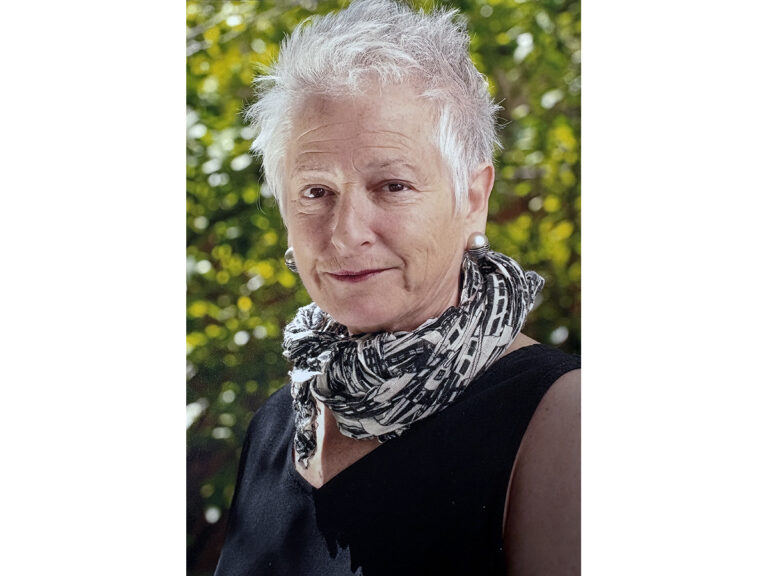
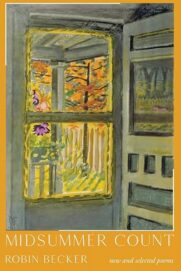
Robin Becker’s new book Midsummer Count: New and Selected Poems (University of New Mexico Press, $21.95) adds over forty pages of new poems to well-chosen selections from her eight acclaimed collections, the most recent of which was The Black Bear Inside Me (University of Pittsburgh Press, 2018). Spanning nearly half a century and filled with poems grounded in clear narratives that belie their formal complexity, Midsummer Count provides a fitting showcase for the great variety of themes (sexuality, Jewish identity, animals, art, and friendship among them) that recur in this writer’s work; it also demonstrates why Becker is widely considered “the foremost feminist poet of her generation.”
Other previous books by Becker include All-American Girl (University of Pittsburgh Press, 1996), which won the Lambda Literary Award for Lesbian Poetry. A Liberal Arts Research Professor Emeritus of English and Women’s Studies at Pennsylvania State University, Becker lives in central Pennsylvania and southwestern New Hampshire.
LIZ AHL: In a Q&A with Deborah Kalb, you mentioned having considered organizing this New & Selected thematically rather than chronologically. What thematic structures had you considered?
ROBIN BECKER: I had read Michael Waters’s Parthenopi: New and Selected Poems (BOA Editions, 2001), and I loved the way he made a storytelling arc. He culled poems from each of his books by subject and theme, building from childhood to adolescence to young adulthood; he also grouped poems about love and divorce and travel, and in so doing a rich portrait of the poet-speaker emerged. I envisioned doing something like that. I also liked how Lynn Emanuel eschewed chronology in The Nerve of It: Poems New and Selected (University of Pittsburgh Press, 2015), juxtaposing old and new poems to create a wholly new book. In the end, I decided that I wanted my New and Selected to provide an historical record, a book-by-book “re-telling” of my journey as a poet and as a lesbian-feminist who came of age in the 1970s.
LA: Midsummer Count includes one of my favorites of your poems, “Dyke.” It’s a great poem to teach, with its riffing on the titular word in terms of its sound and variants, how it personifies the word and also braids it with the narrator’s experience of the broader cultural history. If you imagine lesbian-feminist identity and history (both individual and societal) as manifested through your poems across the decades, what story emerges? What story of the poet Robin Becker, and what broader, shared story of us all?
RB: Liz, I’m glad you singled out “Dyke,” as it joins linguistic play and cultural specificity. The poem compresses personal and social history by moving the speaker’s emotional geography—from the scary lesbian bars of the 1970s to the freedom of Boston’s streets. It concludes by looking forward to a time of LGBTQ+ cultural acceptance and personal peace. In my early poems, lesbian relationships secure and (often) claim the narrative. In later poems––as I took my own sexuality for granted––animals, crazy family life, consolations of nature and inevitable loss assumed thematic primacy. I think my literary shift here mirrors larger social changes, such as the ability of LGBTQ+ people to marry.
LA: Can you say more about the shift of focus to poems about “crazy family life” in particular?
RB: Families—functional and dysfunctional—have fascinated me since childhood. I remember going to friends’ homes and studying the interaction between parents and kids, or among siblings. In an early poem, “The Conversion of the Jews,” the child narrator tries to understand the relationship between Christian and Jewish children. My sister’s epilepsy and subsequent emotional and psychological decline hovered over my family. One way of coping with the “shame” of illness was to write about it, and I struggled to do so. Having immigrant parents, my parents wanted, desperately, to assimilate, to fit in. Thus, my lesbian-feminism terrified them, as it separated me (and therefore them) from the heteronormative life they longed to have. Some of my poems reflect the gulf we navigated for many years. Another aspect of aging: My definition of “family” expanded to include a close group of ex-lovers and friends with whom I share my life.
LA: Many of your poems devote deep, appreciative attention to visual art, both in terms of specific artworks and artists as central subject matter and as deployed in various ways in poems not “about” art. How did this interest emerge and evolve over the decades represented in this collection?
RB: Drawing and painting, my first loves, gave childhood a material texture: paper and colored pencils; charcoal sticks and pen-and-ink washes; watercolor paints and sable brushes. At my Quaker school, I excelled in studio art and in the required art history classes that anchored me in the visuals of western art and architecture. For a long time, I thought I was headed in that direction. Translating feelings into something visual became a natural response to loving something —a horse, a landscape.
LA: “A natural response to loving something” makes me think of the generous attention of poetry, and perhaps of all artmaking—the deep, long looking. Attention itself can be very loving, I think.
RB: Liz, your observation connects to what Robert Hass says in “Meditation at Lagunitas”: “a word is elegy to what it signifies.” The impulse to cherish something or someone in words exists alongside the inevitable partiality of the effort. I think of my repeated efforts to capture what I love about the American Southwest, how they’re always falling short.
As a horse-crazy kid, I discovered a reproduction of Rosa Bonheur’s enormous painting “The Horse Fair (1855),” which depicts grooms and riders bringing draft horses to the Paris horse fair in the center of the city. When I first read the signature of the artist in the right-hand corner of the painting, I thought that Bonheur must have been the owner of the painting—it never occurred to me that a woman might have painted such a large and powerful picture. Many years later, I found a book about Bonheur and dove into her biography, and that led me to write the title poem for The Horse Fair (University of Pittsburgh Press, 2000).
On a visit to the Maeght Foundation in the south of France, I saw a group Giacometti sculptures and became obsessed with his gaunt, life-sized, bronze “Dog.” I wrote pages of notes—describing the sculpture, speculating, free-associating. Eventually, all that writing became the title poem of Giacometti’s Dog (University of Pittsburgh Press, 1990), a metaphor for the abandoned among us, the scorned and left behind.
A collaboration with the Frick Art and Historical Center in Pittsburgh resulted in the chapbook Venetian Blue, which the Frick published in 2002. My residency included writing poems in response to an exhibit of Old Master prints and drawings on loan from the Albertina in Vienna. That explicit ekphrastic assignment prompted a lot of research into 15th-17th century European artists such as Durer and Rembrandt.
“The Unfinished Painting,” which is the last of the “New” poems in Midsummer Count, has an interesting backstory. I saw the painting in a vintage shop in Cambridge, Massachusetts and learned that the woman who brought it in to sell on consignment was the daughter of a woman who collected only unfinished paintings. What a novel idea, collecting unfinished work!
LA: I’m glad you bring up “The Unfinished Painting”—like many of the new poems, it has me thinking about mortality, about that brand of “finished” and the “unfinished” alongside it. Here are some key lines from the poem:
I keep coming back
to the muzzy shoreline—swatchof wet-footed grasses and rocks,
a deferred undertaking that now never
will resolve into summer or fall.
The painter who abandoned thislandscape left me its abundant
incompleteness, a paradise
of possibility so spare I can walk
the pond’s perimeter and disappearinto the homespun mystery—
The dynamic between abandonment and abundance in these lines seems especially important in this collection––the idea of an “abundant / incompleteness,” spaces meant to be filled that weren’t, an emptiness that’s not empty but full of possibility or purpose. This also feels aligned with reflecting on one’s life and contemplating being on the far side of it.
RB: You’re describing the feelings I had when I first saw the painting! I leapt to enter or attend to the “incompleteness” I found there. I wanted to wander around in the de-familiarized season and semi-recognizable marsh land. And yes, I intentionally ended the “New” section on “incompleteness” to suggest the work ahead, to gesture towards the poems and the living still to come.
LA: We often return to certain paintings and novels and poems and music at different points in our lives and experience them differently across the span of those years.
RB: For me, returning to certain pieces of music over time has been revelatory. How did I miss so much? Listening to Beethoven’s string quartets today, I travel to an emotional place that wasn’t available to me decades ago. Bach’s pieces for solo violin, similarly, speak with a kind of singular beauty I couldn’t hear or feel as I do now.
LA: “The Unfinished Painting” also sent me back to your poem “Midsummer Count”— originally published in your collection Domain of Perfect Affection (University of Pittsburgh Press, 2006) and now the title poem of your rich New and Selected––probably because of the lines “a deferred undertaking that now never / will resolve into summer or fall.” How did working on this book prompt you to re-encounter past versions and visions of your poetry—past work, past worlds, past poetics, past Robins?
RB: In the title poem to which you refer, the narrator imagines crossing “natural barriers” and eluding fixed gender identities, living as a “hybrid cultivar.” This indeterminacy is certainly linked to the condition described in “The Unfinished Painting.” In that poem, the “outcome” of the painting—its meanings and boundaries—never reaches a final form, because the painter is called away and never returns to finish it. On one hand, the uncertain season, the vague architectural structures, and the absence of clear landscape features are disturbing and unsettling; on the other hand, the open-endedness is dynamic, surging, suggesting forces still at work. Encountering past versions of myself as I read through my books, I saw time passing—I re-experienced beloved places and creatures. The feelings available to us (as fallible human beings) rose and receded like waves. I remembered how it felt to work on a particular poem, the struggle of each specific prosodic challenge. The variety in the poems buoyed my sense that my writing future will contain new, unimagined challenges.
LA: Readers and reviewers have often remarked upon the variety of animals, domestic and wild, featured in so many of your poems. Thinking of the title Midsummer Count, could you speak about the abundance of birds––especially owls––inhabiting this collection?
RB: I’m not alone in my fascination with owls. Mine began with experiences I had in New Mexico (“The Death of the Owl”) and Wyoming (“Meeting the Gaze of the Great Horned Owl”). Their otherworldly faces, their swiveling heads, their stealth, their night vision, their silences . . . it’s little wonder they hold power in Native myths and in many poems and stories. Mary Oliver’s “In the Pinewoods, Crows and Owl” enacts the savagery of prey and predator in gorgeous language. With its “Who cooks for you?” mnemonic, Richard Wilbur’s “A Barred Owl” is a twelve-line masterpiece in six rhymed couplets. Arthur Sze has a delicate, nine-line piece called “The Owl” which seems to call the creature into being. And then there’s Edward Lear’s whimsical “The Owl and the Pussycat,” which turns the predator into a lover.
Animals have so much to teach us about living and dying. John Clare’s “The Badger” forces us to reckon with human cruelty—the depiction of badger-baiting and the eventual defeat of the badger is unforgettable. As a teen, I read D.H. Lawrence’s “Snake” and never forgot the speaker’s fear and remorse. Donald Hall’s “The Names of Horses” evokes generations of working horses who lived and died on his family’s New Hampshire farm. Poems showcasing dogs and horses fill books by Maxine Kumin, who says, in one poem, “Dogs live in the moment, pursuing / that brilliant dragonfly called pleasure.” Pleasure and grief. Days in the sun and burials in the woods. Many of us live intimately with our dogs, their bodies and habits as familiar to us as those of our human companions.
LA: Your own beautiful renderings of birds illustrate the title page for each of your collections in Midsummer Count. Did you make them especially for the book, or did they already exist?
RB: Over the years, I’ve continued to paint, returning to landscape painting every summer. The birds on the title pages of Midsummer Count are black-and-white renditions of my watercolors. I made them because I thought I might want birds on the cover of the book, but then I fell in love with the Charles Burchfield watercolor of the open door. So I asked the book designers to find a place for the birds inside the book; they did, and I’m very happy with birds as repeating elements throughout the text.
LA: How does one know or suspect that “it’s time” to pull together a new-and-selected collection?
RB: Whenever I thought about putting together a new-and-selected, I chose, instead, to keep working towards another full-length individual collection. I wanted to see myself as still fecund, generative, vital in the sense of having plenty of gas in the car. After my eighth book, The Black Bear Inside Me, I thought, okay, you can stop for a moment, and pause, and see what you’ve got and where you’ve been. I paid a poet-editor-friend to go through all my books and make a tentative list of poems she thought might belong in a New and Selected. I started with her list and went from there.
LA: So, you’ve paused to reflect with this collection, and I’m curious to know about your sense of resumption, of continuing to move forward again. Where will you go in that gassed-up car? What’s unfinished that you’d like to keep exploring?
RB: As I worked on assembling Midsummer Count, I was also tinkering with poems-in-progress. A few of those poems made it into the “new” section of the book. Others remain in folders. At this point in my life, I want to read the late work of poets I already love, and I want to discover poets from whom I can learn.
LA: Which of your loved poets might you start with?
RB: Seamus Heaney. Wislawa Symborska. W.S. Merwin. Phillip Larkin. Denise Levertov. Gerard Manley Hopkins. Emily Dickinson. Louise Bogan. May Swenson.
LA: And beyond beloved poets you encountered on the page, who were your important poetry teachers or mentors?
RB: Though I had almost no women professors in college, Anne Sexton taught my graduate poetry seminar at Boston University the year before she died. Suddenly, women were not only the subjects but the writers of the poems. A new way of thinking about poetry opened to me, and I joined the crowded auditoriums in Boston and Cambridge to hear Maxine Kumin, Denise Levertov, Audre Lorde, Adrienne Rich, and Anne Sexton read their work. The literary journals slowly changed, and we began to see women’s names in the tables of contents. When I was in my thirties, I met Maxine Kumin, who became a friend and mentor, and that friendship deepened over the decades. I spent many weekends with Max and Victor at their horse farm in Warner, New Hampshire, where I helped out with the garden and the horses. We read and commented on each other’s poems, but even more important to me was that Max, unlike Plath and Sexton, was a woman poet who loved her life. I needed that model to imagine my own.
LA: And you are now Professor Emeritus of English and Women’s Studies at Penn State, having spent over twenty years teaching poetry there on the heels of seventeen years teaching at M.I.T. What role has the work of teaching played in your writing life?
RB: The academic calendar dictated the shape of my life for decades, and I submitted—grateful, at first, to have a job in The Writing Program at M.I.T and later at the MFA Program at Penn State. Like many teaching poets, I became a June-July-and-August writer, going to art colonies in the summer to carve out time and space to do my own work. During the academic year, I worked with terrific graduate students, many of whom now teach in universities, edit journals, and run non-profit language arts programs. I developed new courses in chapbook writing and literary book reviewing. I tried to model a kind of “literary citizenship” for my students, serving as the long-time Poetry Editor for The Women’s Review of Books, as a Board member for the Associated Writing Programs (AWP), as committee member and judge of awards and prizes. A rich time, those years earned me the friends and colleagues I have today.
LA: When do you suppose the “midsummer” of your writing life was or will be?
RB: This question makes me think of Matisse, who, when old, infirm, or confined to bed or wheelchair, continued to “draw and paint with scissors.” In other words, he made large cut-outs, such as the magnificent “Swimming Pool” series of blue figures against a white background. In 1951, three years before he died, Matisse saw the completion of the Chapel of the Rosary in Vence, for which he designed every aspect: the architecture, the priests’ vestments, the stained glass, the ceramic tiles.
Midsummer Count refers to the annual summer bird count that takes place around the summer solstice each year, in many locations around the country. It’s a phrase from the title poem, in which the speaker imagines herself a bird, a “star” in her own midsummer count. For me, the word “midsummer” conveys a rich abundance, even as the word “count” suggests a tallying, a ledger-keeping. These words pull in opposite directions, at once being in the thickness of life and acknowledging the passage of time.
Like Matisse, I intend to remain creative and vital as I age. I love the image of him holding a long pole with a large piece of chalk at the end, drawing on the walls of his studio.