
 by Eric Keenaghan
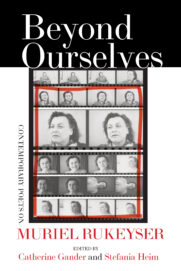
Critical appreciation of American poet Muriel Rukeyser (1913-1980) has waxed and waned for decades, but it is certainly having a moment now. The latest example of the renaissance underway is the recent publication of Beyond Ourselves: Contemporary Poets on Muriel Rukeyser (West Virginia University Press, $27.99). Editors Catherine Gander and Stefania Heim solicited other poets to write about the continuing influence of Rukeyser; the resulting collection features contributions from the editors as well as Daniel Borzutzky, Susan Briante, Stacy Hardy, Erika Meitner, Philip Metres, Jena Osman, Deborah Paredes, Khadijah Queen, and Nomi Stone, plus an afterword by Solmaz Sharif.
Through an innovative mix of long poems, serial poems, critical studies, lyric essays, and memoirs, the collection’s authors develop personal and studied responses to Rukeyser. They engage a wide range of her works, including her well-known poetry as well as her lesser-known biographies, children’s literature, musical theater, fiction, and documentary film. Their perceptive and often moving insights provide new lessons about both the possibilities and limits of contemporary social poetics grounded in formal experimentation, personal experience, and activist commitments—three hallmarks of Rukeyser’s extraordinary body of work.
Rukeyser scholar Eric Keenaghan conversed with Gander and Heim to explore a few of the aspects that make Beyond Ourselves an important addition to Rukeyser studies.
Stefania Heim has published two poetry collections, most recently HOUR BOOK (Ahsahta Press, 2019), and two translations of writings by the Italian metaphysical artist Giorgio de Chirico, most recently his posthumous novel Mr. Dudron (A Public Space Books, 2024). A former poetry editor at Boston Review and a founding editor of CIRCUMFERENCE: Poetry in Translation, Heim teaches literature at Western Washington University in Bellingham, WA.
Catherine Gander teaches modern and contemporary American literature at Maynooth University in Kildare, Ireland. Her book Muriel Rukeyser and Documentary: The Poetics of Connection (Edinburgh University Press, 2013) won the biennial book award of the Irish Association for American Studies; more recent scholarly publications include The Edinburgh Companion to Don DeLillo and the Arts (Edinburgh University Press, 2023). Also a poet, Gander is the author of Matches (Verve Poetry Press, 2024).
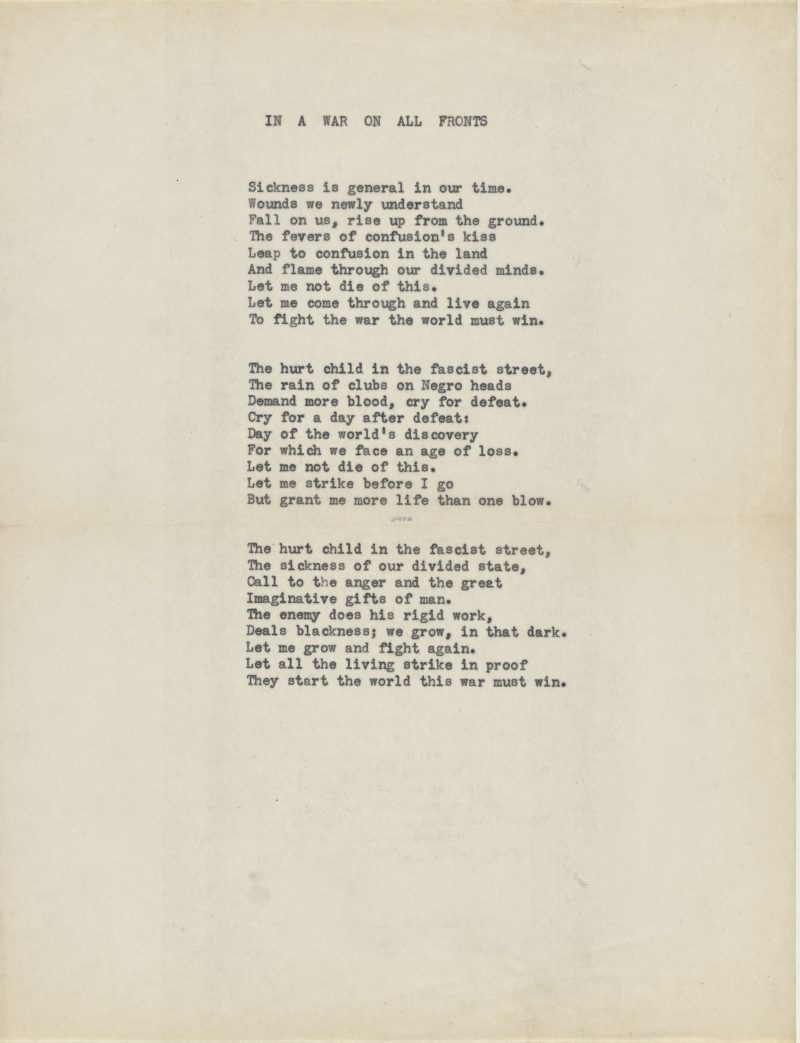
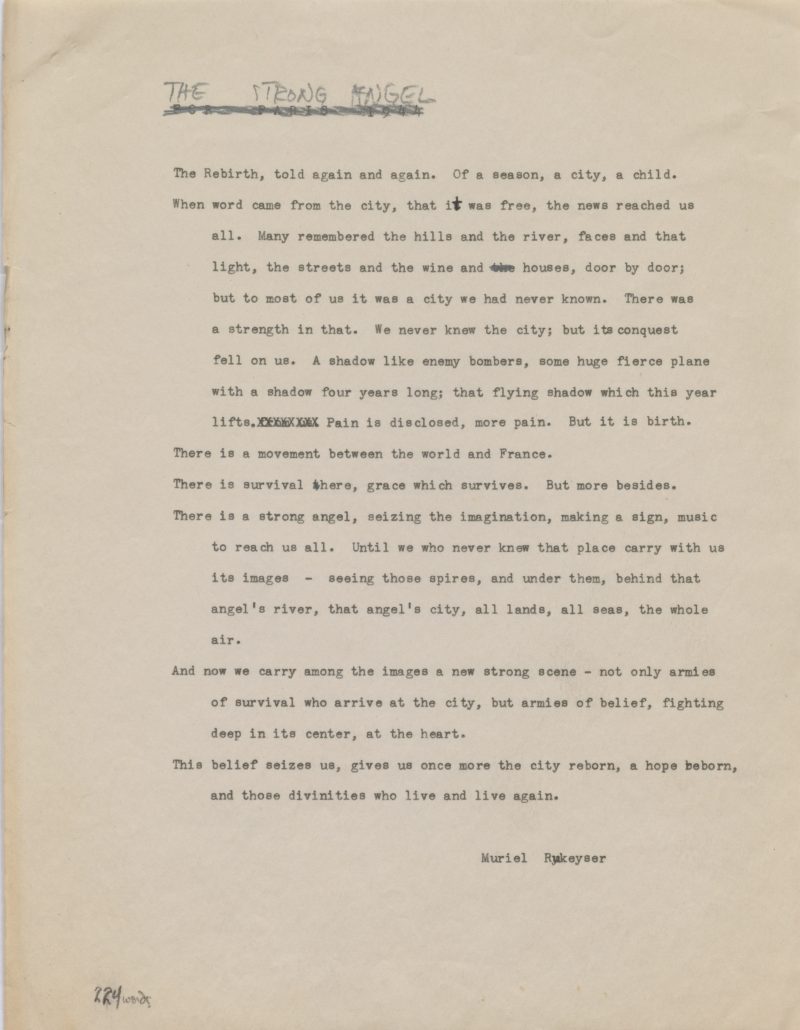
Eric Keenaghan, who teaches at the University at Albany, SUNY, is the author of Queering Cold War Poetry: Ethics of Vulnerability in Cuba and the United States (Ohio State University Press, 2009); with Rowena Kennedy-Epstein, he co-edited The Muriel Rukeyser Era: Selected Prose (Cornell University Press, 2023), a recipient of the MLA Prize for Bibliographical or Archival Scholarship. His forthcoming book, The Middle of the Air: A Critical Edition (Cornell University Press, 2027), recovers a previously unpublished antifascist play Rukeyser wrote in the 1940s. For more on poetry as antifascist cultural activism and the first publication of two poems from the 1940s which Rukeyser suppressed, “In a War on All Fronts” (c. 1943) and “The Strong Angel” (1944), see Keenaghan’s “Unburying History: Two Lost Antifascist Poems by Muriel Rukeyser” on the website Muriel Rukeyser: A Living Archive.
Eric Keenaghan: In her afterword for Beyond Ourselves, Solmaz Sharif movingly describes what first drew her to Muriel Rukeyser’s work, and it seems an attraction you and many of your collection’s contributors share too: “What I found in her was not unique to my own finding, but essential all the same: a poet who wrote of the material present in order to change it.” Why do you think it is “essential” to conceptualize poetry and other literature as vehicles or tools for social transformation today, and how do Rukeyser’s life and work in the twentieth century provide writers a unique and still-timely model for doing so?
Catherine Gander: What I love most about the line you pull from Solmaz’s deeply affecting afterword to the book is her description of the present as “material.” Our lived moment is not something in the abstract, but something real, alive, tangible. It is physical: it matters.
As we initially conceptualized the book, and then, as we came to assemble it, we knew Rukeyser’s approach to poetry was fundamental to our own understanding of how the various components of the book would come together—not as a self-contained, static arrangement of perspectives, but as Stefania beautifully phrased it in her essay for the volume, “a settling of the kaleidoscope,” a collection of parts that, like Rukeyser’s famous diagram of the dynamic relations within an artwork, from her poetics treatise The Life of Poetry (Current Books, 1949), “is false until all the components are shown in motion.”
Rukeyser, as you know, wrote and spoke often about poetry as a meeting-place: “Wherever it exists, it gives us a clue as to a possible kind of imagination with which to meet the world.” That kind of imagination, being motile, necessarily effects change. This is why she preferred the word “witness” to “reader”—because with its overtones of responsibility, it announces that, as Rukeyser writes in The Life of Poetry, “we are about to change, that work is being done on the self.” Rukeyser’s model is essential here, because she draws it from a model of physical science: poetry is the exchange of energy, and “exchange is creation.” What poetry and literature can produce, then, in her moment and in ours, is what Rukeyser calls an exchange of human consciousness: “the capacity to produce change from the existing conditions.”
In the poem from The Speed of Darkness (Random House, 1968) from which we took the title of our book, “Poem [I lived in the first century of world wars],” Rukeyser writes of the insanity that living in “the first century of world wars” can inflict. Her response is to “get to pen and paper.” The conditions that shaped that poem shape our century too. All this to say that your question is one I don’t think we will ever stop asking, and one as relevant today as it was then.
Stefania Heim: I’d like to build on this to grapple a bit more with that second part of your question, Eric, about how Rukeyser’s twentieth-century models remain unique and relevant. Her approaches to thinking about how poetry can be a force of change, a “resource” to be “used” beyond narrow aesthetic realms, are super various, in that truly interdisciplinary sense Catherine mentioned—and maybe even more importantly, they’re honest.
With “honest” I mean to get at something like not manicured, not tested or optimized. I want to foreground Rukeyser’s openness to––even courting of—risk and failure, which is something that many of the contributors to Beyond Ourselves notice and respond to in their pieces. I think often of the comments Rukeyser contributed to a 1945 anthology of war poetry (“War and Poetry,” reprinted in The Muriel Rukeyser Era), where she introduces a straw-poet who chastises her, “You bring the world in too much. Poems should not be written about the war. Are you not afraid of guessing wrong?” She responds simply, “I deny all of this.” Rukeyser understood poetry to be a vehicle both for approaching situations of tremendous complexity and for arriving at “the emotional meanings at every moment.” She eschewed easy or static answers as she eschewed orthodoxies. For Rukeyser, the straw-poet’s question is ridiculous because the consequences of not struggling to find the meanings are so much graver than trying with honesty, humility, and openness and getting it wrong.
At a time when we are experiencing existential crisis after existential crisis, when looking away feels sometimes like a relief, I think Rukeyser’s refusal to “put off” what is difficult, her insistence on looking unflinchingly at the world and at herself, and her commitment to “the truth of feeling” are part of what make her work essential and, as you put it, timely.
EK: Your characterization of Rukeyser’s work as built on honesty is provocative, Stefania. Such honesty grows out of her holistic response to her material conditions, including her body, emotions, intellectual ideas, and activist commitments. Making such a living poetic response, with her full self, is central to her continuing relevance, as you note, Catherine. In your introduction, you note that neither of you remembers exactly when the idea for Beyond Ourselves came about, but could you share how you identified poets who might respond to their moment in similarly honest ways as Rukeyser had to hers? What surprising revelations will readers discover in your collection through some of your contributors’ responses to Rukeyser, to present crises, or to poetry today?
SH: As we began to imagine the book and identify contributors, we reached out to writers we saw turning to Rukeyser in deep and surprising ways. A great example of a reference we encountered and followed up on was Khadijah Queen’s beautiful hybrid essay “False Dawn: a zuihitsu from the early months of the pandemic” (Harper’s Magazine, August 2020). Working in the zuihitsu form allowed Queen to move between facts, intimate musings, and miscellany as she explored modes for sustaining life—from a philodendron leaf to an aging mother and sick sister—amidst so much danger and fear. And interwoven among a “list of what [she] appreciate[s],” virus death tolls, and a trenchant examination of race and death was Muriel Rukeyser. In “False Dawn,” she reflects, “When I wrote that essay, about the value of studying Muriel Rukeyser even though, like Whitman and Melville . . . she operated from a baseline assumption of white supremacy, I meant to provide practical guidelines for analyzing older American literature . . . I meant to offer an alternative solution to throwing it all away.”
After reading the piece we immediately sent Queen an email, inviting her to build upon that “meant to” for our volume. Her essay for Beyond Ourselves—a reading of a wide range of Rukeyser’s works including her musical about legendary escape artist Harry Houdini (Houdini: A Musical, Paris Press, 2002), her children’s book More Night (Harper & Row, 1981), and her late book of poetry The Gates (McGraw-Hill, 1976)—rigorously and generously probes the effects, both positive and negative, of Rukeyser’s engagement with empathy, what Queen names her “open self.”
One thing I love most about our book is the way so many of the pieces use the occasion of writing to really think something through, to follow a question, some discomfort, the glimmer of an idea. I’m thinking too about Jena Osman’s confession in her essay on documentary, complicity, and critical consciousness about what is currently Rukeyser’s most famous work, “The Book of the Dead”: “For a long time, I wasn’t sure I liked the poem.” The confession makes it possible for Osman to interrogate the poem alongside Rukeyser’s short documentary film A Place to Live (1941) in a way that both honors and transcends discomfort, just as Osman’s grounding the essay in her daily commute insists upon a particular perspective, time, and space in order to both fully inhabit and move beyond that specificity.
CG: Yes! This impressed me, too. And it’s important, as Rukeyser becomes more visible to contemporary readers, that we do not ignore the more challenging or troubling aspects of her work alongside the wider difficulties of poetic positionality. Queen and Osman both advance these challenges as part of the necessity of thinking with Rukeyser to confront our current moment.
To address that second part of your question, Eric, it was a joy to be able to lift stylistic constraints in this book and allow contributors to work in whatever form they felt best fit the nature of their inquiry (another very Rukeyserian approach). What was revelatory at the outset was how this formal freedom enabled our contributors to really grapple with something—a difficulty, a fear, a frustration, a politics, even trauma—in a way that allowed both form and content to actively work as examples of what Rukeyser in The Life of Poetry called “usable truth.”
For example, we knew Philip Metres would have something important to say about Rukeyser’s legacy, but we weren’t prepared for his astonishingly open and vulnerable meditation on embodied poetics. Likewise, Erika Meitner’s essay visits her family history, in which the Holocaust looms large, at the same time as it wrestles with the vicissitudes of being a mother in a multiracial family in an increasingly racist country. Both draw on Rukeyser’s models of speaking with the whole self, out of silence. And then there’s the illustrated poem sequence “The Breathers” by Daniel Borzutzky and Stacy Hardy, which extends Rukeyser’s “politics of breath” into a poetic treatment of “the mere act of breathing as a form of political resistance” to ongoing colonial violences.
There’s much more to say here, including how contributors engaged with such a wide range of Rukeyser’s oeuvre, but I’ll conclude by noting that “revelation” is such a fitting word for Rukeyser, not only because it denotes the kind of exposure to light of hidden truth that one associates with her most famous works, but also because it involves a disclosure of the self to the self, by which process our denied and muted parts are examined and made speak. At root—and building on Stefania’s earlier point—revelation is a gesture of honesty, and it was this honesty that soon revealed itself as a kind of binding agent of the book.
EK: And Beyond Ourselves is full of revelations, and self-revelations. For me, some of the most paradigm-breaking ones are in moments like when Queen and Osman admit their skepticism about Rukeyser’s methods or acknowledge her limits, as you pointed out, Stefania. And then there is Metres’s incredible reading of her long poem “The Outer Banks” (1967), which you mentioned, Catherine, where he admires Rukeyser owning the softness of both her body and poetic form, usually devalued in a culture focused on hard bodies and poetic rigor. Such moments demonstrate how to keep a poet’s legacy alive by—not in spite of—avoiding hero worship and appreciating the unappreciated. To invoke another contributor, Deborah Paredez, it’s an anti-epic approach to an anti-epic writer.
For a poet who prioritized the future over the past, as Rukeyser did, it’s fitting to avoid such mythologizing. Such refusal reminds me of a line from “The Fear of Form: Third Elegy” from A Turning Wind (Viking Press, 1939), that I’ve been obsessing over: “The useable [sic] present starts my calendar.” Beyond Ourselves helps bring Rukeyser, her person and her work, more fully into our usable present. Do you have any parting words about the future possibilities you hope she can help readers discover when they reengage her, after reading your book?
CG: Thank you, Eric! That wonderful line brings us back to Rukeyser’s conviction that poetry’s imaginative response to the world disallows the postponement of its meanings. For while a key device of poetry is metaphor, the work it does is not metaphorical: as Rukeyser notes in The Life of Poetry, “our lives may rest on this; and our lives are our images.” The possibilities readers may discover in reengaging Rukeyser are as multiple as poetry’s possibilities to generate meaning. Stefania’s deceptively capacious essay for the book provides key insight here, not least because it enacts Rukeyser’s thinking with, through, and about poetry—how poetry allows us “to hold on to all the possibilities for what word and world might have to do with each other.” Those word-world relations might be ignited in ways that involve activism and communality—found in both Susan Briante’s and Nomi Stone’s pieces for the book, as they each appeal to Rukeyser to challenge the barriers and violences materialized by the language of othering.
Readers might discover, too, the prevalence of children in Rukeyser’s work. Again, her engagement here is not the transference of responsibility onto future generations, but attention to (among other things) how a child’s presentism is inseparable from their lack of fear—toward poetry, toward failure, toward “otherness.” Among the many human freedoms for which Rukeyser advocated was the freedom to choose our own ancestors; embedded in this, I think, is the implicit reminder—however corny this may sound—that we are all ancestors of the future.
SH: Threaded through this question, Catherine’s answer, and our book, is a concrete concern with how our present acts reverberate beyond their limits, temporal and otherwise. The simple but profound question of what we have to do with each other. How to make meaningful choices about actions whose effects we will not personally experience.
There’s a line from The Life of Poetry that shows up more than once in our introduction; in it, Rukeyser turns her gaze outward, asking, “You reading this book, who are you?” She is making direct contact with the future, invoking her readers as much more than her market. Her readers—we—become those who might take up the collective work she imagines. It belies an understanding of lineage that is predicated on something other than the raising up of individual genius.
A beloved mentor of mine, Joan Richardson, has a beautiful figure in her book Pragmatism and American Experience: An Introduction (Cambridge University Press, 2014) for this sort of ongoing and collective project of truth seeking. She points out that Charles Sanders Peirce’s term for continuity, “synechism,” comes from the Greek for “‘to have or hold together,’ as the activity of rowers on a bi- or trireme.” I love imagining that taking up of oars across time as, for example, Briante and Stone respond directly to Rukeyser, or Paredez, Borzutzky, and Hardy weave her words through their own. I guess my big hope for readers of Beyond Ourselves is that they may feel called, too, to climb aboard and join this work.
CG: To return to Solmaz Sharif’s galvanizing afterword: “It’s over . . . So let’s begin.”