Uncategorized

Arcana: A Stephen Jonas Reader

Stephen Jonas
Edited by Garrett Caples, Derek Fenner, David Rich, & Joseph Torra
City Lights ($21.95)

by Patrick James Dunagan

Arcana brings together the first major gathering of work by Stephen Jonas in over two decades. Jonas, a poet of Boston who died in 1970 at the age of 49, is an American original, as brilliant a wordsmith as any in what might best be termed the poetics of the New American vernacular. The intensity of Jonas’s poetry surprises and delights as his words burst across the page. He introduces a gay, gender-bending, street hustling voice into the Modernist tradition, deeply immersing his work in Ezra Pound’s use of collage in The Cantos while paying due diligence to the intricacies of William Carlos Williams’ poetics of the variable foot and the American idiom.

Like some other recent projects, this book offers an archival resurrection of what Gerrit Lansing rather infamously phrased, in his original introduction to Jonas’s Exercises For Ear (1968), as “an occult school” of Boston poetry. With Arcana, Lansing once again provides context for Jonas; an unpublished notebook entry of Lansing’s serves as epigraph, describing how “the old Boston vortex still swirls / thru the lives of us poets forever old forever young.” The poets of this 1950s vortex were Jonas, John Wieners, and Ed Marshall, along with mid-century drifters-in from out west, Jack Spicer and Robin Blaser. Lansing himself mingled in this vortex, of course, as did Ammiel Alcalay, who grew up literally at the feet of these poets, alongside magisterially larger than life figures such as Charles Olson, just north in Gloucester. Some of the editors of this book likewise came of age as poets under the tutelage of the same vortex.

Jonas is a figure who has often gone missed in discussions of his peers. He’s the outcast, the true outrider of this tradition who undeniably impacted the work of all those who surrounded him. His home provided a central gathering hub for poets from the 1950s through the 1960s, while also serving as a friendly crash pad for assorted associates trading in various illicit practices. Jonas himself was involved in some light fraud and petty crimes from time to time, but the driving force throughout his life was a passionate dedication to the poetic powers at work upon the page.

As John Wieners declares in his introduction to Jonas’s slim volume Transmutations (1965): “Here is Steve Jonas, here is the language he makes real, the city he lives by and that has died under his grasp, the gods he lives with, the poets he meets, and the men he has loved, and the painters, that are thrown in for good measure. Here is the poetry he makes come alive.” And Gerrit Lansing, once again from his introduction to Exercises For Ear, is spot on when claiming “it is a Boston lingo Jonas tunes up.” The poems frequently capture language straight from the streets, hip yet focused, nothing loose to it. Jonas remains in tight control, as in “The Music Master (after a Mozart divertimento)”:

“that’s it
for today, baby.”
Now he calls me “baby”.
This to be follow’d by
my dishy
sister’s voice:
“did-DENT you
make him
YET?” Hell noe
besides, he’s straight. Letz go
ovah to grease alley

Though at times some poems might at first appear sloppy or demonstrative of an uncared for free hand, Jonas’s grip is ever firm. He captures unmistakably living speech patterns drawing out exquisite musical forms imbedded in everyday sorts of spirited exchanges. As Wieners explains in a 1965 notebook entry published in Stars Seen in Person: Selected Journals of John Wieners (2015), echoing his statement cited above—the notebook was likely where he worked out his ideas for his introduction to Transmutations—it is

here in the order of Steve Jonas’ poems
that the orders are given.
And not in the poems, alone. But
by the life also.

Jonas offers palpable demonstration of how poetry should not be pushed aside or separated out from any other daily affair. The poems also provide an endless number of tutorials on how spacing a poem out upon the page should operate, where to break a line to get at the rhythm of what’s being said. In “Poem,” a 1959 culling from unpublished work, we see:

the excitement of their laughter
like leaves
moving together

to no other purpose
than this
that they move
laughingly

While in “One of Three Musicians,” Jonas compares his “first time” hearing Ornette Coleman perform to Picasso’s Three Musicians, describing how the painter’s imagery came alive for him under the influence of the sounds made by the jazzman:

They reproduce the spears, the screams
the outbursts of dark religious ex-
orcisms. These are not the
shoed peasant feet out of Brueghel’s
painting The Kermess, these are
bare black feet pounding
delta clay

Jonas did not balk at embracing the scorching blast of the seer’s oracular voice:

like an Egyptian mummy
whose guts have been excerpted
i tell you

there is a bourgeois
dullness
that settles plumb blank upon
the blobs of american cities
(from “Back O’town Blues”) 

The poem was where the world as lived in became transformed by powerful forces:

To separate elements
by introduction of
additional elements is to use
this opaque substance
we call reality
(from IV Orgasms/Dominations)

Jonas frequently celebrates the act of creating the work, recognizing the hazards and the splendor of the poetic calling he shared with his friends:

it is a Poet’s madness
driving him
willy nilly
howbeit to his own destruction
maskd or
metamorphosed into
some wondrous animal guise
centaur, unicorn or faun
repeat
my sweet will be twenty
on sunday next
so even to the birds
whose calls
the ancients invoked
& unabashedly coo’d
their canzones
to wit-a-woo
all of it i bring
again, my sweet, to you
in the spring-time of the Poem
(from “A Revel” for John Fusco)

The real treat offered up in Arcana is the inclusion of previously unpublished work. There is a small portfolio of singular poems as well as two private notebooks: One, relatively short, delves into alchemy, while the other is a “tarot diary” reproduced in facsimile on facing pages with the typescript. In the tarot notebook, Jonas appears to have recorded his own take on the cards while giving himself a tarot reading, yet it isn’t so much a reading regarding his person as it is of the cards themselves. Jonas describes the imagery on the card, along with offering his own impressions surrounding the root causes and concerns at work within humanity as he sees them reflected within the subject of the card. This results in some startling instances of insightful clarity, for instance:

Justice XI: exact, bilateral
equilibrium—Scales are symbolic of
equilibrium; of good and evil.
Also The Word of God—The enigma
is related to libra. Justice
is astrea. The Devil is the
product of human lies. Men
invented the Devil in order to
have justification for themselves—
to regard him as the cause
of wrongdoing.

Jonas has little time for either the superficial or artificial formalities of society. He is after the full rush of impassioned living. The connections which are made person-to-person in the heat of the moment. His poems are tender avowals of his commitment to those he loves:

Tony, your head is for
dark kisses; it is
the rear’d heads of stallions.
(from LXXIV Exercises For Ear)

These poems are for lovers as much as they are for hustlers, let alone poets themselves.


Click here to purchase this book
at your local independent bookstore
indiebound
Rain Taxi Online Edition Fall 2019 | © Rain Taxi, Inc. 2019

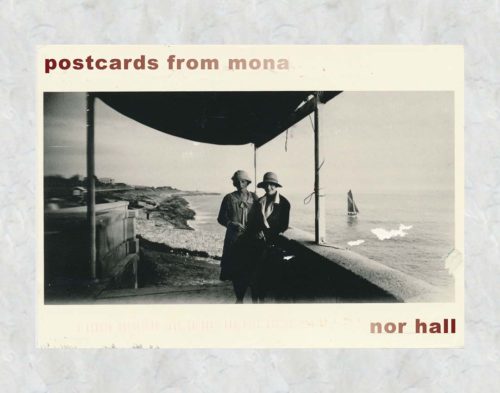
POSTCARDS FROM MONA

by Nor Hall

A selection of fifty-six postcards "from the plenum described by the philosopher Leibniz, a kind of a celestial earth space where all matter and movement come together," Postcards from Mona is a companion volume to Hall's earlier chapbook, Traces, a poem sequence published in 2010 by Rain Taxi. (For more on Traces, see here!) In these missives from various times and places written by "Mona" to her artistic collaborators at home, author and archetypal psychologist Nor Hall imagines history, myth, identity and more through the lens of a fascinating and timeless persona.

62 pages, perfect bound. Limited edition of 250 copies.
Published 2019.

$10 plus $4 S&H in the U.S.
For international shipping, please email orders [at] raintaxi [dot] com for an invoice including up-to-date shipping costs.

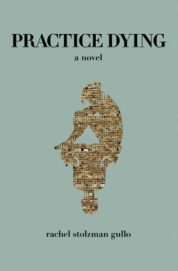
Practice Dying

Rachel Stolzman Gullo
Bink Books ($13.95)

by Andrew Draper

In the late 1980s, a young boy from the Upper West Side walks into the 92nd Street Y and meets the Dalai Lama, setting in motion a lifelong spiritual journey. Twenty years later, a young woman browsing the stacks of the Strand has a “meet cute” with an expatriate chef from India, who is taking a year to work in NYC for reasons that are initially hidden from her, and from the reader. These two encounters instigate the plot of Rachel Stolzman Gullo’s latest novel, Practice Dying, and they illustrate the way various forces (religious, political, cultural, economic) intersect, bringing people into collisions or convergences that shape their lives. The novel gets its momentum from people moving from their centers, with all their confusions and contradictions, but its depth is found in the awareness that our movements are shaped by forces larger than ourselves. It’s a delicate balance, but Gullo finds it, and with it the pleasures of a story where the characters have meaningful choices within a matrix of connectedness.

Practice Dying is about a pair of twins: David and Jamila. The first chapter is narrated by Jamila, just turning thirty, who works at a center for pregnant and parenting teens. With the next chapter, we transition to the point of view of David, who separated from the family somewhat dramatically as a teenager when he became a devotee of Tibetan Buddhism and a disciple of the Dalai Lama. As Jamila has a crisis of alienation, precipitated by a brief but passionate relationship with Salam, the chef, David is having his own crisis: sent away by the Dalai Lama to study in Tibet, he has arrived in Sichuan only to ignore his leader’s instructions, derailed by a desire for connection with a man who will not connect with him. The chapters continue to alternate the point of view. For the first third, whatever happens in New York City belongs to Jamila, and whatever happens in Tibet belongs to David. Once the twins are reunited and their lives begin to overlap, there are times when we see events that center around David from Jamila’s perspective and vice versa. It’s a structure that marries the predictable and the unpredictable nicely.

Gullo builds a story that explores the challenges of cultivating a life of wholeness when the only materials at hand, those we inherit from this world, are inevitably incomplete. This might mean trying to forge romantic and sexual intimacy with another person when our understanding of them is always partial, marked by fault lines and gaps. It might mean trying to follow a religious path, in which both the self and the tradition shaping it are subject to revised understandings. It’s fitting, then, that the novel is structured as a braid of two distinct but related narratives that are incomplete by themselves but together form a satisfying whole.

As Gullo has fictionalized him in Practice Dying, the Dalai Lama leads one to new places without any overbearing direction or coercive strong-arming. This seems to be true of Gullo as a writer as well. In both Practice Dying and her earlier novel, The Sign for Drowning, Gullo strives to communicate in a way that is never obscure but also free from tedious over-explanation; she is always opening up possibilities for understanding rather than closing them off. Clarity is paramount. In The Sign for Drowning, the narrator muses, “How do you tame or whittle or lure one memory into telling the truth? Show me how to look at a child without seeing another child, or its mother, or the place where she came from.” These words would make an equally good mission statement for Practice Dying, a novel that strives to see each person for who they are and the worlds they carry with them.


Click here to purchase this book
at your local independent bookstore
indiebound
Rain Taxi Online Edition Fall 2019 | © Rain Taxi, Inc. 2019

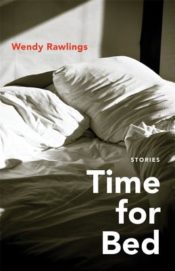
Time For Bed

Wendy Rawlings
Louisiana State University Press ($24.95)

by Hugh Sheehy

For many readers, the title of Wendy Rawlings’s new story collection will conjure contradictory sensations. Time for Bed calls to mind the dark and impenetrable wall at the end of a child’s day as well as the start of the brief reprieve parents have once the little ones are down for the night. It signals the relief of putting off one’s responsibilities until tomorrow as much as the sometimes-overlooked importance of scheduling in one’s circadian rhythms. It reminds us that we spend about a third of life in a state sufficiently deathlike, that sleeping is an activity that can be done only through surrender, and that in dreaming we live second, secondary lives only a little less unknown to us than to those intimates we deign, from time to time, to tell about them.

It is appropriate then that the stories in this collection offer such a rich study in powerful contradictions. Grief brings with it the pleasures of remembering, and it is heightened by the pleasure of connecting with others who grieve. A sense of repulsion can be a helpful companion to lust. Eating is most satisfying when the hunger that drives it hurts. The best laughter is slightly horrified. And so on.

These are themes often located in the territory of lyrical fiction. As everybody knows, “lyrical fiction” is a way of saying “fiction written in poetic sentences”; as we don’t say often enough, it also means a kind of writing aimed at creating the effect of resonance or longing. Rawlings has been established now as a lyrical writer for some time. Her previous books Come Back Irish and The Agnostics evince a devotion to the clear image and the sharp line, and they evoke a profound regard for the poignancy of living and dying. Reading these books, it can be tempting to associate Rawlings with the larger project of lyrical realism.

In Time for Bed, however, Rawlings moves in a new direction even as she relies on her considerable strengths as a crafter of sentences and images and moments. She does this by writing in comic, satiric, and even absurdist modes, which are kinds of writing that work through the production of dissonant effects. The result of this formal experimentation—of mixing the lyrical with the dissonant—is the creation of uncanny or ambiguous textures that feel true to the experience of living in 21st-century America.

At their best, these volatile cocktails deliver stories that recall the fiction of Anton Chekhov. In “Restraint,” a young law student gives herself to her passionate desire for a Vietnam veteran “older than her father,” a desire she acknowledges “is not simple”; her lust for his aged yet virile body is rooted in his identity and history as a killer. At one point, she fantasizes about him murdering her and disposing of the evidence. Later, the protagonist observes—both ironically and soberly—that “her labia are swelling over a relic.” From a lesser writer, these details would give way to gimmickry, and the story would devolve into an obnoxious exercise in erotic rubbernecking. For Rawlings, though, these features turn up and slip away in the wave of overwhelming love that carries these characters to the story’s closing pages, which manage to be beautiful, hilarious, ironic, and tragic.

Rawlings’s ability to mix the lyrical with the comic and satirical serves her exceptionally well when she writes about love and desire, and she’s able to explore the ways they simultaneously cause pleasure and pain at a variety of levels. In “Tics,” narrated from the point of view of a young woman who’s having an affair with her seventeen-year-old stepbrother, the agony of romantic experience plays out entirely in the narrator’s conflicted voice:

After we eat, we make love in the shower, where he soaps my shoulders and breasts and between my legs. “You have a nice body,” he says, as if this is a fact he’s simply reporting. No man has ever told me I have a nice body. The sex has turned me inside out, sex with a seventeen-year-old more tender and honest than sex with men my own age or even men much older. The man I dated most recently, a classical composer, was too caught up in his work to pay much attention to me. I realize Glen can give me his attention because his only responsibility is high school, which he hates.

In the collection’s most ambitious stories, Rawlings takes on absurdist conceits, raising difficult formal and aesthetic questions as she works to deliver the satisfactions readers expect from short stories. In these instances, the endings function less like conventional resolutions than like punchlines that provoke a reader to think. “BodSwapTM with Moses” posits a world where overweight white Americans rent the fitter bodies of people of color from poorer parts of the world. There are obvious risks here, and the destabilizing results of Rawlings’s frank narration are as incisive as they are surprisingly sweet. In “Again,” a young woman literally reenters her mother’s womb, not for any of the trite reasons the dime-store psychoanalyst in each of us reaches for automatically, but rather because she hopes to salve her boomer parents’ disappointments about the way their lives have turned out. In the end, her well-intended gesture simply manifests what younger readers will recognize as their everyday anxiety.

Fiction, and especially the short story, can respond to the feelings of distortion and emptiness that haunt so much of modern life. What can fiction tell us about an America where a significant chunk of the population has grown hateful and disgruntled despite enjoying the most luxurious standards of living the world has seen? How can we write or speak about beauty in a culture that often delights in its own absurdity and ugliness? I am not sure we can hope to do better than Naomi, the devastated and disoriented protagonist of “Coffins for Kids!,” who travels to the NRA headquarters after a mass shooter kills her third-grader and finds that her tragic story only reinforces the beliefs of the gun-lovers she meets. But maybe that is asking too much from art. In modern parlance, the phrase “preaching to the choir” suggests that attempts to communicate are futile, but the easy cynicism of this figure of speech disregards the temporal dimension of religious practice: The choir needs to hear the preacher (a truth not lost, incidentally, on those who fund and run the robust messaging apparatuses of American conservatism).

At any rate, the short story continues to supply companionship for the reader who seeks it. One would be well-rewarded to accept what Rawlings offers with Time for Bed.


Click here to purchase this book
at your local independent bookstore
indiebound
Rain Taxi Online Edition Fall 2019 | © Rain Taxi, Inc. 2019

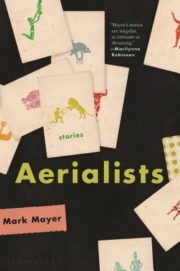
Aerialists

Mark Mayer
Bloomsbury Publishing ($26)

by Nick Hilbourn

The short stories in Mark Mayer’s Aerialists are epicenters of rituals and patterns. Characters ruggedly assemble themselves in the space of his stories, appropriating whatever matter is around to fill themselves out. In “The Wilderness Act,” for example, a lonely bachelor seeks to draw a lover back to his house through a weekly ritual that seems more akin to the consecration of a religious space: “He stacked firewood on a few sheets of newspaper by the stove and vacuumed the living room carpet till it stood tall; he cooked a soup or a curry, something aromatic, as if she would find her way by smell.” The lover never returns, but he doesn’t stop performing the ritual. The act of performing it is what matters the most. The meaning behind it is secondary.

This is something Mayer struggles with: how much should the writer compel his universe to convey clear and coherent meaning? “I try to remind myself it’s never my job,” he noted in an interview with The Paris Review, “to summarize or conceptualize experiences, neither my characters’ nor my readers’. If I feel like I really understand what an event means for them, then I’m probably not living it deeply, since it’s not like I go around fully understanding what the events of my life mean.” His stories have an earthy fullness to them as if they sprout in the moment they’re read: an ecosystem of narratives that don’t fit into the spaces carved out for them on the page. Yet, there is something beautiful and heartbreaking about the strange shapes they form. Mayer, who speaks without guile about craft discussion, admits “I start with whatever I’ve got, scrap materials . . . No stage of writing comes easily to me, and nothing that worked once necessarily works twice, so I’ll start with whatever I have.”

The stories in Mayer’s collection awkwardly brush up against each other, but no matter the content, they share a contempt for ending. In “Strongwoman,” Rico, a young son of divorce who has expressed exasperation with the hidden argot of relationships, watches in dismay an indecipherable exchange between his mother and an ex-lover/friend: “I could hear my mom, at the opposite edge of the house, cackling on her own phone . . . I let go and lay back on my bed and stared between my stupid stars. ‘I told you!’ my mom was roaring. ‘Too many is too many!’ I listened hard, but I couldn’t tell what she was laughing about.” The act of “letting go” is the conclusion Mayer’s characters come to, but the one thing they are unable to do. Instead, they create spaces where the antagonists of time and change do not exist. Rituals, patterns, and fantastical spaces and languages allow some control over the uncontrollable by briefly incapsulating it and reinterpreting it; letting go is not an issue when the world is contained within a static, insular frame. In “Solidarity Forever,” for example, mathematics becomes a higher form of understanding the everyday. A young boy draws geometric patterns to imprison the circumstances of his life so he can explain them and interpret them, while his uncle sits in the basement reducing world events to mathematical formulas. At the end of the story, both characters stand by the window of a seventh-story apartment, admitting failure but refusing change. The uncle implores his nephew to have children, to continue a pattern that will promise answers they both know are not coming.

In the title story, a young man on the verge of heading to the Navy helps a blind widow piece the town together using aerial photos. With the photos, time and change momentarily halt for him, but this illusion eventually falters, and time breaks through. There is no clean acceptance of this. Many characters, like Corbin, are reluctant to proceed at the end of the story: “‘Corbin, we gotta move it,’ [Mom]’s shouting. I stood right here with the garden hose . . . I wrapped it around my arm and held on as tight as I could . . . And when I couldn’t float up—when I just stood there, beating my heart, my feet stuck to wherever there was to lose—I still squeezed rubber in my fists. ‘Please,’ Mom’s shouting, ‘let’s go.’” Heartbreak comes with the bitter realization that rituals, despite their impotence, are the only item they can keep. The narrative becomes secondary to the religious will of its characters, which continues after the story’s denouement. As a result, Mayer’s stories layer over each other like palimpsests. Hope becomes an end in-itself and characters suspect what Michael Parsons realizes near the conclusion of “The Ringmaster”: that they are “small things in a world too vast to occupy.” Because occupation implies stasis and stasis is a kind of death, they look to an imagined future just out of reach.


Click here to purchase this book
at your local independent bookstore
indiebound
Rain Taxi Online Edition Fall 2019 | © Rain Taxi, Inc. 2019

JOHN FREEMAN

Wednesday, November 20, 7:00 pm
Magers & Quinn Booksellers
3038 Hennepin Ave, Minneapolis
FREE AND OPEN TO THE PUBLIC!

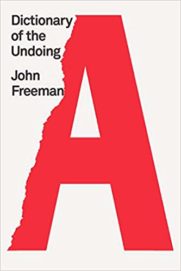
Join us as John Freeman — literary critic, editor, poet, and “one of the preeminent book people of our time” (Dave Eggers) — presents his latest work, Dictionary of the Undoing, a suite of incisive, poetic essays about the current political moment. From A to Z, Freeman has chosen potent words to build a case for their renewed power and authority, each word building on the last.

At this Minneapolis event, Freeman will be joined by local writer-activists including Wang Ping, David Mura, Chris Martin, and Hawona Sullivan Janzen for a discussion about how we can redefine what it means to be a literary citizen.

Praise for Dictionary of the Undoing

“John Freeman has created a work of both artistry and activism in Dictionary of the Undoing, a lexicon of what should matter from A to Z—a complex and nuanced rebirthing of words that have been worn away by the strife and noise of this era.”
—Walter Mosley

“All [of John Freeman’s] projects feel like an invitation to enter into a polyphonic, multi-voiced conversation with other minds. Dictionary of the Undoing is no different. It is a book that makes you think, then rethink. It invites you to engage with it, to refute it, to contribute to it.”
—Valeria Luiselli

"How to be good in bad times? How to speak truth? Why read? Why write? Why bother? It is a symptom of our ongoing catastrophe that such questions must be asked, but we’re lucky that John Freeman is out there looking for some answers. Language is Freeman’s primary concern, because that’s where our struggle begins and ends, and he sets out to reclaim it and restore what was damaged by an onslaught of evil and idiocy. One day you might be asked what you were reading in 2019, when everything seemed to be coming apart, and you’re going to want to say: John Freeman’s Dictionary of the Undoing.”
— Aleksandar Hemon

“Freeman offers an alphabet of hope and action in this spare, eloquent meditation on injustice . . . A protest, a poem, and a plea, Freeman’s utterly original manifesto is a pocket manual for informed political dissent and a must-read for all thinking citizens.”
Publishers Weekly (starred review)

ABOUT THE AUTHOR

John Freeman is the editor of Freeman's, a literary annual of new writing. His books include How to Read a Novelist and The Tyranny of E-mail, as well as Tales of Two Americas, an anthology of new writing about inequality in the U.S. today. Maps, his debut collection of poems, was published in 2017. His work has been translated into more than twenty languages and has appeared in The New Yorker, The Paris Review, and The New York Times. The former editor of Granta and one-time president of the National Book Critics Circle, he is currently Artist-in-Residence at New York University.

Unspeakable:
A Conversation between
Michelle Lewis and Jeffrey Morgan

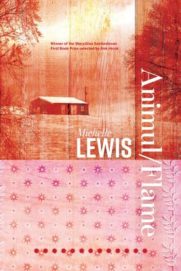
After twenty-five years of publishing its print journal, Conduit Books & Ephemera launched a book publishing division in 2018. It did so with two book prizes for poetry: the Marystina Santiestevan First Book Prize, judged by Bob Hicok, and the Minds On Fire Open Book Prize, judged by Conduit’s editorial board. In the following piece, the authors of the winning books, Michelle Lewis (for Animul/Flame, $16) and Jeffrey Morgan (for The Last Note Becomes Its Listener, $16), interview each other about the unique experiences that shaped their books and the challenges of translating inexpressible moments into language.


Michelle Lewis: Hi Jeff. First, a belated congratulations on winning the Minds On Fire Open Book Prize. I am thrilled about The Last Note Becomes Its Listener. It has given me enormous pleasure to read, and it has made me aware that you are a careful and immensely competent poem-maker. It is also a book that dives headlong into a certain kind of beauty (such a difficult word for a poet) that I am always chasing. I am so pleased to be your press-mate; it enhances my profile, among other things.
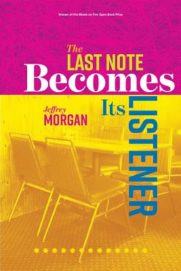
Jeffrey Morgan: Hi Michelle. Congratulations to you for an amazing book and for winning the Marystina Santiestevan First Book Prize. Bob Hicok is a poetry hero of mine, so knowing he chose Animul/Flame predisposed me to an affection for it, which reading it only enhanced. The opacity that rewards, the traveling and returning, the running away and towards; I was transfixed and read it straight through quickly the first time. Like most good books, subsequently reading it again more slowly revealed myriad pleasures and intricacies of language, loss, and mystery.

ML: I appreciate the kind words. As for The Last Note Becomes Its Listener, as the title puts forth, this book is very much like a note resolving, and I realized as I was reading it that there is an integration being fought for within these poems. There are many opposing forces at play—illness and remedy, brother and brother, calmness and chaos, player and listener, among others. There is also a sense that the book is sipping from the well of the surreal, which occurs to me has been described as a “machine for integration” for how it places diverse elements in concert. We’ve talked a little offline about voice and tone in our work and it’s no accident that tone, a poetic concept that derives from music, is one of the driving forces of these poems as the poet struggles to find harmony among inimical elements. As that struggle becomes apparent to the reader, there is a surge of both joy and disquiet. I wonder if you could tell me what your musical heritage is and what dualisms you felt you were balancing in this book?

JM: Thanks for your thoughtful question. My brother and I grew up playing music. I play the cello and my brother is a violinist. Our mother is a violist and started us on instruments when we were both four. I learned to play music before I could read it (and before I could read anything, really), and I think that has informed my relationship to sound in poetry. The music of language is very important to me, but I also find that the kind of taut, dense syntax that I often enjoy in other people’s verse is not something I practice. I like to write in long lines and long phrasings, and I sort of shy away from pre-determined meters and syllabic compression.

In terms of the book’s dualisms, as you say, there’s the notion that I’m writing about my disabled brother coming to live with us (my wife, our daughter, and me), but, no, I’m really writing about myself. When my brother got encephalitis at eleven, he almost died. After he recovered, he was not the same person. Prior to that, we were remarkably similar, even from a physical perspective—to this day people often ask us if we’re twins, despite the fact that I’m almost seven years older. Music saved my brother because it was one of the only parts of his brain that wasn’t especially affected by his illness, brain scarring, and subsequent epilepsy. Being a violinist is a fundamental part of his identity. It’s also perhaps the only way we relate to each other that is more or less the same as it has always been. All the other dualisms that you mention (and certainly more) stem from there.

The other aspect of this worth mentioning is that my brother has very little short-term memory. If you’ve ever seen Christopher Nolan’s Memento, my brother is a bit like that. He’s often unable to access short-term memories due to scarring on his hippocampus. However, through repetition (as with music) he can turn short-term memory into long-term memory and access it. It’s an interesting situation to say the least, and some of the fundamental obsessions of a writer, memory and identity, are daily practical questions in our household.

ML: What a fascinating backstory to this book and to what informs your daily life, Jeff. Your poetic line and its relationship to music gives me the opportunity to mention how much I admire the formal aspects of your work: the phrasing, the avoidance of compression. The beginning of one of the “Translation” poems, for example, begins with a complex sentence structure, heavy with clauses:

What I love about St. Sebastian is not the colander

the arrows made of his body,

or how he is always shown riddled and tied

to a column, which I should be able to identify

as Doric, Ionic, or Corinthian—

possibly the most pedantic and predictable question

on any art history exam. No. What I love about St. Sebastian . . .

It’s very Shakespearean, and I don’t want to start up that comparison (will an alarm sound), but I keep thinking of the tautology of Polonius’ speeches, for example, and how they are knowing and witty and push seemingly too far on a concept and how that is an important part of his expression. I guess I mention that because as you allude to, that can be wanting in more disciplined forms.

On another note, I have some understanding of what it takes to have a person who has significant challenges in the family and I know that part of that experience is living simultaneously with the ridiculous and the heartbreaking. I see so much of this in your work. The speaker has an acute knowledge that he is a speck on a spinning rock, a natural defense mechanism to pain and chaos, and joins forces with the reader in the wonder of that. It makes so much sense that you would come by this quality honestly. I’m thinking of how these poems grapple with meaning in real time—is that tree a poplar or not (an interjection in one of your poems)? It creates the sense of a joint venture. It is very communal, very inside. For instance, when the speaker observes a breeze that “moves the glistening mane of a willow like jewels around the neck of a woman nodding off,” the joy of that metaphor is in its being stretched. It’s wise and cagey and knowing. I see the affinity with Hicok immediately, a poet that is similarly self-aware, whose poems address ordinary life but end up inevitably touching the sky.
JM: I’m very interested in voice in poetry. I think that accounts for the long lines and my resisting of compression in The Last Note Becomes Its Listener—I’m a long-winded guy. Of course, the voice is more stylized and philosophical than my own. I like the notion of soliloquy that you imply; I think that’s often what I’m trying to do when I write.

In terms of Animul/Flame, it strikes me that the book is at times almost an epistolary, one side of a conversation about loss that is sometimes direct address, sometimes not. There’s a quality of eavesdropping that I love because what’s true about good poems is their ability to precisely describe the unknowable. I’m wondering what you can tell me about the opacity and the rewards of the speaker’s shifting conversation. How did writing this book reveal itself to you, and how did you manage to make such a fractured thing cohere so well? I’m a bit in awe of the balance this book achieves.

ML: I’m glad you found there was an internal coherence to the book. You bring up some things that I struggled with a lot—like why Rivulet poems were alongside the Animul poems, for instance, and what some poems in the chronology had to do with the others. I knew intuitively what the connective tissue was, but to make those teeth sort of interlock for the reader meant doing some difficult work, some of which was external and some internal. Sometimes it meant making some clear assertions about those connections that were uncomfortable to make. Prior to this book, I had been giving myself a lot of linguistic escape hatches so I didn’t have to commit to a single truth—you could see it in my metaphors, even, which would often have two vehicles for one tenor. With some help and anguish, I got to a point where the opacity you mention was not obscurity—I can defend any line in the book, for example, which is significant for me.

Thinking of the book as an epistolary where sometimes there is someone on the other end and sometimes not seems like a very lovely way to think about the poems. It strikes me that returning over and over to that form of address was one way of plugging one of those escape hatches—something real must be expressed if you’re going to the lengths to put pen to paper and address some other.

It’s interesting you mention this sort of tensile strength that holds a book together and how to negotiate that balance—how much can that connective tissue be stretched until it feels light and airy enough to fit one’s sensibility but doesn’t shatter into pieces? It feels very related to the tension I sense in how you balance dualities in The Last Note Becomes Its Listener.

JM: I wonder if you might also talk about voice in your own work. The speaker in Animul/Flame has a self-awareness, almost as if trying to piece together a telling. In the title poem, you write:

I was Flame, a fig wasp hunched in her own
sky. Sunrise tasted of red gums and spittle.

I stood at the bars of night, kneed
the floor, thought that would dismantle it.

Like the recitation of a lot of good stories, there is a tension between trying to make the thing cohere and trying to relay its wildness. The good ones don’t quite obey the storyteller. The pronoun “it” weighs heavy there, perhaps a placeholder for what is not quite knowable or expressible that exists at the center of this story. How do you see the speaker and the speaking in this book, particularly in terms of what is ultimately inexpressible?

ML: I like “piece together a telling”—that summarizes the book accurately to me! The “I” has a journey in this book. I enjoyed playing with the idea of who the “I” is and what the “I’s” identity is, and then questioning that. The “I” is often labeled with being Flame, for example, and there are many characteristics about a flame you can choose from: it’s changeable, susceptible to currents, extinguishable, easily lost or subsumed. But I like to think that there is a reclaiming of the connotations of this label for this “I.” Things like persistence, of being a source, etc. Also, the “I” has truths that change, and I love that about poetry—that it allows the poet to make assertions and commit to them in the isolated moment of the poem.

The idea about speaking the inexpressible is something I was thinking about recently because I just took the Myers-Briggs personality test and found I was an INTJ. It was a little surprising that this is not the type associated with the poet/philosopher career path until I realized that is a fundamental misunderstanding of poetry making—that it is someone engaged in dreamily watching a butterfly. It is much more mathematical than that. The poet is dealing with formal concerns, the intersection of meter, lineation, tone—a lot of data; it’s perfect for data-brain. Anyway, to your point, one of the traits of that the INTJ is that they have trouble explaining concepts to people because they feel like if you can’t brain-meld with me on this concept, forget it, I can’t explain it to you in language. So they shut down, sometimes making communication difficult. That really struck me as a characteristic of mine, and I think that’s what writing poetry can be for me and probably many poets. It’s the result of a desire to zap a current through that complex, fraught, difficult stuff to create a more effective route to expression, one with different rules that will get your closer than the old rules can. Non-poetry readers find this kind of poetry confusing, whereas readers of contemporary poetry sink into it and get a flush of understanding.

In fact, I suspect one of the techniques you’re using to this end in your book is the “Translation” poems. There are thirteen poems titled “Translation.” In them, the poet serves as a type of portal to the ineffable or the misunderstood, or as a broker between the terrestrial world and a world beyond that. But some poems are the inverse, as well, where the poem can be a decoder ring for overwhelming, languageless moments. I love that this “translation” moves fluidly across this sort of blood-brain barrier. It provides such gorgeous, existential moments. What was your intention for these poems? What indicated to you that a poem was destined to be a “Translation” poem?

JM: Hmm, I don’t know what the Myers-Briggs personality test would have to say about a person who didn’t even know there were thirteen of the “Translation” poems in his book, but that’s me apparently. It now makes me think of them in a “thirteen ways of looking” sort of way. Despite my ignorance, I do actually have a theory/methodology for what became a “Translation.” I think of them as me retelling a memory through the lens of that memory’s questionable veracity (because all memory is sketchier than we like to admit), while at the same time acknowledging the memory’s importance in contributing to self-identity. In other words, the “Translation” poems are me puzzling through how I think about complicated aspects of memory and identity. Often they involve/star my brother, but they are not about him as I see it. Rather, they are about me trying to figure out a little bit of who I am. “Translation” as a title was something that came to me as a shorthand for all these things. Within the “Translation” poems I was also able to provide a narrative spine for the book as they function more or less chronologically (with some asides in there for good measure).

All of this reminds me that I want to ask about your “first book process.” First books are this thing that people always talk about in poetryland. Did you think of Animul/Flame in terms of it being a first book, or does that sort of thinking not enter into it? And as a follow up question, do you think of your poetry writing to come differently in the wake of this publication milestone? Do you have the urge to keep writing as you always have, or do you feel the urge to do something “different”? I’m very interested in these questions as I struggle with versions of them myself.

ML: I’m so glad to hear that about the “Translation” poems (you have an undiagnosed triskaidekamania!) and to now read those poems with this in mind. There is something so freeing about this idea of course correcting a memory—Emerson says, “Poets are liberating gods,” and these feel liberating. I can see that wonderful uncertainty, the recalibration, and the digressions that open up to questions. You write, “Thank goodness // for the very dark beers // that pour like night, smell of coal smoke // and once inside us smolder, the process // like a fire in reverse.” Thank goodness indeed!

To your question, at the point of writing Animul/Flame (I had no indication this would be a first book, nor that any of these poems would be published—this has all been a crazy dream for me), I very much felt I was disconnected—also released—from any kind of literary establishment or community; it was sort of like I was putting in the time, why not do it my way, I have nothing to lose. I let go of some of the old workshops saws I was steeped in for decades, stop wondering who might read these poems and what they would think. Then it materialized, and it certainly wasn’t a book until it was—slowly at first, and then all at once, I suppose. Then it had a life of its own. I have recently completed a new book that digs into some topics of class and family that feels similarly dangerous but in a different way, and it’s actually lyric prose with research woven in, so I guess, yes, I did have the urge to do something poetically different! The desire to leave the Animul/Flame characters behind at least in the forms they were in was very powerful.

Tell me about this in terms of your struggle, as you mention. I will say that I read Crying Shame, which came out from BlazeVox in 2011, with delight. That book has this most recent book’s DNA for sure. It also feels very much to me like The Last Note Becomes Its Listener took some of the pulp of Crying Shame and just wrung it out. The Last Note Becomes Its Listener is a very realized version of Crying Shame, I might argue. I can only admire and hope for a publishing trajectory like this, though I don’t know if that’s how you feel about it, especially in terms of what you are doing now.

JM: I’m sort of happily “project-less” at the moment. Both Crying Shame and The Last Note Becomes Its Listener just came from writing a lot of poems before understanding there was a direction. I’m generally more interested in writing a poem than writing a book of poetry, at least for a time. I do like writing personae poems. They can be a little risky in terms of subjectivity, who gets to speak for whom, etc., but I write them anyway, and there’s more or less a pile of them sitting around at this point. What’s recently been hard for me is getting out of writing “Translations” as a mode/process. I had the same problem with continuing to write letter poems after Crying Shame was published. I’m not sure why I should stop, but it feels like time to do something else. Probably it doesn’t matter. The poetry changes but the obsessions stay the same.

Your new manuscript sounds really interesting. Lyric prose with research, issues of class, etc. That sounds like it might be sympathetic with work by Mark Nowak, Brenda Coultas, C.S. Giscombe, and Alice Notley—four of my favorite writers. I’d love to hear more about that if you wouldn’t mind expounding a bit.

ML: Yes, you’re on my wavelength there, but I need to dive in to C.S. Giscombe, so thanks for that. The form for Spare, this new book, came in part from reading Maggie Nelson and Claudia Rankine; C.D. Wright was also a huge influence. It’s something I’m very excited about; it attempts to explore issues surrounding class and marginalized populations, as I mentioned, and struggles with personal/social accountability through the prism of my own slice of the world. There are formally diverse sections that layer and create a momentum that I hope works to speak to these complex themes in a way straight language that we have at our disposal cannot, to sort of bring it back to our initial discussion. I’m licking the envelope to send it to you right now—kidding! I know we have to wrap, but were there particular writers hanging over your shoulder when you wrote your book, or are there now, maybe more so now that you are not mono focused on a book project?

JM: Please, send me the manuscript! I would love to read it. Hmm, how to answer the anxiety of influence question. I think the honest answer to this question and the answer I want to give are slightly different, so I’m struggling with that. I’ll go with the truth. I’m currently most influenced/delighted by writers who have a persuasive voice in their work. Bob Hicok (who wisely chose your book for publication), Alice Notley, Gabrielle Calvocoressi, Erica Hunt, and John Ashbery all come immediately to mind. But also, if I’m being honest, I tend to fall in love with individual poems. At the moment, my favorite John Ashbery poem is “Daffy Duck in Hollywood.” It’s a silly poem that is also profound. I want to write poems like that, but if that’s not possible I just want to write poems.

ML: I want that for you and for the rest of us who can read them, Jeff! What a perfect way to end our conversation. I’m so pleased to have had the chance to learn more about your book and life. Congratulations again on this well-deserved prize.

JM: Congratulations to you too, Michelle. Animul/Flame is a fantastic debut! It’s such a pleasure to be your press-mate.


Click here to purchase Animul/Flame
at your local independent bookstore
indiebound
Click here to purchase The Last Note Becomes Its Listener
at your local independent bookstore

indiebound
Rain Taxi Online Edition Fall 2019 | © Rain Taxi, Inc. 2019

Mea Roma:
A Meditative Sampling
from M. Valerius Martialis

M. Valerius Martialis
translated by Art Beck
Shearsman Books ($17)

by Paul Vangelisti

In a recent essay on translation, “The Latin Epigram: Brevity, Levity and Grief,” Art Beck suggests that what defines the Roman masters of the epigram is their remarkable blending of the aphoristic and the elegiac. He insists that the more ample range of feeling found in the shorter Latin poems is what sets them apart from the noteworthy English tradition of the 18th century epigram.

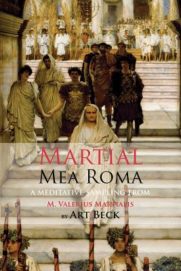
In Beck’s new Martial compilation, Mea Roma, this critical understanding of Roman elegiac verse couldn’t be more in evidence. The translator’s selection, as Beck writes in the preface to Mea Roma, “becomes in itself an aesthetic of translation,” presenting some 140 poems, of varying lengths (from two to twenty lines), out of a canon of nearly 1,500 short poems. Beck presents his selection bilingually—a vital feature of the book—to serve as a starting point for a reader unacquainted with this remarkably quirky classic, or who has been only marginally exposed to some of Martial’s more notorious verses.

What immediately comes across from Beck’s renderings of Martial is the subtlety with which the Latin poet employs everyday speech. These epigrams are so much more than displays of an acerbic, sometimes obscene wit, as all too often has been the portrayal of Martial. Let’s consider a few of the translations to underline the remarkable effect Martial is able to glean from the quotidian, as well as the sensitivity and vigor of Beck’s English versions.

It might be interesting to look at the elegies on the death of the child Martial calls Erotion, a six-year-old slave girl, for whom the poet composes three very different versions of his lament. I quote the three in their entirety to emphasize the sensitivity and profound caring found in the poet’s approach, qualities that for some readers might be rather unexpected. The first, “Book V, 34,” is a graceful and poignant farewell meant to accompany Erotion’s little shade to the underworld, commending her to his deceased parents, the “old guardians” of his own childhood:

Father Fronto, mother Flaccilla, protect this child
who was my lips’ delight. Don’t let the darkness
and the snapping mouths of Tartarus’ monstrous
hound panic Erotion’s shivering little shade.
She almost survived her sixth chilly winter.
She lived just that many days too few.
Let her play and work her mischief on you, old
guardians, and chatter away and garble my name.
Soft grass gently cover these gentle bones. Please,
earth, rest as lightly on her as she scampered over you.

The second version is a much less conventional farewell, bound up with the social context of the poet’s time, wherein one of Martial’s friends questions the poet’s grief. However beautiful and ingratiating a child Erotion might have been, she was, after all, according to the conventional wisdom of the time, just “a little house slave.” When a friend reminds him of Erotion’s station in life, Martial’s grief gives way to anger and the poet can’t avoid taking up, with memorable irony, the cruelty and hypocrisy of his comfortable friend’s remarks. One of the longest poems in Mea Roma, “Book V, 37”—where Martial shows his debt to the Latin satirists, from Horace through Juvenal—follows on the heels of the first elegy:

A child with a voice as sweet as the fabled swan’s,
gentler than a Galician lamb, delicate as a Lake Lucrine
oyster shell. Who you wouldn’t trade for Red Sea pearls
or polished Indian ivory. A lily shimmering in new snow.
Her hair glowed like golden Baetic fleece, like German
curls, like a hazel dormouse. A girl whose soft breath
was as fragrant as damask roses, or Attic honey
fresh from the comb, or amber warmed in the hand.
Next to her, peacocks were crude, tiny squirrels
unlovable and the Phoenix nothing much.

Now Erotion lies still warm in the grave. The bitter
edict of brutal fate took her before even completing her
sixth winter. Our love and delight, my merry playmate.
And Paetus, my friend, forbids me to weep, beats his
own breast and tousles his hair: “Aren’t you ashamed
to lose it over the death of a little house slave,” he says.
“I buried my wife—but I got on with my life. And she
was a socialite from the old nobility, proud and wealthy
in her own right.” Who can set a braver example than our
Paetus? He collects twenty million and gets on with his life.

The third version of the elegy is also included in the translator’s selection for Mea Roma, and comes from “Book X, 61” some ten years after the two earlier compositions. Scholars have it that this poem is from one of the last books of the Epigrams that Martial composed before leaving Rome and returning to his native Spain to live out his last years. More condensed, though no less moving and refined a lament, “Book X, 61” reads like an epitaph on a child’s gravestone, addressed to whomever comes into possession of this plot of land after the poet has moved away:

Here rests Erotion’s hurried shade, robbed
of life by fate and her sixth winter. Whoever
owns this little plot after me, make an offering
to her small ghost each year. Then, may your
household endure, safe and untroubled.
Let this stone be the only sorrow on your land.

It might be useful to quote one more poem from these later books, “Book X, 63,” appearing right after the above in Mea Roma. Like the third Erotion elegy, it too uses the conceit of a gravestone inscription, as both of these late epigrams point to the form’s probable origins in Greek poetry as tombstone epitaphs. Here Martial is at his witty and scabrous best, undercutting any sentimentality for the aged matron. The poet leaves us with a bittersweet admiration for the lady, not only for her advanced years, but for what she has seen and endured with a quite remarkable vigor and dignity. Just when the reader is full of good feeling and somewhat complacent in the poet’s praise for this fine example of everyday Roman virtue, Martial twists the sentiment in his conclusion—making, in the simplest, colloquial terms, his elderly subject all the more sympathetic:

This gravestone you’re reading may be small,
traveler, but cedes nothing to any mausoleum or
pyramid. I attended not one, but two Saecular
Games, sixty four years apart, and never lost a step
until my dying day. Juno gave me five boys and as
many girls, and every one of their hands
closed my eyes. My marriage was a glory to
behold, and I was faithful to just that one prick.

It goes without saying that any contemporary English reader’s knowledge of Martial is dependent on the translator’s skill. In the above, for instance, Beck uses what, in his introduction, he terms an “invisible footnote” to clarify an apparent inconsistency for the contemporary reader. The problem is that the Secular Games were supposed to be at least a century apart and, if so, Martial’s persona would be making our Roman matron’s declarations quite laughable. However, Beck tells us that Claudius held special Games in 47 C.E. to celebrate the eight-hundredth anniversary of Rome’s founding, making it sixty four years after Augustus’ 17 B.C.E. Games, and certainly in line with the character of his persona. Thus, Beck creates his “invisible” note by rendering the lines: "I attended not one, but two Saecular / Games, sixty four years apart…"

Work as outstanding as Art Beck’s in Mea Roma, as well as his choice of epigrams, reveals the Latin classic not only in a new light, but with the full range of values that characterize the original. Beck’s is a poet’s translation, and a great one at that, demonstrating the work of a contemporary speaker of American English who has come to live with the canon of a Roman poet from the first century C.E. Art Beck has not only discovered contemporary poetic equivalences for Martial’s verse, but has achieved, in Mea Roma, that rare distinction of speaking through Martial, creating new American poems that give life to a 2,000-year-old imagination.


Click here to purchase this book
at your local independent bookstore
indiebound
Rain Taxi Online Edition Fall 2019 | © Rain Taxi, Inc. 2019

Straight Around Allen:
On the Business of Being Allen Ginsberg

Bob Rosenthal
Beatdom Books ($28)

by Richard Kostelanetz

Though many books have been written about Allen Ginsberg since I profiled him for the New York Times Magazine in 1965, this one told me much that I’d not known before. Uniquely, it is written from the perspective of Ginsberg’s literary secretary, who ran the home office for two decades while his boss traveled and starred around the world.

Its subject is a celebrity who refused to live like a celebrity, which is to say that Ginsberg rented modest apartments in a marginal neighborhood while keeping the same P.O. Box for decades. He retained friends, some of whom became his de facto wards; continued to publish in eleemosynary magazines, even though an aggressive agent had connected him to the literary-industrial complex; and he instructed Bob Rosenthal to give reprint permissions for whatever publishers would pay, which could be nothing.

One recurring theme is Ginsberg’s generosity, indicatively allowing his fellow poet Gregory Corso, a drug-addicted beggar, to steal from Ginsberg’s library rare books that he would then purchase back from the bookseller who’d paid Corso. (John Cage was comparably generous; like Ginsberg he did not have children, and both correctly surmised that their estates would support at least one executor for decades later.)

Filled with modest detail, Straight Around Allen is an intimate portrait written from personal distance; Rosenthal, himself straight and married, notes that Ginsberg preferred manly men, often essentially heterosexual, in part because he simply ignored women (he often got wrong the first name of Rosenthal’s wife). His theme, implicit in the book’s subtitle, is of Ginsberg as a small businessman discharging many responsibilities while worried about income. Do not minimize this last achievement, which few prominent artists have realized as well. Consider also that Ginsberg overcame negative reviews to survive professionally for four decades while establishing a legend that continues for additional decades later.

Rosenthal writes dispassionately about his subject’s last days (here with a full text frequently quoted by others) and more about Ginsberg’s will and estate than most biographers do (though he refuses to mention dollar amounts). Those who consider Ginsberg devoid of calculation should read about his image of “Three Idiots.” One stylistic departure here, which I like, is that brief commentaries appear in smaller type adjacent to the principal text; these function like extended footnotes with asides and additional information. With images new to me—not only photographs but specimens of Ginsberg’s handwritten messages—and an informative text, this is a treasure. However, it does seem strange that Straight Around Allen should appear in 2019, more than two decades after its subject’s death, and that it should be published by a small publisher based in England.


Click here to purchase this book
at your local independent bookstore
indiebound
Rain Taxi Online Edition Fall 2019 | © Rain Taxi, Inc. 2019

STARTS SPINNING

by Douglas Kearney

From Harry Belafonte's "Jump in the Line" to Eric Clapton's "Tears in Heaven," Douglas Kearney's poems in Starts Spinning will have you saying yes YES. Short, personal takes on pop hits, filled with humor and pathos.

29 pages, perfect bound. Limited edition of 150 copies.
Published 2019

$10 plus $4 S&H in the U.S.
For international shipping, please email orders [at] raintaxi [dot] com for an invoice including up-to-date shipping costs.