
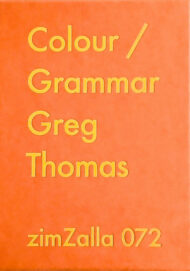
 Greg Thomas
zimZalla
by Ross Hair
Colour / Grammar, Greg Thomas’s collection of 49 new and redesigned postcard-poems, offers an ideal introduction to the work and sensibilities of this prolific Glasgow-based poet, artist, and critic. Thomas is the author of one of the most authoritative critical studies of British concrete poetry, Border Blurs: Concrete Poetry in England and Scotland (Liverpool University Press, 2019) and more recently, with the poet and publisher Julie Johnson, has co-edited a new selection of Edwin Morgan’s poetry, Home in Space: Selected Concrete, Visual and Sound Poetry (Reaktion Books, 2026). Although the poems that comprise Colour / Grammar wear this learning lightly, the concrete poetry of Ian Hamilton Finlay (one of the subjects of Border Blurs) and the minimal poetry of Aram Saroyan are very much Thomas’s touchstones: “The feints and tricks I learned from Finlay’s work, but also from Saroyan’s,” Thomas claimed in a 2022 feature at the online zine SPAM, “are still probably the basis of what much of what I’m doing (in particular, the page not as an invitation to forward movement but as a visual frame).”
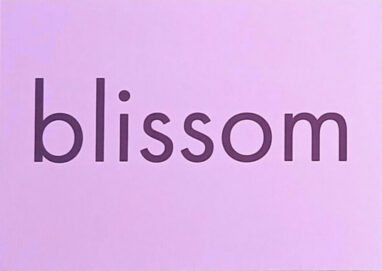
The influence of Saroyan is most evident in Thomas’s one-word poems, including “blissom” which conflates a prominent subject of Japanese haiku (blossom) with the sensation it elicits (bliss). However, whereas Saroyan utilized the solecism (most famously, misspelling “light” with an extra “ght”), Thomas’s one-word poems tend towards the portmanteau and neologism. The distinctive color of “blissom” also gives some indication of how, according to Thomas, the poems in Colour / Grammar explore “the possibilities of colour as grammar and grammar as colour.” In this instance, the rich plum of the word “blissom,” printed on a pale pink background, makes the ephemeral phenomena of blossom all the more tangible and vivid.
In terms of its colors and design, Colour / Grammar recalls Finlay’s Poems To Hear and See (Macmillan, 1971), a colorful collection of some of his most familiar and accessible concrete poems aimed at junior readers. In the case of Colour / Grammar, however, the page is replaced with the postcard—a simple format that suits the brevity of Thomas’s bright, playful poems. Maximizing the possibilities of simple colors and verbal configurations, the postcards never outsay their welcome and encourage being displayed and shared. Indeed, two copies of each postcard are included in the orange box that houses them, with the idea that the duplicates might be posted to friends and other sympathetic parties. It is a generous sentiment but perhaps one that is rather anachronistic, if not nostalgic, in its harkening back to a different (pre-digital) time when mail was an inexpensive means of communication and exchange.
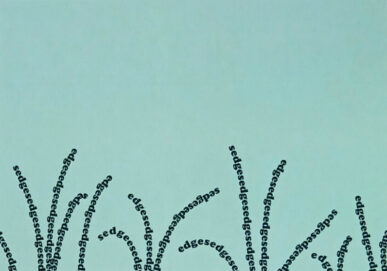
Many of the poems in Colour / Grammar take a backward glance to evoke the heyday of concrete and visual poetry. In one such poem, for example, the word “sedge” (set in a bold Cooper Black font) is repeated to form a calligram of the grass-like plant which splays and sways against the card’s sage green stock. While this inevitably recalls Apollinaire, the result is also not dissimilar to Mary Ellen Solt’s concrete flower poems such as “Forsythia,” which manifests the titular shrub with the letters of its name. However, whereas Solt makes her shrub bloom by utilizing other methods common to concrete poetry (such as acrostics and encoded symbols), Thomas’s plant is made entirely from the consecutive repetition of “sedge,” which yields the additional words “edge” and “edges.” As a result, Thomas’s calligram makes a playful allusion to the mnemonic rhyme for identifying the plants of the Cyperaceae family: “sedges have edges.”
Unlike the triangular stems of sedge plants, the poems in Colour / Grammar are themselves rarely “edgy.” This is something that Thomas is evidently conscious of, and a quality that he recognizes in Finlay’s work. In his SPAM feature “Greg Thomas: Ten Things,” Thomas claims he learned from Finlay’s example
that it’s not inherently problematic to make poems that are small, simple, and express a kind of emotional warmth (I find ‘edginess’ quite a facile quality in poetry). The reader or viewer can feel they understand your work, feel a gentleness and love from it, without that signifying some sort of complicity with a damaged world.
If the challenge that comes from cultivating such warmth is to keep the poem from becoming anodyne or trite, then Thomas generally avoids such pitfalls. One way in which he does so is by subtly defamiliarizing otherwise common turns of phrase, making the everyday just a bit more incongruous and strange. In “the buzzing / of instincts / in hedgerows,” for example, Thomas subverts assumptions by substituting what one would expect, “insects,” with the more idiosyncratic “instincts.” Such a feint not only deftly evokes the liveliness of summer hedgerows, but it also conveys their diverse ecologies. In a similar spirit, the satisfyingly sibilant one-word poem “restlessnest” conjures both the insatiability of a burgeoning nest and the harried parents tending it.

Several poems in Colour / Grammar are commendable for how they breathe new life into the otherwise hackneyed subject of dawn. The non-gendered personification in “the dawn / clears / its throat,” for example, deftly ensures that this evocation of the dawn chorus is not mistaken for the less salubrious guttural hacks and hawks of a human early morning riser, while in the more aphoristic “day / breaks // night / mends” and the proverb-like “the dawn / was not / born / yesterday,” Thomas strikes a perfect balance between poignancy and whimsy. While such punning and wordplay confirms the extent to which Colour / Grammar is not an “edgy” collection of poetry, it nevertheless reminds us that the optimism and joy contained in its bright orange box is perhaps something that, in these dark and difficult times, we all need a bit more of right now.