
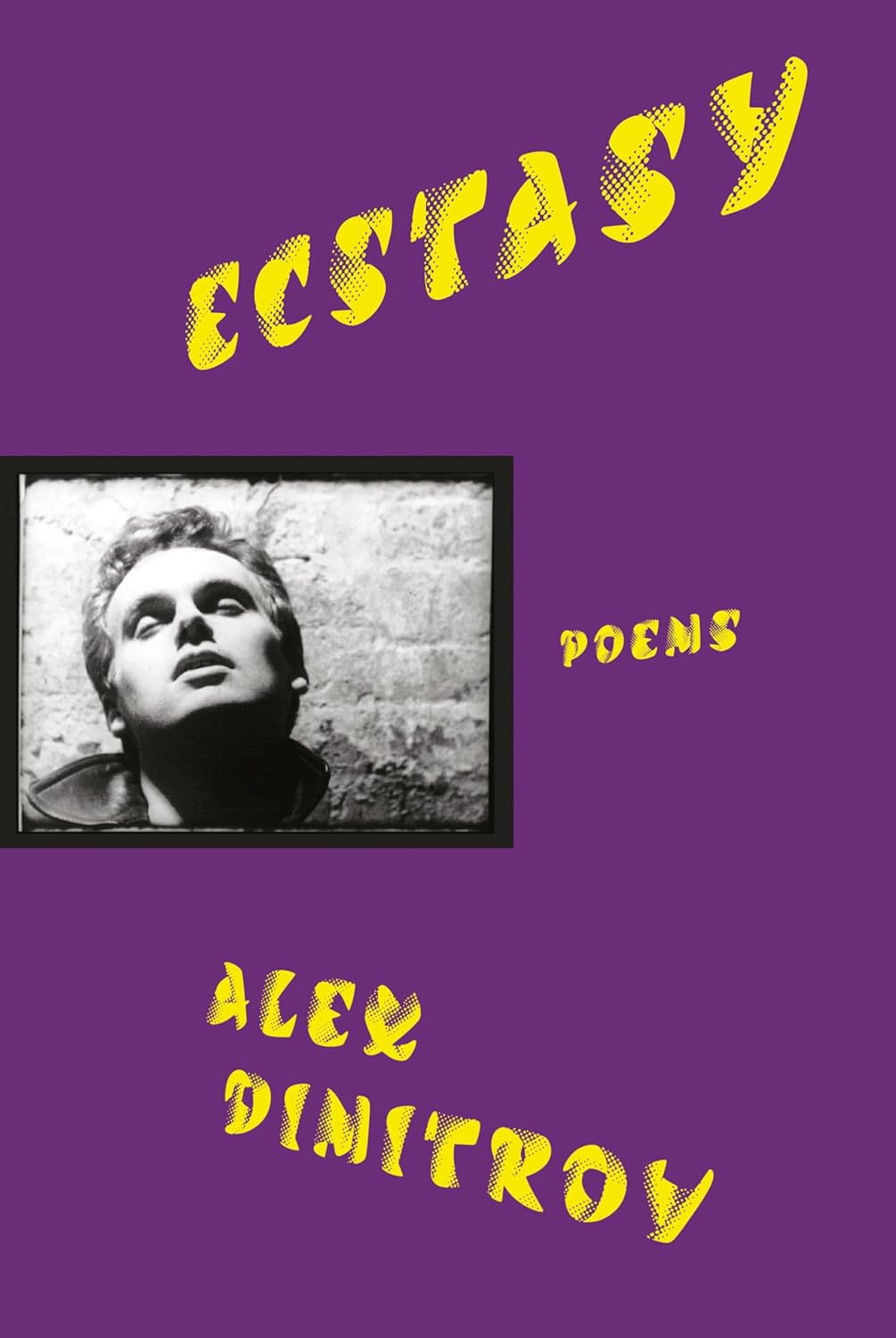
 Alex Dimitrov
Alfred A. Knopf ($29)
by Walter Holland
Alex Dimitrov, a clear and artful descendent of Frank O’Hara, richly appropriates the heady musings of the 1980s and 1990s, when Nan Goldin photoshoots in despondent shadowy doorways and bathroom stalls documented a version of New York City that has all but disappeared. Take “Another Party,” an early poem in his new collection Ecstasy, which begins:
An orange streak in the sky!
Before I go in I smoke
with the roses on Fifth.
They’re drenched from the rain
and perfectly dressed.
The party is beautiful.
The windows are French.
The windows are open
although it’s not time
to jump out of them yet!
Here, Dimitrov mimics the whimsy and sarcasm of O’Hara’s blithe conversational banter and “Personism,” adding a nice dose of Dorothy Parker’s flippant bite. Skilled at capturing the camp cadences of the past, Dimitrov takes us through the lonely quotidian of 1980’s and ‘90’s East Village bohemianism; he can speak the dark New York chic of Capote as he name-drops designer labels, makes cocktail banter, and pines away with belabored sexual longing in his favored Manhattan restaurant. His range of settings roams from trendy bar to trendier eatery, always pitch-perfectly capturing the despairing intonations (laced with shots of acidic self-pity) that attend the sophisticate poet. The collection’s queer urban voice feels generally authentic, though at moments a bit posed and heavy on the world-weariness.
Boredom in the midst of privilege and American materialistic decadence seems just one of Dimitrov’s fallback themes. “Gold Amex,” for example, glows with cynicism:
The city glitters like a gold Amex.
A guy lifts his shirt and shows you his scar.
You lose your ID. The palms rustle.
Someone asks if it’s Tuesday . . .
Dimitrov is fascinated with the disillusioned cadences of American writers who wallowed in the wake of New York’s heyday, but the East Village of queer criminals and dissident bad boys no longer exists as he conceives it; his jaded cosmopolitanism is almost now a genre in itself in American literature. Though at times repetitive or nostalgic, his soliloquies are magnificently melancholy, and his flickers of international settings serve the poems nicely, as in “Paris”:
I drank holy water
from the church on Rue du Temple.
I couldn’t remember names
and I couldn’t remember hours
especially after ten, after sunset
after everything I thought I wanted
was here and not mine anymore.
Here, Dimitrov mixes Weltschmertz with just the right accord of wit, humor, and vulnerability. One senses a lonely reach for mid-century drugs-sex-rock-and-roll nihilism and the desire for a new entourage of rebel co-conspirators—though he may have to settle for the less glamorous company of jaded millennials.
Despite my sense of his manqué poetic voice, Dimitrov is a poet of effete aesthetic savvy and emotional truth who understands lacerations of spirit. There is something of Fitzgerald in him, a tragic sensibility; his urbane ennui has the bored auteur spirit of Andy Warhol in his diaries (in fact the cover image is taken from Warhol’s 1964 film Blow Job, a fitting bit of kitsch), as well as the raw, desolate view of David Wojnarowicz. He’s good at reflecting a past of elitist boredom, educated solipsism, and melancholy, but if he’d step out of the shadows and address the hard realities of now with that deeper voice he conceals within, he would better help us to feel the currency of the new and the present.