
 Derf Backderf
Abrams ($29.99)
by Chris Barsanti
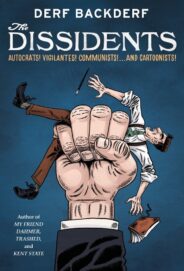
“I’m not a Marxist, let’s get that out of the way,” Derf Backderf notes at the start of his latest graphic novel, The Dissidents. “I am, however, a cartoonist.” This may sound defensive, something an artist feels is required as a throat-clearer in reactionary times to ensure they are not dismissed as some radical or ideological simpleton. But though the book is about the U.S. government’s intimidation of a cadre of Red-aligned cartoonists in the early 20th century, Backderf’s interest is less in their political beliefs than in the frighteningly unconstitutional nature of the pressure campaign against them.
The Dissidents is an illuminating slice of art history knitted into a knuckleduster of a story about the mostly immigrant agitators, organizers, and pamphleteers who thronged America’s industrial cities at the start of World War I. It’s a big shift from Backderf’s recent graphic novels such as Kent State: Four Dead in Ohio (Abrams, 2020), which even when political have been mostly autobiographical. Here, he takes a page from fellow Ohioan graphic novelist Harvey Pekar, whose Students for a Democratic Society: A Graphic History (Hill and Wang, 2008) also illuminated the struggles of a faction of Americans who tried to hold back the tide of militarism.
Though his book is filled with a roster of historical figures, Backderf invents a fictional protagonist as the reader’s entry point to the story. Joe Hertle is an earnest German-American from Cleveland—one of the ethnic “hyphenates” whose loyalty and Americanness is always in question—who aspires to be a great cartoonist like those he sees in his favorite magazine, The Masses. In many ways, The Dissidents is a love letter to this short-lived radical publication, whose gorgeous and striking artwork Backderf liberally reproduces throughout. While high-minded in its denouncements of capitalist excess and the pointless butchery of World War I, the magazine was not an intellectual exercise but instead aimed at the everyday readers whose lives and livelihoods were under threat.
Hertle is galvanized by his first direct encounter with dissident politics. Attending a Wobbly labor rally led by “Big Bill” Haywood that turns into a pitched battle when police and private goons try to bust it up, Hertle is grievously wounded. Looking to meet his heroes, Hertle leaves for New York; there he works his way into the cell of underground radicals and aesthetes publishing The Masses while being tailed by government agents. It’s a heady flutter of parties and verbal jousting in cafes where the frenetically idealistic spirit is further intensified by the looming threat of President Wilson’s crackdown, like coal being crushed into a diamond. In case readers weren’t already reminded of Warren Beatty’s Reds, John Reed, Louise Byrant, and Emma Goldman make bold cameos before Hertle’s starstruck eyes.
Like nearly all stories of political movements, The Dissidents ends in tragedy and disillusion. Wilson’s crackdowns on “sedition” used the excuse of World War I to imprison, deport, silence, and crush (spiritually, economically) his opponents like at The Masses. Backderf’s style becomes darker as the story trends downbeat. His crisply tactile figures and sharp shadows are used to illustrate the police brutally rounding up and bystanders jeering at all the “radical hyphenates” targeted by 1919’s ignominious swell of authoritarian xenophobia.
There’s beauty aplenty in The Dissidents, which stands as a visually eloquent testament to the power of creativity, alongside a realistic appraisal of the limitations of even the most finely-wrought agitprop. Backderf’s insight is not to separate art from action in this poignant, evocative portrait of hope in the face of oppression.