
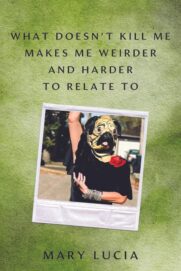
 Mary Lucia
University of Minnesota Press ($22.95)
by Frank Randall
A groundbreaking and widely acclaimed radio DJ in the Twin Cities of Minnesota, Mary Lucia has played a pivotal role in the development and sustained popularity of indie rock in the Midwest and beyond. Aware of her talent for “connecting with the listener,” her employers at Minnesota Public Radio built a brand around her savvy take on modern music, steeped in reverence for punk, Prince, and pugs (in this case her beloved dogs, not the band). Lucia’s first book is an impressive and attention-worthy memoir that combines a behind-the-scenes account of her unique professional journey with the harrowing story of being targeted by a deranged stalker.
Starting out as host for the eclectic REV105 (“Revolution Radio”) in the 1990s, Lucia’s success as an on-air personality was immediate. With an irreverent attitude that matched her genre-resistant approach to curating rock and roll, she was everyone’s cool friend with an ass-kicking record collection. In this enlightened realm, Jackie Wilson’s “Reet Petite” would be immediately followed by the New York Dolls blasting “Personality Crisis,” then Madonna urging everyone to “Express Yourself,” David Bowie walking the walk on “Heroes,” and Prince burning through “D.M.S.R.” By 2005, she was asked to be the central voice for MPR’s foray into the rock world with the launch of The Current. Her audience followed and the bands played on.
Like many talented performers, however, Lucia’s ease with a radio audience masked an array of personal insecurities, including bouts with anxiety and depression. When unsolicited and inarguably bizarre packages (raw meat, religious artifacts, blurry Polaroids) started to arrive addressed to her in the office mailroom, the mental alarms began sounding. For years, Lucia was the victim of a listener who targeted her with disturbing voice mails, letters professing a delusional romantic connection, and eventually visits to her home despite a restraining order.
How on earth does a person deal with a nightmarish situation like this? Thankfully, part of Lucia’s survival plan included keeping a journal, which not only helped her navigate the experience, but acted as a starting point for this unflinching narrative. Lucia bravely opens up about virtually every aspect of her journey—the professional disruption, the emotional trauma, and the ultimately ineffective legal system, which she navigates with remarkable composure. Lucia felt trapped in a dangerous situation unlike anything she had experienced before: “I was up against an unknown force of mental illness that acted fearlessly. All I could do was sink deeper into the dank hole that had burrowed inside of me.”
The unwanted effects of Lucia’s case impact every aspect of her life: Parents too wrapped up in their own emotional dilemmas to offer support; inept bosses that are not only jealous of your success but want your job as well; well-meaning but misguided help from friends and family; tone-deaf reactions from legal and mental health professionals. Lucia makes her life appear normal for as long as possible, until it becomes impossible. With survival instincts kicking in, she seeks traditional mental health and legal care, but she pivots to improvised methods of self-preservation when the traditional falls short. These lead to unforeseen setbacks and roadblocks on the path to wellness, but Lucia embraces her choices and their consequences with an emotional honesty that is supported by her unrestrained prose. “A lifetime of sticking my neck out for possible beheading is my choice,” she proclaims. “That way the failures (F.A.I.L. = First Attempt in Learning) and successes rest on my shoulders.” Throughout panic attacks, stress-induced shingles, dangerous weight loss, and years of fear for her own safety, she remains amazingly resilient in the face of circumstances beyond her control.
Lucia’s ability to find the humor in the darkest and most unfathomable situations stands out as her remarkable superpower. When she reluctantly sends out the call to her siblings for help, she has one brother (older, and yes, adult) literally swinging from the trees in her yard in a misguided attempt at branch maintenance. The other brother house sits overnight, leaving a note explaining that all was quiet, but he was swiping her vintage leather coat “as payment for standing watch.” Unafraid to portray the dysfunctional family she somehow survived through childhood and her own shortcomings as an adult, Lucia possesses the rare ability to maintain a state of jaded grace in the telling of uncomfortable events.
Lucia’s portrayal of her relationship with her mother is especially poignant—and painful: “When you’re told as a child by your mother that she can’t stand your father and you’re just like him, it does a number on your head. I get it. You don’t like me.” Despite Lucia’s efforts to help her mother deal with her own traumatic past, the adage that no good deed goes unpunished seems to be written in the stars:
Foolishly, I put aside a lifetime of boundaries to confide in her about the daily fear I was living with. Even I couldn’t have been prepared for her callous dismissal of my current situation.
“He’s just a fan. Lighten up.”
The editors of this bold memoir deserve special praise for not polishing every rough edge in Lucia’s intensely personal prose. The genuine anxiety, the dark humor, the appreciation for the absurd, the misplaced faith in institutions that should protect us, the awesome power of music when the written word simply can’t rise to the occasion—Lucia wraps her arms around it all and somehow manages to wrestle it to the ground. Understandably shaken, appropriately resentful, but intact. After multiple rounds of unwanted attention, courtroom trauma, and ultimately an unjustified dismissal from an unsupportive employer, she remains defiant. “The system is deeply flawed. Do I accept that? Never.”
Having battled demons in public and in private—and on multiple fronts—Lucia comes through the ordeal with her rock and roll spirit intact. She never downplays the toll it has taken on her outlook and health, but she refuses to let these events define her. “I don’t want to be the face of stalking,” she admits, fully self-aware and realistic about the challenges that still lie ahead. “My eyes are open, and if it’s a heathy dose of anger I need to feel slightly less powerless, so be it.”
What Doesn’t Kill Me Makes Me Weirder and Harder to Relate To provides a deeply moving narrative of the multitude of negative impacts a stalker can have on the life of a victim. There is no happy ending, as any victim would attest, but Lucia has a natural gift for storytelling, and the very existence of this account is a reason for hope. If we are lucky, she will report back on her future endeavors, surrounded by friends, devoted pugs, and eccentric cats, all accompanied by a brilliant playlist.