
by Jeremy Wang-Iverson
This year marks the ninetieth anniversary of the onset of the Spanish Civil War, which had a profound effect on the American writer Muriel Rukeyser (1913-1980). The days she spent in Barcelona when the war began in July 1936 served as a source of inspiration throughout her life, forging her commitment to antifascism and her unwavering belief in writing’s ability to create the conditions for political change.
The unrestrained idealism expressed in Rukeyser’s work inspired succeeding generations of American poets: Anne Sexton, Sharon Olds, Kate Daniels, Natasha Trethewey, Daniel Borzutzky, and Solmaz Sharif are among her legion of admirers. Many critics found her artistic approach less convincing and her political commitments suspect, but in recent years, with fascism once again on the rise globally, the tide has turned in her favor, and a Rukeyser revival is firmly underway.
This is not to say that Rukeyser was neglected in her lifetime. She won the Yale Younger Poets Prize for her first collection, Theories of Flight (Yale University Press, 1935); a few years later, she was called “the most inventive and challenging poet of the generation which has not yet reached thirty” by Louis Untermeyer in The Saturday Review of Literature. Along with winning more prestigious awards and fellowships, she lived to see her collected poems published—a significant capstone—and published fiction, plays, memoirs, biographies, criticism, children’s books, and translations of poets such as Mexico’s Octavio Paz and Sweden’s Gunnar Ekelöf. And not incidentally for a writer committed to political activism, Rukeyser served as president of PEN America and wrote op-eds for the New York Times.
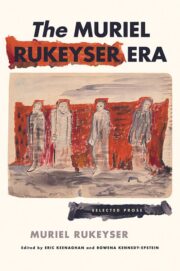
Despite her accomplishments, Rukeyser did not achieve the canonical status that many poets and scholars believe she deserves. Partly this is because so much of her writing has not been given the same consideration as her poetry, but with the recent publication of The Muriel Rukeyser Era (Cornell University Press, 2023), a selection of her prose edited by Eric Keenaghan and Rowena Kennedy-Epstein, that can begin to change.
Gathering work from the full span of Rukeyser’s life, The Muriel Rukeyser Era shows the extent to which she experimented with genre and technique in an effort to connect with larger audiences and advocate for social justice. With many of its entries originally written for a general readership, this anthology is an excellent starting point to learn about Rukeyser: Here we meet a writer with genuine concern for those struggling, and we gain a clear understanding of her profound desire to share what she witnessed. The volume is an inspiring reminder of the ways in which an artist can defy a political reality and strive to create something new.
Rukeyser’s resolve to pursue this lofty project crystallized in the days following the start of the Spanish Civil War, an experience into which newly published pieces offer further insight. She was twenty-two years old, and it was an improbable turn of events that led her to Spain. Initially, she went to London, accompanying the activists George and Elizabeth Dublin Marshall, who were researching cooperatives. While in London, she met Robert Herring, the editor of Life and Letters To-Day; Herring asked if she would go to Barcelona to cover the People’s Olympiad, a gathering of athletes protesting the official games held in Nazi Germany that summer. She left London on July 18, and as Herring notes in the header for the article Rukesyer eventually wrote: “She was on the last train to enter Spain after fighting began and arrived back in London on July 27th. This was her first trip to Europe.”
And what a trip it was: The People’s Olympiad never took place. When Rukeyser arrived in Barcelona, as she explained in another journalistic account included in The Muriel Rukeyser Era, the war had begun:
I could never find the man who was managing the publicity for the Olympics because he was always out on the street fighting with the People’s Front. We were taken to dinner that night in an automobile spangled with bullet holes, the upholstery stained with blood; the officials apologized for the condition of the car, explaining there had been fighting that day.
Rukeyser returned to New York later that year and wrote the novel Savage Coast, which fictionalized her experience in Spain, including an account of falling in love with a German athlete named Otto Boch, who was later killed fighting the fascists. The novel, written before George Orwell’s Homage to Catalonia, was rejected by her publisher and only released in 2013 by The Feminist Press. Rowena Kennedy-Epstein, who discovered the believed-to-be-lost manuscript for Savage Coast in Rukeyser’s archive at the Library of Congress, writes in the book’s introduction that it “defies and remakes the artistic, political, and gendered categories of twentieth-century modernism.” Eulàlia Busquets, who has translated Savage Coast into Catalan, describes it as a “documentary, biographical, and experimental” novel, writing in her 2020 essay “Returning to Savage Coast” (published in Muriel Rukeyser: A Living Archive, /2020/05/08/eulalia-busquets-returning-to-savage-coast/):
Savage Coast tells us about the things that could have been possible but that ultimately did not happen . . . We must go on fighting . . . This is the message Rukeyser held on to as she left Spain on the ship Ciudad de Ibiza and accepted the responsibility to tell what she had seen the day she “was born” in Spain.
This moment of epiphany on the ship as she was evacuated from Spain is narrated by Rukeyser in several non-fiction pieces as well. In The Muriel Rukeyser Era, Keenaghan and Kennedy-Epstein include a series of lectures that she gave at Vassar in 1940, when she was twenty-six, that were previously part of the one book of essays published in her lifetime, The Life of Poetry. This is Rukeyser from the original introduction:
We were on a small ship, five times past our capacity in refugees, sailing for the first port at peace. On the deck that night, people talked quietly about what they had just seen and what it might mean to the world . . . Suddenly, throwing his question into talk not at all leading up to it—not seeming to—a man—a printer, several times a refugee—asked, ‘And poetry—among all this—where is there a place for poetry?’
Then I began to say what I believe.
Rukeyser’s attempts to answer the printer’s question can be traced across several lectures, essays, and reviews in pieces included in The Muriel Rukeyser Era. The most direct (and amusing) answer is in a radio script that she prepared in 1949, aired by a San Francisco station that summer. There are moments where Rukeyser sounds like a writer tentatively trying a new technology—think of Joyce Carol Oates’s earliest tweets—before she locks in:
Mrs. Melville said to her mother—and you can hear the misery of her words—“Herman has taken to writing poetry. You need not tell anyone, for you know how such things get around.” What is this distaste for poetry? If you ask your friends about it, you will find, as I have, that they will give you the same answers. Your friends may say that they have not the time for poetry. Now this is a curious position to take; for poetry, of all the arts that live in time—music, theater, movies, writing—poetry is the briefest and most compact of these.
She continues: “A poem invites a total response from you . . . A first-rate poem, a fine poem, will reach you intellectually . . . or may I say that when you reach it, you will reach it intellectually too . . . but the way is through emotion . . . through what we call feeling.”
Rukeyser could have been describing her own extraordinary poem sequence The Book of the Dead, first published as part of her second full-length collection, U.S. 1 (Covici Friede, 1938). Remarkably, her trip to Spain was the second reporting trip the poet took in 1936; earlier in the year, with photographer Nancy Naumburg, she went to Gauley Bridge, West Virginia, where thousands worked in unsafe conditions to build a tunnel for Union Carbide, and reported on the 1931 industrial tragedy known as the Hawk’s Nest Tunnel disaster. (Naumburg’s photos were meant to be published with the poem, which was not realized until an edition published by West Virginia University Press in 2018.)
Rukeyser revealed in The Book of the Dead “how the company cheated these men out of their lives,” as Naumburg put it. She approached her work on the poem not unlike a documentary filmmaker, as Catherine Gander details in her book Muriel Rukeyser and Documentary: The Poetics of Connection (Edinburgh University Press, 2013). Documentary was an emerging artform at the time; Rukeyser co-wrote with Ben Maddow (a distant cousin of Rachel) the 1941 documentary short “A Place to Live,” which was an Oscar nominee. As late as the 1970s, Gander tells us, Rukeyser was in touch with the producer Paul Rotha about adapting The Book of the Dead into a film.
Along with her interest in film and radio, Rukeyser also worked as a translator, biographer, and literary critic; aspects of this work are also represented in The Muriel Rukeyser Era. The careful selection of pieces, accompanied by insightful and detailed notes, provide a coherent presentation of writings that span Rukeyser’s life, clearly showing how key themes and ideas echoed throughout her work. The editors’ sleuthing, subtle and penetrating, gives us a peek into Rukeyser’s process, even how she grappled with language as she was working. The volume amply makes its case that Rukeyser should be considered a major American writer of the 20th Century.
Over twenty years ago, Adrienne Rich wrote that Rukeyser “created a poetics of historical sensibility—not as nostalgia, but as a resource to express and interpret contemporary experience and imagine a different future.” Now, in another time of crisis, her voice is indispensable once again—and many are listening.