
Yuki Tanaka
Copper Canyon Press ($17)
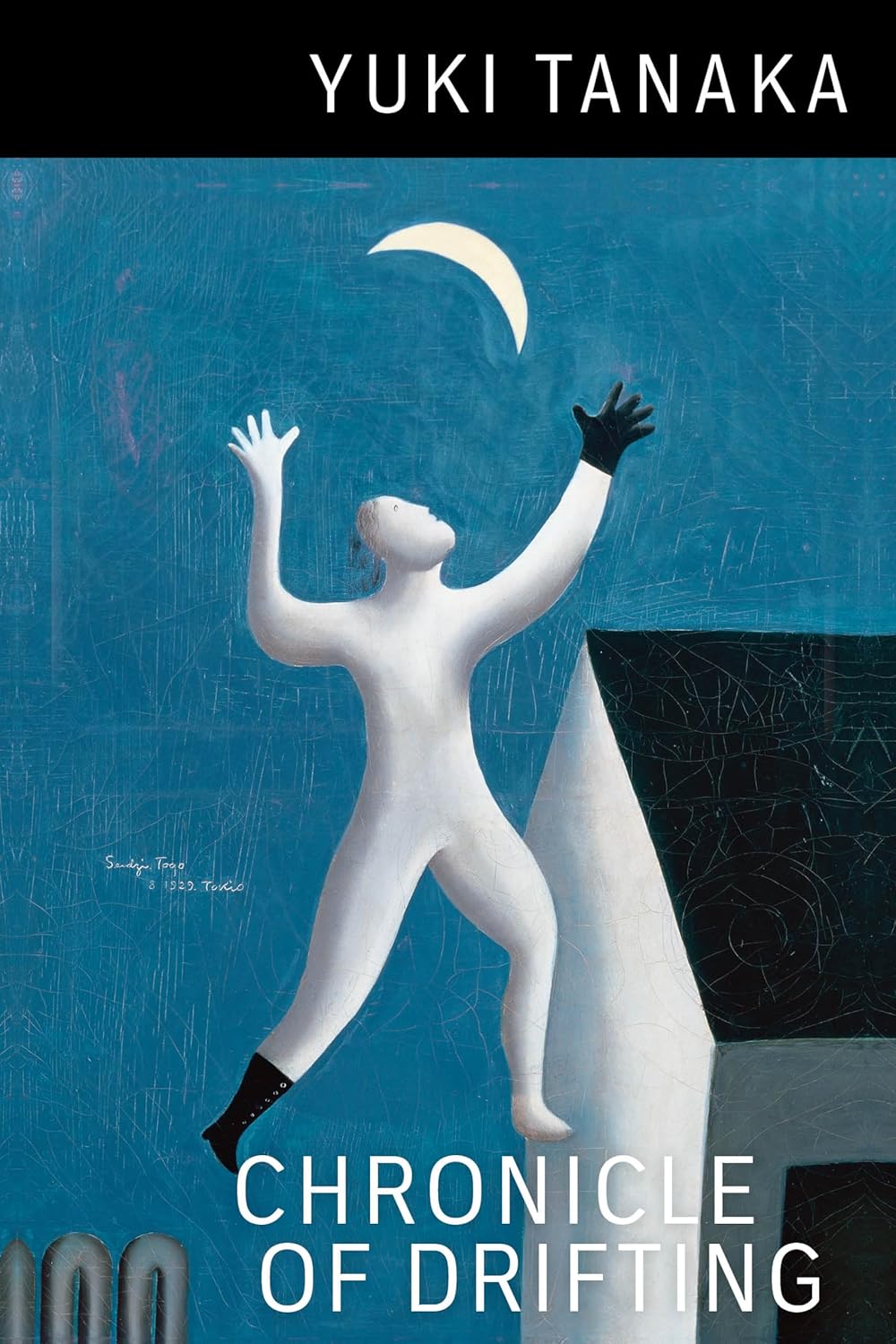
by John Bradley
Although Surrealism is among the most important artistic movements of the past hundred years, the adjective “surreal” has largely lost its connection to the unconscious and the marvelous. Merriam-Webster, for example, defines “surreal” as “marked by the intense irrational reality of a dream,” which is adequate, if lackluster. To witness the power of the surreal to startle and delight, readers should open Yuki Tanaka’s debut poetry collection Chronicle of Drifting, which demonstrates that Surrealism is very much alive.
The title poem consists of sixteen prose poems, all quietly surreal. Here’s the eighth, typical of the series:
A stray cat in an alley in Yotsuya. I had no food but I made a gesture of food inviting the cat but she didn’t come. The locksmith there was wonderful, taught me how to fix my apartment key, which had been bent when it got too close to a kerosene stove at the train station. He reheated it with a burner, until the key glowed in front of us, and he used pliers to unbend it, like setting a broken tail straight. The cat in my head cried in pain, but I patted her to be quiet. Went home with a bag of strawberries, lettuce, oysters, but my head was full of dry things. Someone walking outside. Voice of a sweet-potato seller with a shy trumpet. I can’t make music, not being a piano. But as a child, I kicked sand into the ferns, making the sound of light rain.
There’s a dream-like narrative here, as in the other prose poems in this series, with surprising turns, from a cat to a locksmith to “someone walking outside”; at times associative patterns can be seen, as in the closing lines that move from “shy trumpet” to “not being a piano” to kicking up “the sound of light rain.” The delightful ease and sense of whimsy Tanaka conjures reinforce the playful transformations of self that “Chronicle of Drifting” so expansively relates.
Although this is Tanaka’s first book, he has also translated, with poet Mary Jo Bang, a selection of poems by the Japanese Surrealist Shuzo Takiguichi (1903-1979); in their introduction to A Kiss for the Absolute (Princeton University Press, 2024), Bang and Tanaka say of Takiguchi that his “I” is “a constructed poetic entity—an impish shape-shifter who dashes quickly through a world overflowing with associative imagery.” The same could be said of Tanaka’s own work. In the opening of “Like One Who Has Mingled Freely with the World,” the speaker is imitating a bird: “Surrounded by children, I leap up / with a huge silk scarf around my shoulders // to look like a crane.” But in the very next line, everything changes: “They laugh and laugh / and push me into a rabbit skin and watch.” Just like that, our narrator is now a rabbit “with long ears” who hopes “they’ll let me in”—and it’s only the third stanza of a nine-stanza poem! The speaker then tells us of an earlier mingling, when a “girl in a wedding kimono / . . . screamed when I popped up from the rice paddy // like a big frog.” Near the end of the poem, the speaker holds an umbrella “up against the clear sky,” sounding rather human, at least temporarily.
While Tanaka’s roots can be traced to classic Surrealism, the worlds he creates are unlike any other. In “Prognosis at Midnight,” the speaker reads about a “grandmother” who “fell down the stairs and broke her hip.” This triggers a fantasy where the speaker has his chauffer take him to this woman to “comfort her”:
I’d say, I read about you, I’m terribly sorry,
this is my cockatoo, he’s twelve and loves carrots.
We’d share her hospital dinner and be happy.
Other sick people gather around us, admiring my cockatoo,
who looks proud in his cage, unfurling his light-pink wings,
like stage curtains, and I’m his assistant.
The fantasy continues, no longer feeling like a daydream but like an actual narrative, albeit a fantastical one. Here, as in most of the collection, there’s a casual ease, an effortlessness to the poem’s movement. The only poems that feel strained are in the section “Discourse on Vanishing”; a note in the back of the book explains that these are erasures of Tanaka’s doctoral dissertation. No wonder they feel enervated.
This is a minor issue, however, in a wondrous debut book. Only in Chronicle of Drifting could a reader hear “Tonight, after rain / I’d like you to fly through these irises, // your blue mustache, blue cheeks / infected with sky.”
Click below to purchase this book through Bookshop and support your local independent bookstore:
Rain Taxi Online Edition Winter 2026 | © Rain Taxi, Inc. 2026