Uncategorized

Beats Back Bigger Than Ever: An Interview with Gerald Nicosia

For decades, Illinois-born writer Gerald Nicosia has made it his business to follow the fortunes and misfortunes of the spunky writers of the Beat Generation. This year, with three new Beat movies on the horizon, he’s as vigilant and as outspoken as ever. Daniel Radcliffe of Harry Potter fame stars as Allen Ginsberg in Kill Your Darlings; Jack Kerouac’s dark night of the soul will be depicted in Big Sur; and Walter Salles, the director of The Motorcycle Diaries, directs the big-screen version of On The Road, which will be among the titles competing for best film at this year’s Cannes Film Festival.

An adviser on Salles’s film, Nicosia is betting that it will help spread the rebellious spirit of the Beats. The author of the Kerouac biography Memory Babe (Grove Press, 1983) as well as a new Beat chronicle called One and Only: The Untold Story of On the Road (Viva Editions, $22.95) and a poet in his own right, Nicosia carries on the cultural and spiritual legacy of his literary heroes. For him, American literature is the literature of protest and rebellion that goes back to Henry David Thoreau and that includes socialist adventurer Jack London, and the tribe of Chicago writers such as Nelson Algren, author A Walk on the Wild Side.

Though he lives in bucolic Marin County, California, he walks and talks with the gusto of Chicago and its rough-and-tumble novelists and poets. I’ve known Nicosia for thirty years; we first met after a poetry reading by Allen Ginsberg. When I heard that three new movies about the Beats were on the way, I thought it was time to talk to Nicosia again and find out what he was thinking about Kerouac, Ginsberg, Burroughs, and their friends and lovers.


Jonah Raskin: With new movies about the Beats coming to theaters what would you hope Americans learn about Kerouac, Ginsberg, Cassady, and their wives and girlfriends?

Gerald Nicosia: That they were responding to an urgency in America, a wrong direction taken, a loss of community, a loss of brotherly love, a loss of a moral center.

JR: You worked as an adviser to the film version of On the Road. What suggestions did you make to the actors and the director?

GN: I told the actors not to worry about getting the exact details of the lives they were portraying. I told them that what was important was to give people a sense of their open-heartedness. With the director, Walter Salles, I got into things more deeply. He wanted to talk about the main characters’ search for identity and for the father. I told him I thought the brother relationship between Neal Cassady and Jack Kerouac was at the heart of the novel—these two outcasts, misfits, learning to care about and take care of each other, breaking down the walls of isolation that were being so rapidly erected in postwar World War II America.

JR: Why do you think there are three Beats movies coming out now?

GN: The cash-in on the Beats began several years ago. Now, you have three estates, those of Kerouac, Ginsberg, and Burroughs, discovering that there is unlimited money to be made in marketing these properties in electronic media and film.

JR: Will any of the new movies do justice to the Beats?

GN: I have the highest hopes for the movie of On The Road, because it was made outside the Hollywood system, financed by a small European company, MK2, and made by people who genuinely care about Jack’s message. I don’t think Salles was under the same pressure to make a “hit” that American moviemakers are under.

JR: When and where and how did you first become interested in Kerouac?

GN: I was at the University of Illinois in Chicago, getting my master’s. My officemate was a hip kid from Harvard who kept dropping Kerouac’s name because he knew I hadn’t read him. This was 1972, three years after Jack died. The Dharma Bums and On The Road were the only two Kerouac books in print. I was blown away by Kerouac’s compassion for the down-and-out, the working class, those on the wrong side of American capitalism.

JR: On what side of capitalism were you raised?

GN: My family was working class—my dad a mailman, his father a construction worker and chimney sweep; my mom’s father was a barrel maker, my mom’s mom ran a grocery store, my mom was a secretary all her life.

JR: How do you explain the Beats? Kerouac came from a Catholic working-class family; Ginsberg was from a Jewish left-wing family; Burroughs was White Anglo-Saxon Protestant. What did they have in common?

GN: Amiri Baraka says they all came from minorities not yet fully assimilated into the American capitalist dream. I would say they were individuals who, by birth, temperament, political persuasion, and economic status, did not fit in with materialistic, chauvinistic, and belligerent American society. They were trying to find a way they felt had existed during the Great Depression of the 1930s.

JR: You spent years doing research about Jack Kerouac. What would you say was the biggest surprise?

GN: Kerouac’s books portray a hero and narrator free and easy, confident, sure of his rebellion against the American system. In reality, Jack was torn between Catholicism, Buddhism, and his own demon-driven pursuit of kicks, between spirit and flesh, between mom’s house and the Beat coffeehouse, patriotism and subversion, men and women, society and solitude, carousing and meditation, sacred and profane, secular and divine. It’s a miracle he survived as long as he did.

JR: For years the Sampas family controlled the Kerouac estate. For those who don’t know, who are they and what damage did they do?

GN: Sam Sampas was Jack’s first friend who gave him the courage to be a poet despite the jeers of his working class community. Late in life, when Jack’s mom had a stroke and refused to go into a nursing home he married Stella Sampas, Sam’s older sister, to take care of his mother. The marriage was a disaster, and Jack was about to divorce her when he died of liver disease from drinking at forty-seven.

JR: What happened with the will of Jack’s mother?

GN: Gabrielle Kerouac’s will was forged, probably by Stella, thus stealing the estate from her grandchildren: Jack’s daughter, Jan Kerouac, and Jack’s nephew, Paul Blake, Jr. The damage they did was to sell Kerouac’s archive into private hands. Not one of the nine or ten manuscripts Jack wrote on long rolls of paper is now in a library where it can be studied.

JR: I’ve heard it said that if it weren’t for Ginsberg and his savvy with promotion and public relations, there would be no Beat Generation. How important was he in the marketing of his friends and their books?

GN: He was very important—both in terms of things he wrote, and in schmoozing people in positions of power who could help the Beats get recognized. His thousands of readings carried the Beat message to millions of people.

JR: Ginsberg, Kerouac, Burroughs, and Cassady knew one another from New York in the 1940s. How was that time and place significant for their development?

GN: I think for all of them the key was to break out of the conformity, narrow-mindedness, and materialism that New York represented. Neal Cassady with his visions of Western individualism provided a way out for Ginsberg and Kerouac; for Burroughs the way out was through Tangier, Paris, and London, and finding more freedom in older cultures.

JR: If the major figures of the Beat Generation were alive today, what do you think they would be doing now?

GN: Kerouac would be writing. Cassady would be taking Viagra and chasing women. Ginsberg would be teaching. Burroughs would be taking his daily Methadone and plotting his next novel. They were driven people, on a mission, and only death could stop them.

JR: We know now that there were women of the Beat Generation and that they wrote books. What do their books add to those written by their lovers, husbands, and boyfriends?

GN: There was a heavy price to be paid for that male-led revolution. Somebody had to support it by hard work and carrying the daily load, the family load, that those male revolutionaries didn’t have time or inclination for.

JR: In what ways do you think the Beats led to the rebellion and the protests of the 1960s?

GN: They absolutely made the crack in ’50s consciousness, through which the counterculture of the ’60s poured. It couldn’t have entered without that wedge driven into the concrete wall of Eisenhower-McCarthy-Billy Graham America.

JR: The Beats became a global phenomenon. What is it about them that appealed to citizens of the world?

GN: They are citizens of the world; they speak as citizens of the world. It was a rare American ecumenical movement—even more so than the Transcendentalists, who were also reading Asian and Indian texts. The Beats actually went to those places, mingled with people, shared their writings, and learned from other cultures. I think people in other countries see this as a rare phenomenon among Americans.

JR: The Beats didn’t do anything in moderation. If you knew them back in the day, would you have cautioned them not to be as intense as they were?

GN: No, you can’t slow down intense people. They have to burn at their own rate. People on a mission are unstoppable. God bless them for it. It would be a poorer, more miserable world without them.

JR: For someone nineteen or twenty years old now, what Beat books would you recommend they read?

GN: On the RoadThe Dharma BumsDesolation Angels by Kerouac. HowlKaddish, and The Fall of America by Ginsberg. Most of Burroughs is going to go over their heads, unless they’re lit majors. Gregory Corso’s poems, “Marriage” and “Bomb.” Diane Di Prima’s Revolutionary Letters, Ted Joans’s Teducation, Bob Kaufman’s Cranial Guitar, Jack Micheline’s River of Red Wine, and Ray Bremser’s Poems of Madness and Cherub.

Jonah Raskin is the author of American Scream: Allen Ginsberg’s “Howl” and the Making of the Beat Generation.

Click here to purchase this book at your local independent bookstore

Purchase this book at your local independent bookstore.

Rain Taxi Online Edition, Spring 2012 | © Rain Taxi, Inc. 2012

Fathers and Sons: An Interview with Ben Tanzer

by Paula Bomer

A native of Chicago, Ben Tanzer is the author of several works of fiction, including Lucky Man, 99 ProblemsYou Can Make Him Like You, and So Different Now, among others. He also edits the online journal This Zine Will Change Your Life. His prolific small press presence is a defining characteristic of his work—heartfelt, honest, and straightforward. In one of his most recent books, My Father’s House (Main Street Rag), Tanzer tackles the death of his father; his serious attention to craft and incredible thoughtfulness to structure are an enormous pleasure, despite the gravity of the book’s subject matter. It’s a book that should be read by anyone who has a father.

Paula Bomer: Due to my own recent loss, I’ve been reading literature dealing with death and grief. Joyce Carol Oates and Joan Didion both wrote non-fiction about losing their husbands (and in Didion’s case, her daughter as well), and the recently published Mourning Diary by Roland Barthes deals with the loss of his mother, with whom he lived for 60 years. Even well known fiction writers like Jonathan Franzen and Alexander Hemon have written about death and grief in the essay form. You’ve chosen to write about your father’s death in the form of fiction. Why use the novel for this material?

Ben Tanzer: Just today I was listening to Darin Strauss talk about his memoir Half a Life, and he said that he felt like the material in that book deserved to be a memoir and not a novel because someone had died and he wanted to honor that. I suppose my feelings when writing My Father’s House were the antithesis of that thinking. I initially thought I would do a memoir about my experience of my father’s death that would be an homage of sorts toThe Basketball Diaries. But it never quite worked out and I shelved it. When I was finishing my last novel, I started thinking about what I might work on next and I found myself thinking about several things. First, I felt like having written about friendship in Lucky Man, love in Most Likely You Go Your Way and I’ll Go Mine, and birth in You Can Make Him Like You, I needed to write about death to complete some kind of collective effort to capture these milestones. I also thought about how I needed to tweak my own approach to novel writing so as not to repeat myself. I have favored humorous, pop culture driven stories wrapped around themes of how we cope with pain and confusion, and so I was interested in how I might invert that formula. Finally, I was having drinks with a publisher who was damning creative nonfiction, and this discussion reminded me of my attempt at memoir and how it hadn’t worked for me. Unlike Strauss’ story, I realized my focus on nonfiction was limiting the creative possibilities for the story. From there I started thinking about what a fictional riff on a son coping with losing his father might look like, how people would talk and what their days would become, and then I was off and running.

PB: Toward the beginning of the novel, when the father character first gets sick, your narrator thinks, “I feel like today has been one long out of body experience. I’m doing the things I always do, I know, making breakfast, going to work, doing the laundry, watching television, and whatever, and yet even as I’m doing these things, I feel like I have been watching myself do them from afar.” The enormity of the possibility of his father’s death already transports the narrator into another world, so to speak.

BT: I think there are a lot of ways to discuss this, which is partly related to the fact that while the world as you once knew it is blowing up and splintering around you, the world as a whole is not, and probably doesn’t care. The world keeps going, and because it keeps going, you have to keep going, and even if you drop things to focus on the dying person, or your grief, you don’t drop everything, and definitely not the mundane things—laundry has to be done, you will watch television—all that. The difference is that you’re aware that your world is not normal, and so on the one hand, those mundane things are even more rote, and on the other hand they feel unreal. Part of you is aware of this, but it’s not always present, and then something triggers those feelings—a song, a phone call, a memory—and you think fuck, I’m not only going through the motions, I’ve been a full step removed from even doing that. I’ve been watching myself go through the motions, because really, none of this matters all that much right now, and so not thinking about death, yet thinking about it all the time, is about all I can really handle.

PB: Three things outside of his marriage and family seem to comfort your narrator: running, drinking large amounts of beer, and having sex—first with a stranger, and then, more pointedly, with a woman from his childhood. This sort of behavior comes up a lot in the literature of grief, but the sexual acting out is complicated—in your novel, it is self-destructive, guilt inducing, something that could destabilize the narrator’s marriage, and yet it’s also a grabbing onto life, which perhaps drinking can also been seen as—it’s a “celebratory” behavior. Why do you think this is?

BT: I think we are talking about how people cope with what is confusing and painful and how many of the things that allow us to cope, or not cope, and to lose ourselves in something other than grief and anger, are the same things that can bring us pleasure and joy and more healthy escapes in completely different circumstances. I also believe that what we’re drawn to and compulsive about when we’re happy or content is only heightened when we’re grieving—anything to escape, to feel better, and sometimes just to feel. You could probably write a similar book to mine where the coping behavior was focused on things like eating and OCD behaviors, both of which are touched in the book, and which are also interesting to me—just not as interesting as substance abuse, running, and sex. Running in particular is a personal compulsion and release, and sex is the one activity I think we all obsess over, men for sure—should I, shouldn’t I, can I get it, will I get it, how will I get it, is it good for me, for her? It dominates our thinking even when we aren’t interested in it, because we are immersed in it, it comes at us from every direction, and it never quite makes sense. Like death I guess.

PB: Throughout the novel, the narrator thinks back on his dad, what kind of father and man he was in general. I wonder if it’s sort of an homage to your own father, a way of immortalizing him—what better way to preserve a dead father than to write about him?

BT: My reaction to this question is very similar to my reaction to the journal notes I wrote when my dad first got sick. I was reminded of a phrase by the writer Graham Greene: “There is a splinter of ice in the heart of a writer.” I cannot say My Father’s House was conceived as an homage to my father in any conscious way. While unconsciously I may have wanted that, my initial impulse was more coarse: my thinking was that there will be a story here, this experience will be fucked-up and twisted, fraught with conflicts and tensions, as father and son relationships are anyway. But my father’s life is as ripe as any for homage: he was a great artist and teacher, beloved locally and regionally, though he never achieved the kind of fame and respect he wanted from the larger art world. And it wasn’t a pipe dream or the frustrated longings of someone with a rich fantasy life either—he was the real thing, he just never quite figured it out. Another sort of irony is that any immortality he might ultimately receive with this book will be somewhat of a letdown for him in death, because he would have wanted it while he was alive so could revel in it.

PB: There is a famous book that talks about the “stages” of grief that isn’t really of interest to me—who wants an instruction manual?—but it is true that emotions run the gamut, and rage seems to be quite normal. Two instances of this in the book stand out for me: one where your narrator lets himself be angry at his father for not taking care of a hernia, saying, “I realize that his decisions, and non-decisions, don’t just affect him, they affect all of us, and they always did.” Another instance is toward the end when a friend of the father’s recommends a ton of morphine to end his father’s consciousness. Your narrator thinks of him as a murderer, but I also see it as the narrator’s inability to let go.

BT: Letting go is terrible, torturous, and it doesn’t matter what kind of relationship you had, good or bad. If it’s good, you feel cheated, because something has been torn from you that you cherished and planned to hold onto and watch evolve, and now that’s fucked. And if it’s bad, you’re still cheated, because if you find some kind of closure then you wasted a lot of time being angry, and if you don’t quite work it out, then you feel set-up. There is endless shit with parents, even great parents, that never gets worked out, and some of this is what allows you to separate from them in the first place, but it’s also what can cause anger as well. What I was also interested in, though, is how the rage of loss is further warped by our own personalities, our past, how we perceive ourselves and our memories. This character wants to be tough, but being tough is only so affective in the long run. It can mask feelings and suppress them, just as running or sex or alcohol does, but for how long, and in what ways, and how does it impact your ability to understand what you’re feeling, and even how you remember things? How cut off from what you’re experiencing do you become? The character could have told the father’s friend to shut the fuck up, but he can’t quite grasp what’s being said. It’s not really so confusing though, so is that an inability to let go, or is it an inability to see clearly what’s happening in front of you because of all the other junk bouncing around in your head?

PB: Both the narrator and his father have tough guy personas and yet both are artists, and in the case of the narrator, a caregiver. There’s a lot of ambivalence about masculinity and what it means, how confining it can be but also how necessary. Eventually, your narrator is allowed all sorts of release—crying, really letting go of his father, and figuring out what he needs to do next. Perhaps it was the slow painful aspect of a death by cancer; not to diminish the loss, but I’ve heard people say about certain deaths, “it was his time.”

BT: It’s funny because one reviewer wrote how there were certain ways the character managed his emotions in the book that bothered him as an editor, but then he realized that maybe his own need to be tough was affecting his ability to embrace the emotions being expressed, and that made me smile. He was the first person to touch on this thread, and now you are the second. It was a conscious thing I wanted to play with, but if I’m the only one who sees it in the text, I’m not sure it qualifies as being part of the book at all. The character does need to find a way to be sad though, and experience grief, and to embrace that tough guy persona—or not—regardless of confusing signals about masculinity and what it means to be a father or son. I don’t know that the character gets there in a healthy way, but he does get there because he’s ultimately so overwhelmed by all of it he has no choice. It’s an implosion of grief, though in this character’s case it is also the start of something, because I wanted to connect all of this to being an artist as well. When my father died, my mom and I talked about whether he might have been more successful and better able to bring more layers to his work if he could have better embraced his feelings and been less caught up in being tough and not exploring things. I wanted the character to come to understand this in the latter stages of the book as he realized that he wants to create art as well. In terms of the idea that “it was his time,” we always have to separate out people’s suffering from their actual lives. If someone is suffering, then yes, it can feel like someone’s time because you can’t bear to watch them suffer, but that has nothing to do with what they may have still done with their lives if they were healthy and how you may have yet interacted with them. From that perspective, it’s never anyone’s time.

PB: You’ve published seven books with a variety of independent publishers and it seems to encourage you to be both productive and free—no agent telling you what to do, no publisher asking you to do something similar to your last book, and so on. In many ways, I feel you could have a career like Charles Bukowski—revered but remaining an outsider, doing what feels true to your heart. I mean no disrespect for writers with more mainstream careers, of course, but as both of us come from the small press world, I thought you’d tell us your feelings about your experiences.

BT: My experiences as a whole have been very positive and over the last several years especially I have had the great pleasure of working with people who I either sought out and hoped would want to work with me, or people who wanted to work with me that I had been trying to cultivate in some way. There is definitely some freedom that comes with that: I never worry about audience, because one, there isn’t much of an audience, which is liberating in its own way, and two, I focus on what I find entertaining and hope at least some publisher will as well. Not having an agent or a big publishing house behind you, though, I think you lose some “heft at the table” (to quote my friend Michael FitzGerald), and to have those relationships certainly means it’s more likely someone will express interest in things like movie rights and foreign rights. I have no opposition to selling tons of books or having an agent or publishing house supporting me, it just hasn’t worked out so far and I haven’t pursued it as much as I might have. I guess this means that I may remain an outsider, and I’m fine with that if the opportunities that have been coming to me keep coming. As far as being revered or even mentioned in the same breath as Bukowski, that seems incredibly unlikely to me, but even with all of my ambition, the idea of being a Bukowski-like presence—well, sans his incredible fucked-upedness—is way cooler to me than having a best seller or being nominated for awards. The worst thing would be the have no one interested in my work at all. I would still write, and I would still write what I find entertaining, but it would disingenuous of me to say that I would be happy to write for an audience of one.

Rain Taxi Online Edition, Spring 2012 | © Rain Taxi, Inc. 2012

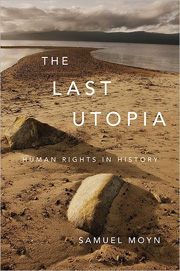
THE LAST UTOPIA: Human Rights in History


Samuel Moyn
Harvard University/Belknap Press ($18.95)

by Vladislav Davidzon

As discourse, rhetoric, ideal, and mantra, the specter of “Human Rights” haunts and permeates our world. This wraith is a reflection of our deepest and most humane hopes and aspirations for a better future. Respect for the dignity of the body, entitlements to education and clean water, freedom for thought and deed, of speech and assembly, and protections from government repression are all things that should be a human being’s birthright. “Human Rights” are in fact the watchwords of our age, engulfing and surrounding us, and are invoked constantly: ours is nothing if not an empathetic age. These words also serve as justifications for military interventions, the West having abandoned the prudence of risk-averse sleeping giants, and increasingly laboring to dislodge totalitarian regimes wherever circumstances present themselves—a barrage of artillery shells is pounding apartment buildings in Homs, Syria while I write this, and the West debates possible courses of action agonistically.

So where exactly does the idea of “Human Rights” come from? In his exemplary study The Last Utopia, Samuel Moyn, a historian at Columbia University, offers a revisionist and convincing riposte to the classical account of its development. The orthodox narrative is one of incremental and syncretic evolution, originating in Greek philosophy and stretching to a rebirth of idealism after the horrors of the Second World War. It posits, in brief: early Jewish jurisprudence and the political ideas of the Stoics were codified into the godly ‘natural law’ of early Christianity. The statutes of this celestial order were augmented by medieval sources, fashioned into cohesive form by the Renaissance, buttressed by early humanism and extolled as the emancipatory foundation by the Enlightenment before being tempered by utilitarian 19th-century protections for aristocracy. The phrase “human rights” remained mostly foreign to Anglo-American ears and sensibilities, but the French revolution’s call for the rights of man reverberated until the triumph of the United Nation’s ratification of the Universal Declaration of Human Rights in 1948.

For Moyn, though, that painstaking genealogy is almost entirely irrelevant. He locates the modern foundation of the concept in the disillusionment of postwar political arrangements, demonstrating conclusively that the assertions of universal rights by the allied powers were not to be honored. He does not consider the ensuing struggles of decolonization (and the civil rights campaign in the US) to be a struggle of “human rights,” but a continuation of the “rights of nations” agenda of the Versailles Treaty. This utopian idea had to first run the nationalist course before the leap could be made to Hanna Arendt’s ‘right to have rights’ for the individual. The Cold War impasse only renewed obverse ideologies—internationalisms, socialisms, third worldism, and fresh strains of communism (Maoist, revisionist, Althuserian, Marxist humanist). Before “Human Rights” could become the last utopia standing, it would have to vanquish or outlive a host of other, competing utopias that gripped the radical imagination. These other utopias were communitarian and economic, giving credence to the critique of “rights discourse” as one facet of neoliberalism.

For Moyn, 1977 was the pivotal year zero of “Human Rights.” With the unwinding of the Cold War, Jimmy Carter’s ascension to the U.S. presidency was accompanied by a declaration of human rights as the U.S.’s state policy; Amnesty International won the Nobel Prize and Charter 77 was founded in Czechoslovakia. In a chapter titled “The Purity of this Struggle,” Moyn writes of Western policy combining with the resistance of intellectuals in the Eastern Block. This emergence marked a truly international consensus, represented by the “refusenik” politics of Natan Sharansky and Andrei Sakharov, the spiritualism of Solzenitsyn, Václav Havel’s existentialist approach, the “Antipolitics” of György Konrád, and the legalist demands of Alexander Esenin-Volpin to make the Soviet Union respect its own constitution.

The signing of the Helsinki Accords heralded the inevitable bureaucratization and professionalization of the proliferating non-governmental organizations (NGOs). The chapter on the responses of International law illustrates the cautious approach taken by Western elites on the question of human rights during the Cold War. Implicitly, this is also story of the resurgence of the sovereign state, the rise of John Rawls-ian orthodoxy among political philosophers (though A Theory of Justice is mentioned only once, in the epilogue), and the coupling of “Human Rights” with state citizenship. To be a citizen everywhere, one has to be a citizen somewhere, as anyone who has ever been stateless has learned the painful way.

The book concludes with the formation of the “Human Rights” apparatus, and somewhat maddeningly draws a boundary at discussing the outcomes of the movement’s ideals over the last two decades. What happened or did not happen in Serbia, Rwanda, Darfur, Iraq, and Libya bizarrely fall outside of the purview of Moyn’s study. Yet, the argument is trenchant, subtle, and original; as such, it has led to vigorous criticism from all corners. Many who have weighed in question the book’s conclusions, but all have leavened their critique with a tone of subdued admiration—Moyn’s scholarship and bibliography are excellent. The Last Utopia is not the last word on human rights, but it is a heady place to enter the debate.

Click here to purchase this book at your local independent bookstore
Purchase this book at your local independent bookstore.

Rain Taxi Online Edition, Summer 2012 | © Rain Taxi, Inc. 2012

TOLKIEN AND THE PERIL OF WAR


Robert S. Blackham
The History Press (£12.99)

by Ryder W. Miller

The English era of World War I comes alive in this photographic and biographical tale of icon J. R. R. Tolkien's experience of youth, war, injury, and marriage. There are plenty of pictures and maps in this account by Robert S. Blackham, who connects the reader to a history that had a profound effect on Tolkien, the immediate literary fruits of which were not published until after the author’s death.

Before he became a professor and wrote his classic novels of Middle Earth, Tolkien was a loyal soldier. He was removed from the conflict because he caught Trench Fever and the flu, but the war remained with him, as evident in The Lord of the Rings. Like fellow Inkling C. S. Lewis, Tolkien sought to explain war to younger people, even though he attests to being uninterested in writing an allegory. Tolkien did seek to create a "new" myth for England, and The Lord of the Rings was later championed by a counterculture that enjoyed the pipe weed, idealism, and post-nuclear sagacity of the epic’s heroes.

Tolkien and the Peril of War does a good job of showing some of the connections Tolkien made from the English land to his classics; the highlighted Battle of Somme, for instance, left many places in England without an entire generation. Though Tolkien was one of the survivors, he had lost many of his friends, leading to a profound sense of sadness he expressed in his Miltonesque work The Silmarillion, which he was not able to get published during his lifetime. The book ends on a more hopeful note, with Tolkien off to marriage, scholarly success, and the literary stardom that makes his work as popular today as ever.

Click here to purchase this book at your local independent bookstore
Purchase this book at your local independent bookstore.

Rain Taxi Online Edition, Summer 2012 | © Rain Taxi, Inc. 2012

77 REASONS WHY YOUR BOOK WAS REJECTED

(And how to be sure it won’t happen again!)

Mike Nappa
Sourcebooks ($14.99)

by Luke Taylor

Kathryn Stockett knows the sting of rejection. According to a July 2009 article in The Telegraph, Stockett’s manuscript for The Help was rejected at least 45 times before it became a bestseller. Her perseverance paid off, but Stockett may have appreciated Mike Nappa’s new book, 77 Reasons Why Your Book Was Rejected (and how to be sure it won’t happen again!).

With more than twenty years of publishing experience, Mike Nappa knows all angles of rejection. From the first page of 77 Reasons, Nappa dismantles any romantic notions of the publishing industry, declaring it takes him just 60 seconds to reject a book proposal. Nappa isn’t being cruel; he’s simply sharing wisdom gained from slogging through slushpiles. “First, foremost, and always,” Nappa writes, “there is actually only one overarching reason why any book is published—or rejected: Profit.”

77 Reasons is divided into three sections: editorial, marketing and sales reasons for rejection. Some reasons are apparent (“Your Writing is Crap”) while others may be surprising (“You Are Not a Celebrity”). Each reason is clearly explained and followed by at least two solutions for overcoming it. As such, 77 Reasons becomes a sort of condensed, actionable amalgam of William Zinsser’s On Writing Well and the annual Writer’s Market guide.

With a natural and conversational voice, Nappa delivers home truths with mentor-like honesty, provides encouragement with avuncular warmth and even humor. For example, when Nappa describes how failure to do one’s research could lead to insulting an editor, he channels Homer Simpson: “these insults are unintended,” Nappa posits, “but the result is still the same—another ticket to Rejection-ville.”

Nappa’s approachable tone supports the greatest strength of 77 Reasons: establishing realistic expectations. The book’s subtext is that writing is hard work with elusive reward. “Too many people like the idea of ‘being a writer’ more than they like doing the work of a writer,” Nappa observes. “Make sure you are someone in that second category and not the first.”

There are aspects of 77 Reasons that do not work so well: some readers may find Nappa’s repeated self-deprecation disingenuous, and while he insists prospective writers practice impeccable grammar, Nappa himself falters at times with subject-verb-pronoun agreement, as in “the sales department says they [sic] can’t sell your book.” But perhaps the book’s biggest flaw comes when Nappa encourages would-be authors to learn about sales channels by interviewing a retail book buyer. There’s certainly nothing wrong with that, but Nappa advises readers to invent a fib to secure the interview: “Tell the secretary you’re doing research for an article for your website or for a report for your writer’s group.” Why he doesn’t suggest telling the truth (e.g. “I’m an aspiring author and I want to better understand the industry”) is puzzling, especially since everywhere else in 77 Reasons, he promotes honesty and transparency.

That blunder should not undermine the entire book, however; 77 Reasons is far too useful and it’s obvious Nappa writes with heart. Will 77 Reasons put off some would-be writers? Yes, but as Nappa asserts, “If I can talk you out of pursuing a writing career, then you don’t belong in publishing.”

Getting a book published is hard. Mike Nappa’s book makes it clear just how hard. But remarkably, his book might make it easier, too.

Click here to purchase this book at your local independent bookstore
Purchase this book at your local independent bookstore.

Rain Taxi Online Edition, Summer 2012 | © Rain Taxi, Inc. 2012

THE MESSENGERS


Malcolm Anderson
The Experience Publishers ($17.50)

by Scott F. Parker

In Running in Literature, Roger Robinson argues that the marathon “is without parallel in being a major sports event that has entirely literary origins.” Those origins reach back to Herodotus, Plutarch, and Lucian, but it was Robert Browning’s 1879 poem “Pheidippides”—which recounts the legend of the Greek messenger of that name bringing news to Athens in 490 BCE that their army had defeated the Persians in the Battle of Marathon, running the whole way and dying promptly after delivering the message—that later led organizers to include a long-distance race in the first modern Olympics (Athens 1896) to commemorate Pheidippides’ accomplishment. That race was approximately twenty-five miles, and none of the seventeen competitors completed the event without walking. The distance wasn’t standardized at 26.2 miles until 1921. Women weren’t allowed to marathon until the 1960s, and didn’t have the race as an Olympic event until 1984.

All this history is just to say that the marathon as we know it is an upstart. This makes the exponential increase in the number of people running marathons, the number of marathons out there to run, and the number of marathons individuals are running either more or less impressive—but in any case unprecedented as far back as we have records. It’s those distance runners who are compelled not just by distance but by repetition as well who interest Malcolm Anderson in The Messengers. “Messengers,” drawing from Pheidippides, are runners who have completed at least one hundred marathons.

Anderson became interested in these runners after meeting one at the 2006 Athens Marathon; Anderson was there to run his first marathon, Dave his 200th. This accidental encounter led the author to wonder why these runners keep going, what we can learn from them, and why “they all seem so damn happy,” and these questions set Anderson out to interview scores of messengers from around the world. The book intertwines his interview transcripts with musings on the sport and readings of the running literature and philosophy.

The result is as inspirational as you’d expect. The achievements themselves are staggering—runners who earn messenger status in a single year; runners who surpass 1,000 marathons—but perhaps more striking is the amount and kind of meaning these athletes draw from their sport. Again and again, the things these runners say about running center around friendship, learning, self-acceptance, and happiness. Health for them is as much mental, spiritual, and emotional as it is physical. These runners all participate in the joy of running qua running, a jovial state wherein the experience of running becomes its sole purpose. Anderson quotes James Fixx capturing this approach well in his book, The Complete Book of Running: “We can run where we want to. We can go fast or slow, hard or easy. We can run by ourselves or with friends. We can get out seven days a week or fewer. We can think or let our minds go blank. All these choices are entirely up to us: furthermore we can change them according to the minute-by-minute requirements and fancies of our minds and bodies.” The messages these runners carry begin from running but they finish with life itself: “throw away the watch,” says Jim Barnes; “enjoy the run,” says Harold Copeland. “That’s the answer. Enjoy whatever you’re doing.”

Click here to purchase this book at your local independent bookstore
Purchase this book at your local independent bookstore.

Rain Taxi Online Edition, Summer 2012 | © Rain Taxi, Inc. 2012

JOSEPH ROTH: A Life in Letters


edited and translated by Michael Hofmann
W. W. Norton & Company ($39.95)

by Steve Danzis

Lars von Trier’s latest movie, Melancholia, is a study of how different personalities respond to catastrophe—literally the end of the world. I was reminded of the film while reading Joseph Roth: A Life in Letters, edited and translated by Michael Hofmann. Roth, one of the finest German-language novelists of the 20th century, was inept at handling everyday matters. Depressed and alcoholic, he comes across in his letters as self-pitying, needy, manipulative, and sycophantic. Yet when Hitler rose to power in 1933, Roth understood the consequences of this event with greater clarity than many of his peers. As he wrote to his friend and benefactor Stefan Zweig, “The barbarians have taken over. Do not deceive yourself. Hell reigns.”

This wasn’t the first end-of-the-world experience for Roth. A Jew born on the eastern edge of the Hapsburg Empire, he served in the Austro-Hungarian army in World War I and developed a strong sense of patriotism. “The most powerful experience of my life,” Roth said, “was the war and the end of my fatherland, the only one I have ever had: the Dual Monarchy of Austria-Hungary.” After the war, Roth began his writing career. He became one of the highest-paid German journalists, and his work led him to travel throughout Europe. Roth was essentially homeless well before he fled Berlin in 1933, a condition he shared with most of his fictional protagonists.

Roth said that if he were a publisher, his motto would be, “Books with practical occasion elevated into the poetic sphere.” The phrase “practical occasion” seems to signify realism—Roth rejected the formal experimentation of Modernists such as Joyce and Proust. He has sometimes been compared to Tolstoy, both for the breadth of his social vision and the vividness of his prose. But he was probably more influenced by Flaubert. Often in his fiction, precise descriptions veer off into figurative language that heightens the verisimilitude of a scene but also gives it a hallucinogenic quality. Here is an example from his masterpiece, The Radetzky March:

The church, with its shingle roof, stood in the middle of a little graveyard, surrounded by slanting crosses, which seemed to sway in the moonlight. Before the high, gray, wide open churchyard gates three corpses were strung up—a bearded priest between two young peasants in sand-colored smocks with rough raffia shoes on their motionless feet. The priest’s black cassock reached to his shoes and, from time to time, a night wind stirred them so they swung against the round edge of the cassock, like dumb clappers in a soundless bell, which, though no sound came, appeared to be ringing.

The passage describes an incident in the first days of World War I; the metaphorical bell tolls the death of the Hapsburg Empire.

No writing of this quality appears in Roth’s letters. Michael Hofmann introduces his collection with a sort of apologia, admitting that the surviving letters “have little bearing on [Roth’s] literary output, and are not even addressed to the people who mattered most in his life.” In the absence of a biography in English, Hofmann hopes that the letters will give readers a sense of Roth’s chaotic life and help us understand the circumstances in which he wrote. Roth is indeed a fascinating, complicated figure, and no one has been more devoted to restoring his reputation than Hofmann, whose section introductions and footnotes provide valuable information. However, too many of these letters would be of interest only to Roth scholars, most of whom could read them in the original German.

The heart of the book—Roth’s exchanges of letters with Stefan Zweig—would make a worthy volume if they were collected on their own. (It would be tempting to reuse the title of Zweig’s best-known work, Beware of Pity.) Like Roth, Zweig was an assimilated Austrian Jew, but their temperaments were very different. Independently wealthy, Zweig was a pacifist during World War I, and he achieved international fame for his writing in the 1920s and 1930s. Roth first wrote to him in 1927 to thank him for praising one of his books; they did not meet in person until two years later. At first, Roth just complained to Zweig about his overwork, financial problems, and personal crises (his wife was institutionalized for schizophrenia.) Then he began to ask for favors, including loans that he failed to pay back. He often accompanied these requests with expressions of self-disgust: “Any friendship with me is ruinous . . . You have no idea how dark it is inside me. My dear, admired friend, you have the grace of luck and of true golden joy in the world . . . Basically, you don’t like people like me; and quite rightly: because they harm you.”

The Nazi takeover of Germany made Roth more dependent on Zweig but also more domineering in their relationship. Roth condemned anyone who compromised with the Nazi regime. Zweig went into exile in London, but he resisted attempts to draw him into the political opposition, and he tried to remain with his German publisher. “You may be smart,” Roth warned, “but your humanity blinds you to others’ wickedness. You live on goodness and faith. Whereas I have been known to make sometimes startlingly accurate observations about evil.” Roth even threatened to end their friendship, despite his indebtedness to Zweig: “there will be an abyss between the two of us, unless and until you have finally and innerly broken with Germany.” The matter was soon resolved by a new German law that invalidated all contracts with Jewish authors.

Roth occasionally offered astute criticism of Zweig’s writing, softening him up first with flattery and then dissecting his weaknesses. Roth was a better writer than Zweig, which both of them recognized, and he continued to write well until the end of his life. Yet rather than gaining comfort from his work, Roth sank deeper into depression and alcoholism. Zweig’s advice to quit drinking and get his finances in order often aroused indignation: “And I tell you now, with the justification of the condemned friend that you are unfair to me, unfair, UNFAIR!! —You do NOT have the right to judge me. . . .” In other letters, Roth groveled: “Please, please don’t forsake me! Don’t take anything here amiss! Picture me lying flat out on my deathbed. Forgive me.”

Zweig, amazingly, did not forsake Roth. As Roth raged against publishers he felt had betrayed him, Zweig began to fear he was losing his sanity, but Roth insisted there was a moral logic to his unreasonable behavior. Citing his World War I experiences, he wrote: “even then, in the trenches, staring death in the face 10 minutes before going over the top, I was capable of beating up a son of a bitch for claiming he was out of cigarettes when he wasn’t. The end of the world is one thing, the son of a bitch is another.” As it turns out, Roth’s cynicism was often a surer guidepost than Zweig’s idealism. When Zweig complained in 1938 about an Austrian publisher who mistreated him, he seemed to forget that four years earlier, Roth dismissed the publisher as a “little twit” and chided Zweig for his “‘blind’ holy credulity.”

Roth died from symptoms of alcoholism in the spring of 1939. It is said that he purposely drank himself to death, but there is something curiously life-affirming about Roth’s despair. Just before his death, Roth rejected Zweig’s claim that their situation was hopeless, and he characterized him as a defeatist. Once again, his perception was astute: Zweig eventually moved to Brazil, where in 1942 he committed suicide, unable to endure his comfortable life in exile. By the end of the collection, one comes to realize how dependent Zweig was on his extraordinarily needy friend. In one of his last letters to Roth, he wrote about his “deep need to sit with you again, to talk things over, and above all to hear about you and your work. I know nothing of you, and I don’t want to lose you.”

Click here to purchase this book at your local independent bookstore
Purchase this book at your local independent bookstore.

Rain Taxi Online Edition, Summer 2012 | © Rain Taxi, Inc. 2012

AN AESTHETIC EDUCATION IN THE ERA OF GLOBALIZATON


Gayatri Chakravorty Spivak
Harvard University Press ($35)

by W. C. Bamberger

The first paragraph of Gayatri Chakravorty Spivak’s Introduction to An Aesthetic Education in the Era of Globalizaton announces, “Globalization takes place only in capital and data. Everything else is damage control.” For Spivak, the “most pernicious presupposition today is that globalization has happily happened in every aspect of our lives,” yet, she objects, it “can never happen to the sensory equipment of the experiencing being” in any significant way. It is this experiencing being, the part of us that can learn to recognize and to swerve from the beliefs and desires of globalization, that Spivak addresses in these essays.

For Spivak the new, electronically homogenized and all-pervasive information flow which is adapted to and created by a desire to attach oneself to the flashy powers of capital and data have ruined, among other things, “knowledge and reading.” The effect of this is that most of us no longer know what to do with the information to which we are exposed. Information is now most often sorted but not analyzed in any depth; it is used mostly to support the new globalized electronic capitalist model. When scholars in the humanities try to join the globalization parade, the result is that they become “epistemologically challenged market analysts,”and are “no longer a moving epistemological force. They will increasingly be like the opera, serving a peripheral function in society.” Spivak advocates a return to an earlier model of reading and of knowledge formation, one that embraces intellectual wandering and chance and avoids limiting itself to the rational and to self-interest.

In that spirit, Spivak offers this thick collection of essays which, as she tells us, concern themselves with a “productive undoing” of the current popular aesthetic of what should be learned and desired. She strives to alter the aesthetic—that which forms the premises of “the doing” beneath the globalization—by looking carefully at “the fault lines of the doing . . . with a view to use.” The goal of Spivak’s approach is to create a new aesthetic basis, one with different premises, from which a new epistemology could develop, one that will promote the emergence of new—and ideally less destructive and numbing—desires. Because as Spivak knows, desires (not needs) are what drive cultures, and desires are shaped by what is admitted into the process of the formation of knowledge. More simply put, what we believe we know shapes what we desire.

The essays gathered in this book were written over a span of more than a quarter century. They share a number of common concerns—translation, education reform, the effects of the new global capitalism, nationalism and literature, the “international civil society” (NGO’s that cross borders), and Marxist economics, to name a few. They offer both theoretical approaches and intriguing anecdotal support. In “The Burden of English,” for example, Spivak observes that a reader cannot make sense of anything written or spoken without at some level believing it was “destined” for them; therefore, Indian students of English Literature “might still be open . . . to an alienating cultural indoctrination that is out of step with the historical moment [of pulling away from the former colonial power].” That is, engagement with literature can “bring a degree of alienation.” This theoretical note is reinforced by her personal experience of having taught English Literature in post-colonial India. In “Translating into English” what begins as a traditional exposition on the philosophical difficulties of translation ends with Spivak contemplating the odd dynamics of translating some forty-plus-year-old poems from the Bengali, poems that were written for and dedicated to her by a young man she had never spoken to and who had only watched her from afar for two days in 1961.

As has been observed many times, Spivak’s writing style is difficult. (In interviews she seems almost proud of this.) The difficulty is in part due to the fact that Spivak often chooses not to present her arguments in a simple linear fashion, but it is also in part because she chooses to “borrow” terms and use them in senses which differ from those we are used to. Spivak’s use of the term “double bind,” for example, may be distracting to readers familiar with Gregory Bateson’s coining and uses of the term. While Spivak credits Bateson and quotes from some of his work, the most fundamental aspect of the term for Bateson—that either of two possible choices result in equally punishing ends—is absent. In most instances Spivak’s use of the term means something more like a dialectic, but without the need for any syntheses to emerge. The use of “double bind” may introduce an extra element of tension and a suggestion that what needs to be changed is our habits of thinking, but it also introduces a level of blurring into the language.

Other terms can be equally challenging. The most important of these terms for her arguments here is probably “subaltern.” ”Subalternity is the name I borrow for the space out of access to the welfare mechanisms, however minimal, of the state,” Spivak writes—those so far down the class and financial helix that their governments are no longer able to mitigate (or are no longer interested in mitigating) their circumstances. Spivak sees hope for aesthetic education in this subaltern, a hope that some sympathetic intellectual and social movements above them still believe they can learn from those below. She explicitly denies that she is advocating “romanticizing the aboriginal”; rather, this would be taking from the subaltern a view of the world not dependent on reason and self-interest. “We want to open our minds to being haunted by the aboriginal. We want the spectral to haunt the calculus.”

Spivak deliberately positions the reader to react with skepticism to her work. Her conclusions and suggestions are presented as being firmly based in theory and reinforced by personal experience, yet she does not present them as definitive. There is a pervasive sense in the Introduction and in the updating material she has written into a number of essays that Spivak now believes—or at least wants us to believe—that she had settled for too-easy answers in earlier considerations of the questions she looks into here. Yet, even in the essays she now casts a skeptical eye upon, she can be seen constantly revising her opinions—just as she tells us an aesthetic education ideally must do. For example, in reconsidering the idea that women must be more integrated into the workings of the world economy and considering the terms “women’s reality” and “the beginning of global feminism,” Spivak sees even these positive-seeming ideas in a skeptical light:

Although eminently efficient and benevolent, these headings are in a double bind with the far less bold and confident but far wiser premises of an aesthetic education.

In the end, Spivak offers these essays not as finished thoughts, not as exemplars of intellectual or moral conclusion, but as models for how aesthetic thinking might proceed and how it might meet the challenge of the blinding, glittering—and at the same time numbing and narrowing—allure of globalization.

Click here to purchase this book at your local independent bookstore
Purchase this book at your local independent bookstore.

Rain Taxi Online Edition, Summer 2012 | © Rain Taxi, Inc. 2012

THE STRANGEST TRIBE | EVERYBODY LOVES OUR TOWN

THE STRANGEST TRIBE
How a Group of Seattle Rock Bands Invented Grunge
Stephen Tow
Sasquatch Books ($18.95)

EVERYBODY LOVES OUR TOWN
An Oral History of Grunge
Mark Yarm
Three Rivers Press ($15)

by Justin Wadland

Eddie Vedder tore apart a hotel room when he found out Kurt Cobain had killed himself. “Then I just kind of sat in the rubble, which somehow felt right . . . like my world at the moment,” he later told a reporter. Pearl Jam happened to have a visit to the White House scheduled the following day, so on April 9, 1994, Vedder dusted himself off and appeared in the Oval Office. Fearing a rash of copycat suicides, President Clinton pulled the lead singer aside and asked whether he should address the nation. Vedder wisely counseled against it: such a speech would only generate more attention.

That the Leader of the Free World would consider publicly responding to a rock star’s death reveals how far Nirvana—and grunge music—had come. Just ten years before, Seattle was a town most major rock bands skipped on their tours, the kind of place aspiring musicians fled for brighter lights and bigger cities. But in the early 1990s, as if a butterfly flapped its wings in the temperate rain forest and set off a rock music hurricane, a series of Seattle bands topped the music charts, decisively knocking Michael Jackson and hair metal bands like Guns N’ Roses and Poison from their positions of dominance. Almost overnight, Seattle became a destination and a commodity. Over twenty years have passed and an entire generation has grown up and come of age since the release of those breakout albums from Nirvana, Pearl Jam, Soundgarden, Alice in Chains, and the like. Now seems a good time for a reckoning and accounting of whatever the hell happened back then.

Two recent histories of grunge—Stephen Tow’s The Strangest Tribe and Mark Yarm’s Everybody Loves Our Town—attempt to do just that, in different but complementary ways. Both books illustrate that this story is funnier and more twisted and ironic than commonly understood. What most of us listeners outside the Seattle music scene think of as grunge actually started at least a decade before, and many considered grunge dead before it was born to the world. For instance, Mudhoney’s “Touch Me I’m Sick,” released circa 1988, is often credited as the quintessential grunge song, not Nirvana’s “Smells Like Teen Spirit.” “Nirvana’s ascendance would unintentionally pollute Seattle’s cultural waters,” comments Tow. “If they had not happened, Seattle would have inevitably moved beyond grunge by 1990, and likely garage [rock] would have predominated. But Nirvana did happen.”

As a professional historian, Stephen Tow combines considerable research and analytical abilities in The Strangest Tribe as he identifies the various elements that created this moment. Beginning in 1975, he catalogs and profiles the succession of bands, venues, local music publications, cheap recording studios, and independent labels that together created a healthy ecosystem for original music. His accessible, if somewhat flat-footed, prose condenses an immense amount of information, all with an eye toward the cultural and historical significance of the topic at hand. For example, when he assesses the impact of Op, a small publication based in Olympia, Washington, that reviewed independent labels and artists in the 1980s, he writes: “In the pre-Internet world, London and New York media outlets drove the direction of popular culture. Any trends with any validity typically emanated from the two cities and, after several years, made their way to U.S. West Coast cities and the hinterlands . . . Op changed all that. Perhaps for the first time, music fans around the country learned about underground trends as they were happening.”

In Mark Yarm’s oral history, Everybody Loves Our Town, the story begins in 1985, at an infamous U-Men performance at the Seattle music festival Bumbershoot. Later called a bridge to grunge, the U-Men were the biggest act in town at the time, the band everybody admired. At the end of their set, two roadies poured lighter fluid into the moat around the stage, and the lead singer, John Bigley, ignited the water, creating a brief but intense wall of flame. “I was blown away by the audacity of it. I’m sure if there was a panoramic shot of the crowd, virtually everyone who ended up in a band or was in a band at the time was at that show. I think if you were in a band and you saw that, it made you step up your game.” This observation comes from Kerri Harrop, an employee of the Sub Pop record label, one of over 250 people Yarm interviewed. Although based entirely on testimony, the book arranges quotations in a narrative collage organized around themes, events, and personalities. It reads like a Russian novel, with the requisite huge cast of characters, convoluted but compelling plot line, absurd humor, existential crises, and pervasive gloom.

Although the two books cover the same territory, their different approaches underscore the uncertainty that underlies much of this history. Consider the murky origins of the word grunge for this genre of music. As a historian, Tow offers a definitive explanation: “[Bruce] Pavitt created and hyped the term ‘grunge’ to describe Sub Pop’s bands . . . Pavitt’s use of the term perfectly described Mudhoney and Sub Pop’s early bands. Within a few months, ‘grunge’—initially used in a joking manner—would take on a life of its own.” As evidence, Tow cites a snippet of Sub Pop publicity for the prototypical grunge band Green River. In contrast, Yarm’s oral history spins together a series of snapshots from inside the whirlwind of hype surrounding the term, both explicating and undermining any kind of definite etymology. One person portrays the Sub Pop guys pulling it out of a thesaurus. Another cites a fake hate letter Mark Arm (lead singer of Mudhoney) wrote about his own band back in ‘81. Then, David Duet from Catt Butt mentions putting grunge in a band logo in the late ‘80s. And finally, Jack Endino claims to have tossed the term around all the time before it became popular. “No one fucking knows, and frankly I don’t think anyone really wants to take credit for it,” Endino concludes. “So let’s leave it at that.”

This deep ambivalence toward the term derives from what happened in the 1990s. Nothing demonstrates just how heated and bizarre things got more than the tale of the “lexicon of grunge.” A journalist from The New York Times called the offices of Sub Pop in 1992, curious about grunge slang. “One problem remained, however,” comments Tow, “there was no hip grunge slang.” Weary of media attention, the former Sub Pop receptionist Megan Jaspers thought she’d have a little fun. “Why don’t you give me words, and I’ll just give you the grunge translation,” she told the reporter. Here’s a select list of what ended up in the article:

Wack slacks: Old ripped jeans
Swinging’ on the flippety-flop: Hanging out
Bloated, big bag of bloatation: Drunk
Lamestain: Uncool person
Rock on: A happy goodbye

The band Mudhoney thought the list hilarious and began dropping grunge lingo into their interviews. The record label C/Z made “Lexicon of Grunge” T-shirts with LAMESTAIN on the front. When the Times found they’d been duped, they weren’t happy. Still, when the editor of the Style section called to chew out Megan Jaspers, she did ask where she could buy one of those LAMESTAIN T-shirts.

It is telling how each book deals with the consequences of the Faustian bargain that propelled these bands to fame. Tow concludes his history with the release of Nirvana’s Nevermind and focuses on its effect on larger musical trends: “Prior to Seattle’s explosion, alternative rock meant simply that: rock bands whose songs did not receive play on commercial radio and whose videos did not show up on MTV. After Seattle, alternative rock became a commodity. Anyone who sounded like Nirvana became the new alternative rock.” By contrast, Yarm’s oral history is only half finished by the time Nirvana strikes gold. There remain hundreds of pages that chronicle the human toll of this unexpected storm of wealth and fame. (To make a long story short, the drug of choice was heroin, and the word of choice to describe what happened to individuals, bands, and the scene in general, is “implode.”)

If The Strangest Tribe were a Seattle band, it would be Mudhoney. The book was published by a small, Seattle-based independent press called Sasquatch Books and deserves more attention. A geeky and infectious enthusiasm permeates Tow’s work, and his approach allows him to emphasize the diversity of the Seattle music scene and profile a number of bands that didn’t fit into the grunge mold. The Seattle band equivalent for Everybody Loves Our Town is Pearl Jam: it’s a blockbuster of a book, with blurbs from famous people on the cover. Time just named it one of the top ten nonfiction books of the 2011. All this recognition seems justified, given the book’s breadth, quality, and hypnotic ability to absorb readers.

As many details as both books provide, they still leave open the question of what actually happened, not behind the scenes, as Yarm definitively tells it, but in the consciousness of those who listened to and bought this music. “Nirvana appealed to a disaffected Generation X who found modern music out of touch with their everyday angst,” asserts Tow, and although accurate, this claim is ultimately dissatisfying. Historians and journalists may be able to document, explain, and even show which way the wind blew, but why did it blow in the first place? This is a mystery to mull over but never answer as you play those old grunge tunes again. Rock on, lamestains.

Click here to purchase Everybody Loves Our Town at your local independent bookstore
Purchase this book at your local independent bookstore.
Click here to purchase The Strangest Tribe at your local independent bookstore
Purchase this book at your local independent bookstore.

Rain Taxi Online Edition, Summer 2012 | © Rain Taxi, Inc. 2012

PIERRE JORIS: Cartographies of the In-Between


edited by Peter Cockelbergh
Litteraria Pragensia (€12)

by Megan Burns

“There is no difference between inside and outside at the poem’s warp speed.”
—Pierre Joris, Notes Toward a Nomadic Poetics

Cartographies of the In-Between collates a number of essays by various writers about Pierre Joris and his life as a translator, poet, and manifestor of “Nomad Poetics”; it’s a collection that should prompt a studious return to Joris’s own invaluable contributions to poetic discourse. Editor Peter Cockelbergh had previously drawn a line between two of these works in a 2010 essay for Jacket, in which he points out that A Nomad Poetics introduces the poetic concerns of Joris and that Justifying the Margins fleshes out these concerns more fully (a newer version of this essay appears in Section V of Cartographies). Continuing in that vein, I would argue that not only are these two collections of essays germane to an understanding of Joris’s poetry, translation, and thinking about poetry, but that Cartographies triangulates these two collections, opening up the conversation to many voices. In order to understand Joris’s work and his inclusive approach to poetry, it would stand to reason that a full appreciation of his work would include a reading through his work by others, as well as an enmeshed reading and dialogue with his own words and excavations.

One thread to follow into the labyrinth is Joris’s decades long research and interest in the poetry of the Maghreb. An interview entitled “Maghreb, Algeria- géographèmes” conducted by Peter Cockelbergh, provides one way to begin to frame Joris’s interest in this; in addition, Mohammaed Bennis’s essay investigates the “Arabic Islamic Turn” in Joris’s poetry, examining the recent collection Meditations of the Stations of Mansour Al-Hallaj. This in turn can be read in concert with Joris’s own essay “On the Nomadic Circulation of Contemporary Poetics” found in Justifying the Margins, where Joris outlines his interest in three Maghrebi writers: Abdelwahab Meddeb, Habib Tengour, and Driss Chraïbi. From there one can gaze back into Joris’s past, etching out where his initial experience with these writings were formed. “A Memoir for Mohammed Khaïr-Eddine” (from the second section of Justifying the Margins, which includes five essays for friends of Joris who have passed away—including a touching tribute to Jacques Derrida and an intense recollection of poet Douglas Oliver) can be read in connection with Jean Potante’s essay from Cartographies called “Justification of the Margin: Luxembourg in the Poetic Work of Pierre Joris,” which details the influence that Khaïr-Eddine had on Joris’s early adoption of a life dedicated to poetry as well as a poetry written in a language other than the languages of his youth.

And so, it is “in-between” the readings of these texts that we gather a rounder and more textually rich understanding of Joris’s continued interest in the poetry of the Maghreb as well as poetry written in the Arabic language. Some of this is informed by the early, intense relationship of a young Joris with Khaïr-Eddine, while another layer consists of Joris’s need to right what he sees as an earlier error on Pound’s part in not looking further than the Troubadours for the seeds of language that influenced the Modernist writers: “the Western refusal, century-long, to connect the Mediterranean to open up to the Arabic, to envisage our lyric as also a diasporic entity.” It is a poetics that reads and understands language “horizontally,” to use Joris’s term, and one that allows him to view the poetry of the Maghreb, the poetry of Pound, Duncan, Olson and the Beats, and his own poetry as contemporaneous and involved in an ever-deepening conversation about language.

It is this search that leads Joris from his own written languages of French, German, and English to seek to understand Arabic—and not just Arabic as a language but in the way that an ethnographer must investigate how the language functions in the culture and environment. To that end as a translator, Joris seeks to piece together the threads of the “textum” as he terms it, the invisible threads of language that are woven together to create the final document. In the case of Maghrebi writers such as novelist Driss Chraïbi, it is the langue fourche, the “forked tongue,” that draws Joris’s attention. Joris takes into account the choice to write in the language of the colonizer, French, while remaining on the lookout for the “ghostings of Arabic” in the writing: “The colonizer’s language too is caught in an irresolvable double bind: no language is a house the writer can simply inhabit, the only home is found in the ever-shifting force field of the spaces of its internal contradictions.” This “basic law of nomadicity,” as Joris calls it in Justifying the Margins, echoes his earlier writings in A Nomad Poetics and thrusts us further, if we choose, into our archeological dig into Joris’s poetics and poetic interests. For example, the poem “The Work of Al-Ishk,” collected in Poasis, ruminates on the various threads running through Arabic language and history that spark Joris’s curiosity. Joris tells us in his introduction to his newly released volume of translations of Maghrebi poet Habib Tengour, Exile is My Trade: A Habib Tengour Reader, that “Maghreb1” can be translated as “west” and following that path leads to the idea of traveling so far west that one becomes an exile—hence Tengour’s choice of a title for his reader. This etymology is another clue as to why Joris would be attracted to Maghrebi writers. While Joris has contended he believes translation is a responsibility, it’s no accident that he is drawn to “exiles” and to writers who choose to write in a language that is not their “mother tongue.”

To return to Cartographies, it is again Mohammed Bennis’s essay on Joris’s turn towards Arabic Islamic poetry that can further enrich our understanding of Joris’s own work. Bennis pays particular attention to Joris’s interest in early Sufi mystics, whose influence contributes an important tenet to Joris’s Nomad Poetics. The term “Mawqif,” which is used by Sufi Muslims to define the stopover or moment of rest between movements, is incorporated into Joris’s long poem Meditations on the Stations of Mansour Al-Hallaj. Bennis points out that the idea of stations as resting places conflates a term used by the Sufi Poet Niffari, while the title of the poem alludes to another Sufi Poet of the 10th-century, Mansour Al-Hallaj, who was executed for his use of language. It is easy to see why this mystic’s “poethics”—to layer Joan Retallack’s modern term on an ancient history—would intrigue Joris. Al-Hallaj spoke the words that loosely translate “I am the Truth,” but more importantly, he deigned to weave together the vernacular and the sacred, eventually paying the ultimate price. Bennis points out that even physically, the dip into Arabic requires a change in movement, a reordering of senses in order to get “used to the traits of letters that begin at the right hand side and move to the left hand side.” This movement on the actual page is a vital point, emphasizing Joris’s nomadic notion that one should always be moving. It is when one becomes complacent that the language suffers.

Al-Hallaj’s story is linked to that of Nimrod, who was punished for attempting to reach God via the tower of Babel; his punishment was the break in language, the cut or slice that separated a unifying tongue. “Nimrod in Hell,” the opening piece in Justifying the Margins, takes up Dante’s version of the figure, a character babbling what appears on the surface to be nonsense. Joris sets up unanswerable questions: Is this the Babel-language that we lost or simply the post-Babylonian language that makes translation possible? In either case, Joris believes it is more than just nonsensical blather. If all poetry is its own language, as Joris avers via Robert Kelly, then it is a poem we have yet to translate. Joris uses Al-Hallaj’s mystic terms in Arabic next to his English translations and he incorporates this idea of the “mawqif” into the form of Meditations on the Stations of Mansour Al-Hallaj, where he provides his readers with a contemporary landscape through which to view and embody this idea. He quite literally brings the form forward through a combination of translation and poetry and breathes new life into it, re-animating it as a viable “station” or meditative space for readers to experience. What the Meditations reveal is what Joris has always contended: that it all accrues and goes into the work. The research, the excavation of language, the translating of words at their most basic units, and the living that is done in between; these all join in the final “textum.”

In her essay “Before Babel” in Cartographies, Alice Notley returns to the image of Nimrod babbling and struggles with Joris’s contention that all writing is translation. Instead of translating, Notley defines her own writings as a “harnessing of the magic horse of sound, rhythm.” This in turn brings back the idea of babbling, the vibration that the body makes as it attempts to speak and our need to make sense of that which we find trapped in our minds. Notley’s stance is that before Babel is the same as after, in the sense that the poem travels out on sound, first and foremost. Translatable or not, the landscape of the poem allows us to transcend meaning and to function in a different realm than one defined by pure reason and narrative. This idea recalls another Arabic term favored by Joris, the “Barzakh,” which translates as barrier, veil, or curtain. It is used to name a connection from one to another or as the link between. In this example, I imagine that Notley accesses her poetry from a space similar to a “Barzakh,” a place hidden from us, and yet one in which the poet can move between, returning with the language. Notley and Joris would likely agree that there is a little magic involved in the exchange no matter what word is used to define it.

Joris’s interest in the Maghreb has reached a true pinnacle with the publication of his latest book of translations: Exile is My Trade: A Habib Tengour Reader. Joris met Tengour at the University of Constantine while teaching there in the late 1970s. Presently, the two poets have been collaborating in editing the fourth volume of the indispensible Poems of the Millennium series of anthologies, due to be released later this year. In the “ReadySteadyBlog Interview” found in Justifying the Margins, Joris states “it is in questioning his [Tengour’s] work . . . that I recognize my own quests the most.” Tengour’s essay in Cartographies, “The Trace and the Echo,” describes their long friendship, and the editor notes that the descriptions are punctuated with passages from Meditations on the Stations of Mansour Al-Hallaj, which Tengour translates into French when composing his essay. Moving across languages, Tengour says of Joris: “Transcriber in an alphabet pieced together well away from metropolises. To discover in all innocence what digs into language.” And from Exile is my Trade, Joris translating Tengour gives us this: “He has woven the poem in secrecy. Months of retreat in the desert, at the mercy of winds, so as to conform to the tradition. Chaffing and the whip. The echo’s harshness initiates into tonal ruptures.” If we take Joris at his word, then this new collection of translations of Tengour’s poetry and prose is another way of understanding and experiencing the quests dear to Pierre Joris.

1 In Cartographies, “Maghreb” is spelled with an “e” while in Exile is My Trade, Joris begins to use the “Maghrib” spelling. The Arab spelling for al-maghreb is المغرب—consonants without vowels.

BOOKS BY PIERRE JORIS:

Meditations on the Stations of Mansur Al-Hallaj (Chax Press, 2012).

Justifying the Margins: Essays 1990-2006 (Salt Publishing, 2009)

A Nomad Poetics (Wesleyan University Press, 2003)

Poasis: Poems 1986-1999 (Wesleyan University Press, 2001).

TRANSLATIONS BY PIERRE JORIS:

Habib Tengour, “Exile is My Trade:” A Habib Tengour Reader, (Black Widow Press, 2012).

Poems for the Millennium Volume 4, Diwan Iffrikya: An Anthology of North African Writings from Prehistory to Today, eds. Pierre Joris & Habib Tengour (University of California Press, 2012).

Rain Taxi Online Edition, Summer 2012 | © Rain Taxi, Inc. 2012