
Uncategorized

The Story of a New Name

storyofnewnameElena Ferrante
Translated from the Italian by Ann Goldstein
Europa Editions ($18)

by John Toren

The Story of a New Name is a whirlwind account of friendship, rivalry, and waning interdependency between two women—Lila and Lenú—who have grown up together in a lower-class neighborhood of post-war Naples. We see events largely through the eyes of Lenú, who admires and measures herself against the more attractive, outgoing, and impulsive Lila, but in the book’s first few pages we learn that Lila has given Lenú a box of journals, demanding that no one was to read them and making Lenú swear she herself won’t open the box “for any reason.” Of course, Lenú has hardly sat down on the bus before opening the heavy box, and the insights she gleans from these often random scribblings allow her to paint a more complete picture of Lila’s inner life during the period she goes on to describe in great detail.

Author Elena Ferrante chronicled the shared childhood of these girls in My Brilliant Friend (Europa Editions, 2012), and she wastes little time here moving the story along. The early part of the book deals with Lila’s impulsive marriage, at the age of sixteen, to Stefano, the son of a grocery-store owner who’s invested heavily in her own family’s small shoe-making business. Two incidents set the tone of this new phase in Lila’s life: At her wedding reception, Marcello, a member of the powerful but arrogant and widely feared Solara family, shows up wearing a pair of shoes Lila had designed herself and given to Stefano as a love token, and Lila throws a fit. Stefano later explains that Lila’s own brother, Rino Cerullo, had also been party to the gift, which was intended to bolster a “collaboration” between the Solara and Cerullo families. This tension between personal affections and family business interests keeps the plot simmering throughout the book.

Later that evening, Stefano resorts to violence in the course of consummating the union, and Lila suddenly realizes that she’s married to a brutal stranger. Yet when she returns to the neighborhood from her honeymoon, blackened and bruised, the general attitude seems to be that someone has finally put Lila in her place. Still, Lila has a suddenly loftier position in the local social hierarchy, with a new house and car, nice clothes, and an influential role in running the grocery store, and this estranges her from Lenú, who’s still going to school and is dismayed by her friend’s increasingly outlandish swagger and focus on material things. Meanwhile, Lenú pines for the brilliant and studious Nino, another figure from the neighborhood, who unfortunately happens to be dating Nadia, the daughter of Professor Giuliana, whom Lenú esteems highly.

Ferrante’s description of these and other tangled interrelations between individuals and families carries the flavor of intense adolescent emotion. It’s an appealing tone in small doses, but readers may begin to wonder whether the narrator’s inability to distinguish clearly between important developments and petty exchanges is shared by the author herself. The novel gains in narrative focus, however, when Lila hires Lenú to accompany her on a seaside vacation with her mother and her sister-in-law Pinuccia. (An Index of Characters in the front of the book will be greatly appreciated by those who have not read My Brilliant Friend.) Lenú agrees to come, only after deviously convincing Lila to change her vacation to a locale where Nino is spending the summer. All summer long, she and Lila meet up with Nino and his rich friend Bruno daily on the beach during the week, though on weekends Stefano (Lila’s husband) and Pinuccia’s fiancé Rino (who is Lila’s brother, as you may recall) arrive to have some fun.

Alas, Lenú, always the sensible, prudent one, is the last to figure out that Nino, though still dating Nadia, is actually in love with the now-married Lila—just like everyone else. It occurs to her at roughly the same time that perhaps she has spent her life on the sidelines watching Lila and others grab for one brass ring after another because she never shares her true feelings with anyone. Digging a little deeper, she muses: “Did I keep my feelings muted because I was frightened by the violence with which, in fact, in my innermost self, I wanted things, people, praise, triumphs?” She begins to wonder whether her desire to rise above her condition, to speak Italian well—rather than the coarse Neapolitan dialect used in her neighborhood—has driven her to avoid exposing herself honestly in any way, for fear of making a mistake.

Even her unrequited affection for Nino seems to be based largely on admiration of his lofty ideas and intellectual prowess. She enjoys listening to him talk, though she often has no idea what he’s talking about. Decentralization? Economic planning on a regional basis? Africa? The Social Democrats?

     We went on like that for at least an hour. Isolated from the shouting around us, its coarse dialect, we felt exclusive, he and I alone, with our vigilant Italian, with those conversations that mattered to us and no one else. What were we doing? A discussion? Practicing for future confrontations with people who had learned to use words as we had? An exchange of signals to prove to ourselves that such words were the basis of a long and fruitful friendship? A cultivated screen for sexual desire? I don’t know. I certainly had no particular passion for those subjects, for the real things and people they referred to. I had no training, no habit, only the usual desire not to make a bad showing. It was wonderful, though—that is certain.

Some readers may reach the end of this longish book wishing the narrator had spent more time exploring the political and academic controversies of post-war Italy, and less on the often squalid rivalries, infidelities, threats of violence, and general bad blood stewing in her old neighborhood, which sometimes call to mind low-budget Neorealist films of the era. Lenú feels nowhere so at home as in the parlor of Profession Giuliani, yet she can’t shake the conviction that there is more vitality to be found on the streets of Naples than in verbose political controversies or the acutely circumscribed subject matter that academics find so fascinating.

It’s difficult to hold a story together in which we get to know the central character largely through the eyes of a less flamboyant admirer. Eventually we may weary of Lenú’s incessant self-depreciation, and wonder when she’ll finally accept the fact that others try to convince her of from time to time: you’re smarter than Lila, you’re prettier than Lila. In the end, Lenú’s gifts of observation and general decency compensate for occasional tiresome patches in the storytelling. At one point, for example, as she watches Lila and Nino flirting shamelessly on the beach, she notes that Nino is friendlier than she’d ever see him before. “I thought: the fact that Lila is married isn’t an obstacle for him or for her, and that observation seemed to me so odiously true that it turned my stomach, and I brought a hand to my mouth.”

Lila’s character is less easy to admire. She’s generous and spiteful by turns, stricken by an impetuous desire to experience life that drives her to arrange things so that they suit her best, confident that she can handle whatever consequences may ensue. By the end of The Story of a New Name, that confidence has been shaken, though the last two words in the book will leave most readers eager to follow the story of Lena and Lenú to its conclusion in volume three, forthcoming soon in English translation.

Click here to purchase this book at your local independent bookstore
Purchase this book at your local independent bookstore.
Rain Taxi Online Edition Summer 2014 | © Rain Taxi, Inc. 2014

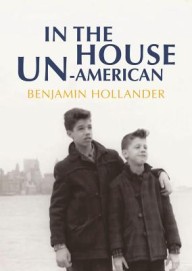
In the House Un-American

inthehouseBenjamin Hollander
Clockroot Books ($15)

by Michael Wendt

Early in Benjamin Hollander’s In the House Un-American, the question is posed: “if everyone is truly welcome [in the United States], why does there exist, in phrase and condition, the un-American?” Throughout the course of the rest of the book we follow Carlos ben Carlos Rossman, a Puerto-Rican Jew with roots in the Middle East, through a protean Bildungsroman that unfolds, by turns, through direct narration, philosophical meditation, brief letters, and transcripts from the House Un-American Activities Committee hearings. Rossman and the characters he encounters take it upon themselves to examine the American narrative that prizes both difference and inclusivity in name while never truly embracing either in substance.

Part and parcel of this exploration is the supreme lack of difference characterizing American language use. Rossman is said to recall that he expected the vocabulary of Americans “like the people to move, to change and expand as it moved, but it only diminished.” And so, by contrast, language that moves, changes, and expands becomes cast as un-American. The fundamental irony, then, is that un-American literature holds the potential to realize the pluralistic promise central to the American fable, as well as the poetic “field of action,” articulated by Rossman’s namesake William Carlos Williams, in which categories of prosody and literary structure are never fixed or discrete.

In the House Un-American situates itself within a body of literature—one inhabited by Williams, Kafka, and Melville, among others alluded to in the book—that is charged with the representation of narrativized thought unfolding. Special attention is paid to exploring the “truths” of the American mythos: “self-evident and, as such, beyond reason and divinely informed,” these “truths” are measured against a constellated set of narratives circumscribing the myriad national, religious, and ethnic identities of the book’s characters. And it turns out that these narratives aren’t so different; that “one country could become fabled depending on how it used the facts of another;” that “the Heart of Islam is American.”

But that last statement may be a bit too declarative to be representative of Hollander’s ambulatory and philosophically charged prose, which continuously expands and moves per Rossman’s expectations. As such, Hollander’s writing seems decidedly “un-American,” like the writing of an “un-person” set to “take its revenge and flow through the [world of American letters] like flood-water”—or, to borrow from William Carlos Williams, Hollander’s writing exists in a “field of purposive action” constantly seeking “new means for expanded possibilities in literary expression.” However one chooses to articulate the experiments Hollander undertakes, what remains clear is that such experimentation, in Hollander’s hands, never removes the ideas from an immediate relationship with the world.

And therein lies the import of the formal ingenuity of In the House Un-American: it is experimentation in the service of a deeper conversation with the world, an unmooring of language from ideology and idolatry. In being un-American, Hollander’s writing seeks an English that is “accented or a bit cracked in its fluency . . . to not only discover ‘the wound in every word in the effort to democratize language,’ but to uncover the world in the wound exposed.”

Click here to purchase this book at your local independent bookstore
Purchase this book at your local independent bookstore.
Rain Taxi Online Edition Summer 2014 | © Rain Taxi, Inc. 2014

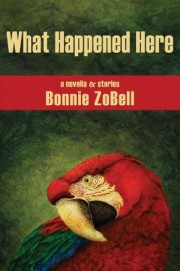
What Happened Here

whathappenedhereBonnie ZoBell
Press 53 ($17.95)

by Matt Pincus

A follow up to her fine chapbook The Whack-Job Girls (Monkey Puzzle, 2013), Bonnie ZoBell’s What Happened Here centers around a thirtieth anniversary party for a 1978 plane crash in a San Diego neighborhood, a real-world event that killed 137 people on board the aircraft and seven others in residences. Each story in the collection attempts to portray a different individual in the neighborhood, giving life to the community and their conflicts as a whole.

The visceral impact of ZoBell’s previous work has fallen to sentimentality in places here. The title novella, about Lenora and her husband John, recounts the latter’s struggle with mental illness, but ends with the couple spreading sage around their backyard to ward off demons and ghosts from the plane crash—a cheap trick for a narrative so invested in deeper issues. In “The Black Sea,” Alexa and Eduardo’s deteriorating marriage is reinvigorated through an encounter on a dirt road with dogs that have had the blood sucked from their carcasses. Rather than delving into the complexities of their relationship, ZoBell relies on the myth of the chupacabra to bring the couple together again: “Eventually, nestled far underneath the covers, listening to the lapping waves, they held each other, slept on and off, fitfully in the heat.”

Although there are a number of shortfalls such as these, two standout stories are “This Time of Night” and “Rocks.” The former recounts Annie and Willy buying a trailer to go camping together, but their vacation to a historic California beach near a nuclear power plant turns into a disaster. Willy’s anger grows in spite of Annie’s optimism, all shadowed by his fight with AIDS and his probable death within three years. The malady acts as a fitting anchor for sentimentality, much better than mentions of a mythical creature or ritual.

“Rocks” does something similar with Lolly, a tour guide in Sedona, Arizona who ran away from her physically abusive husband Roy. The setting seems to reflect Lolly’s desire for anonymity and fear of her husband: “Giant rock formations inflame the town, russet pebbles live naturally by the side of the road, maroon homes made of adobe seem carved out of the pinnacles instead of built new.” Here, spiritual ritual and sentimentality meet in a visceral moment and sentences breathe out the violent yet beautiful nature of human relationships.

What Happened Here attempts to create portraits of people living in the aftermath of a deadly plane crash. ZoBell attempts something Faulkner did so brilliantly in his portraits of men and woman from the south. If it doesn’t always succeed, the text at least shows how difficult it is to write excellent short fiction—and what’s at stake in trying to do so.

Click here to purchase this book at your local independent bookstore
Purchase this book at your local independent bookstore.
Rain Taxi Online Edition Summer 2014 | © Rain Taxi, Inc. 2014

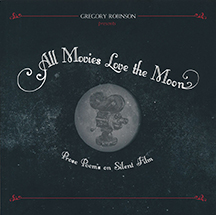
All Movies Love the Moon

allmovieslovethemoon Prose Poems on Silent Film
Gregory Robinson
Rose Metal Press ($14.95)

by Jay Besemer

In September 2013, the Library of Congress published a report by film scholar David Pierce entitled The Survival of American Silent Feature Films 1912-1929. This report (available as a PDF online) details the startling and dismaying loss of over 7,600 original silent features through medium decay, fire, breakage and actual misplacement. Those lost films comprise the majority of the silent features produced in the United States, which means that only a very few complete silent films are now accessible to U.S. scholars, filmmakers, fans, and the general public. Those who love silent film, or want to love it, have to find our own ways to meet it. Sometimes, meetings of that sort occur in unexpected venues.

Keep this in mind as you enter the darkened theater of Gregory Robinson’s All Movies Love the Moon. This astonishing square-format collection of prose poems and images goes far beyond imitation or simple ekphrastic reconstitution. Somehow, Robinson manages to craft a film-festival in poem form. It’s not just that the poems are strongly visual, though that’s certainly true. Here’s a vibrant example, “TESS OF THE STORM COUNTRY (1922)” in its entirety:

Invisible oceans of warm and cold air collide, turning cobalt and blocking the sun. Tess raises her arms—what comes next lets us live.

Elias loves Orn because Orn is poor and Elias needs poor people to clarify what he is not. Elias’ language of love is shaking fists and harrumphing until his monocle falls loose and he is forced to retrieve it.

Orn loves Elias too, though he would never admit it. Elias is confusing and distant, right on the edge of actually living. Orn pities him, but when Elias comes to visit, Orn always has a shotgun in hand.

Tess raises her arms. She is a cloud, born to shelter, hold, and break apart, to stand impossibly between these two foes. She sees the secret between them, their deep mutual affection, and knows it is how the world works, that no enmities are forgotten in another’s need, just redirected, sent upwards, crashing into the cold air and sending down the rain.

The tension between narrative and image is strong in a poem like this, and it’s easy to imagine the same tension in early silent film. Of course, not all films need to be narrative-driven, and narrative poetry is certainly not the only type of poem to be made. Prose poetry seems the perfect form in which to explore the problem of narrative in poetics, as well as the problem of narrative in cinema.

Like the other poems, “TESS” takes its title from that of an actual silent film, and the poems appear in “chronological” order according to the release date of the film each is named for. This kind of organization helps us glean an unofficial, poetic history of the silent film genre. There’s also a careful, quirkily informative introduction, but readers should not expect a straight history lesson or film studies seminar. After all, it’s a book of “prose poems on silent film.“ That ambiguous “on” invites us to make an imaginative leap; although we are reading poems on a page, these verbal works might conceivably be made on film, literally. Even the supple semi-gloss paper on which the book is printed offers a tactile analogy to film. These media/genre blurs resonate nicely from the book’s conceptual core through its content to its realization as an object.

On the facing page of each poem is a figure reproducing or derived from “screen shots” of one of the movie’s title cards. These cards combine text and graphic, or text and film image, to clarify or narrate more or less what’s happening onscreen. Robinson’s funny, ironic, informative captions illuminate or complicate these verbal images, effectively providing title cards for the title cards presented. If “title cards were silent film’s Statler and Waldorf,” as we are told in the introduction, Robinson plays a great Fozzie Bear, commenting on the commentary.

Title cards, readers soon learn, were an art form unto themselves. As early 20th-century cross-genre visual poetry their value is clear, and much could still be written about their influence on poet-artists who came to use similar media—for example, Czech Surrealists Jindrich Heisler and Toyen, whose collaborative collaged photo-poems look quite a bit like title cards. The connection between the poetry on the screen and the poetry on Robinson’s pages becomes delightfully evident as the book progresses.

Title cards (and their authors) finally emerge as the secret heroes of All Movies Love the Moon. The author’s affectionate admiration for some of the best title artists—whom he names for us—feels right for a book filled with wistfulness and fierceness. Here’s one of Robinson’s title card captions, which themselves comprise a sort of stealth prose poem form:

FIGURE 29: Once I drove six hours to dig around a cemetery to find [title artist] Ralph Spence’s grave, crossing state and vastly darker lines.

It’s the perfect teaser. What lines? What states? Six hours in a vehicle, on an obsessive quest for a gravesite, sounds like the perfect silent film plot. Ultimately, All Movies Love the Moon works on both poetic and cinematic levels. The contagious delight of discovery, catalyzed by these poems, may well inspire a new level of interest in silent film (at least among readers of poetry). All Movies Love the Moon gives a new and unexpected meeting-place for readers and film fans to get acquainted with the form. It’s a different way to preserve a cultural treasure, but a highly effective one.

Click here to purchase this book at your local independent bookstore
Purchase this book at your local independent bookstore.
Rain Taxi Online Edition Summer 2014 | © Rain Taxi, Inc. 2014

CORY DOCTOROW

Sunday, October 19, 2 pm
Rondo Library, 461 N. Dale St., Saint Paul

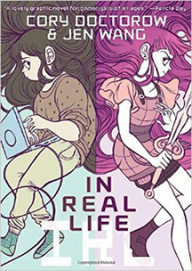
Join us as best-selling novelist and internationally renowned digital rights advocate Cory Doctorow presents his first graphic novel, In Real Life. This graphic novel tackles the problematic issue of “gold farming” in the video game universe, through a riveting story featuring a young female protagonist named Anda. With gorgeous artwork by cartoonist Jen Wang, In Real Life is a perceptive and high-stakes look at adolescence, gaming, poverty, and culture clash by one of the most visionary authors of our time.

inreallifeThis event is free and open to the public. Book sales will be provided by Addendum Books: A Young Adult and Children’s Bookstore, and a reception will follow! PLUS: Teen audience members are invited to stay after Cory Doctorow's presentation; mentors from the St. Paul Public Library's Createch sites will be there to host a video game tournament!

Cory Doctorow is a journalist, activist, and award-winnning science fiction writer. He is a co-editor of the widely read culture/tech/politics site Boing Boing, a fellow of the Electronic Frontier Foundation, and a columnist for many magazines and newspapers. He was named one of the Web’s 25 influencers by Forbes Magazine. His many books include Little Brother, Homeland, and The Rapture of the Nerds; this fall will see the release of his book Information Doesn’t Want to Be Free: Laws for the Internet Age. Born in Canada, Cory Doctorow lives in London, England.

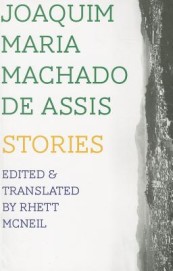
Selected Stories

machadodeassis-storiesJoaquim Maria Machado de Assis
translated by Rhett McNeil
Dalkey Archive ($15.95)

by Kristine Rabberman

Machado de Assis is known for his blending of classic 19th-century style with a sensibility that seems to presage postmodernism. His ironic voice, his love of dark humor, and his predilection for reflexivity and metafictional frames make his works, such as The Posthumous Memoirs of Bras Cubas (also translated as Epitaph of a Small Winner) read as if they were written in the late 20th century. This new collection of his short stories, translated by Rhett McNeil, focuses particularly on what McNeil describes as his experimental period, from the publication of Posthumous Memoirs in 1880 up to his death in 1908.

Fully half of the collection is comprised of the novella “The Psychiatrist” (also known as “The Alienist”). The story, in which Machado de Assis sends up provincial life in a Brazilian town, reveals the author’s sensitivity to social class, political alliances, and religious affiliation. Through a series of increasingly over-the-top scenes and reversals of fortune, the story lambasts bourgeois and village pretensions; it also destabilizes our understanding of insanity, as the psychiatrist asks, “But were [the patients] truly insane, and cured by me, or was what appeared to be a cure nothing more than the discovery of their perfect mental disequilibrium?”

As opposed to “The Psychiatrist,” most of the other stories in this collection are short pieces. Some works are brief sketches, parodies with doses of the author’s subversive sense of humor. “On the Ark” presents three “undiscovered” chapters from Genesis that describe a scene of sibling rivalry on Noah’s ark. “To Live!” is written as a Socratic dialogue between Ahasverus and Prometheus, who meet at the end of time and interweave their Biblical and Classical stories. And “A Visit from Alcibiades” presents an epistolary retelling of the Greek orator’s death, related by a judge who calls him from classical Athens to 1875 Rio de Janeiro with disastrous consequences.

Other stories feature themes relating to life, death, eternity, and identity. Splitting and twinning are interesting subthemes; “The Academies of Siam” explores gender and identity through King Kalaphongko, who “was practically a lady,” and the beautiful Kinnara, who was “a masculine woman—a buffalo with the feathers of a swan.” As the academics of Siam engage in bloody fights over the question of whether souls are gendered, Kalaphongko and Kinnara enact their own experiment to see what their lives would be like if they switched bodies. In ten pages, the story highlights politicized infighting, gender norms and roles, and the gendered nature of political power.

In “Voyage Around Myself,” Machado de Assis combines his interest in split identities with an homage to Xavier de Maistre’s “Voyage Around My Room.” Early in the story, the protagonist quotes the following lines from Camöes: “I know not what occurred / Between myself and me / To make me my own enemy.” He then speculates, “It’s possible that the meaning of these lines is merely figurative, but there is no proof that it isn’t literal, and that ‘myself and me’ aren’t really two separate, tangible, visible people, standing face-to-face.” Similarly, the most inventive story in the collection, “The Priest, or The Metaphysics of Style,” depicts a priest’s efforts to write a sermon, not simply by describing his attempts to distract himself from his struggles, but also by taking a trip inside the priest’s head, where a noun is using “the language . . . of the scriptures” to call an alluring adjective to his side. Most of the story focuses on their struggles to find each other: “It’s a difficult and complex path, this trip through a brain filled with things both old and new. There’s a rustling of ideas in here that barely allows the lovers’ calls to be heard . . .”

Such tales make this collection a rare opportunity to explore Machado de Assis’ experimentation, particularly through ten stories translated into English for the first time. The tight temporal focus of the collection, from 1878-1886, provides an enlightening perspective on the author’s development as a writer during this critical period.

Click here to purchase this book at your local independent bookstore
Purchase this book at your local independent bookstore.
Rain Taxi Online Edition Summer 2014 | © Rain Taxi, Inc. 2014

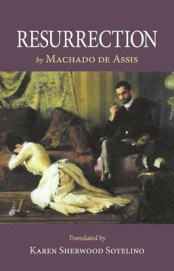
Resurrection

ressurectionMachado de Assis
translated by Karen Sherwood Sotelino
Latin American Literary Review Press ($19.95)

by Douglas Messerli

Brazilian novelist Joaquim María Machado de Assis is the author of several important 19th-century fictions—among them Quincas Borba (Philosopher or Dog?) (1892) and Dom Casmurro (1899)—that chronicled Brazilian society of the period, taking the reader into a world of Portuguese-speaking eccentrics, parties, small-talk, societal gossip, and, most importantly, love and delusion. His first novel, Resurrection (1872), now translated for the first time into English, has nearly all the elements that make Machado de Assis’ work so popular, the major difference being that here the scale is much less epic than in his later works. While its lack of complexity slightly disappoints, it gives us a kind structural glimpse into the underlying themes in those later masterworks.

The plot of Resurrection—and in this author’s books, plot is crucial—focuses on a retired doctor, Félix, and the two women he loves: Raquel, a shy and retiring young woman, and the beautiful and well-to-do young widow Lívia. Minor but important characters include Lívia’s brother Viana and a mutual friend, Meneses. Numerous other figures fill the rooms for the book’s several parties, but only one other figure stands out, the villain of Machado de Assis’ tale, Luís Batista, a man who has been spurned by the widow.

Although the story of these figures’ comings and goings are the heart of this Brazilian fiction, the action is often pared down in this work so that the author can center his attentions on the psychological conditions of his three major figures. Both women are in love with the so-called “hero,” although in time he rejects both of them, because he himself—as we gradually come to discover—has no heart, justifying his rejections and his unperceived misogamy to be the fault of the two irreproachable women. In that respect, Félix can be seen as an early fin de siècle dandy, a man somewhat like characters out of works by Wilde or Huysmans, albeit not recognizing himself as homosexual.

In this case, it hardly matters; the doctor’s core problem, as the author makes clear, is his inability to live life. If we, as readers, might be able to forgive his rejection of the fragile Raquel in order to marry Lívia, we cannot forgive Félix for believing an anonymous letter castigating the widow for driving her husband and others to despair because of her unfaithfulness. The letter, in fact, has been sent by Luís Batista, in revenge for Lívia’s dismissal of him. And it is Félix’s reaction to that Iago-like act that tells us of the doctor’s inability to love. Even though he later discovers the letter to have been Batista’s lie, Félix continues in the illusion:

When all had calmed down in his heart, Félix naively confessed to himself that the breach in his love, as painful as it had been, was yet the most reasonable solution. The doctor’s love experienced posthumous doubts. The veracity of the letter that had prevented the marriage, with the passing of years, not only seemed possible to him, but even probable. One day Meneses told Félix he had ultimate proof that Luís Batista had written the letter. Not only did Félix refuse his testimony, he did not even ask what proof he had. (160)

As Machado de Assis sums up his protagonist: “Nature placed him among the class of men who are cowardly and visionary, whom the poets describe as ‘losing the good for fear of seeking it.’” So does this brilliant author transform his “hero” into a kind “anti-hero,” a figure who begins the work as a possible romantic but in the end becomes a modern everyman, unable to act because of inner opposing forces. The title of his work becomes ironic as what the hero perceives as having “saved” him has, in fact, prevented him from having lived a full life.

While Machado de Assis wrote into the early 20th century, he never adopted modernist transparent narrative strategies as did Henry James (and later Marcel Proust, Virginia Woolf, and William Faulkner). If his storytelling often takes us into a psychological world akin to modernist writing, Machado de Assis remained an interruptive narrator, which is one of the reasons his work is so charming. When Meneses first convinces Félix that Batista is behind the letter, for example, the author intrudes:

     Reader, let us understand each other. I am the one telling this story, and can assure you the letter was indeed from Luís Batista, However, the doctor’s conviction . . . was less solid and well thought out than befitted the state of affairs.

In short, Machado de Assis humorously criticizes his characters for believing what they do—even when they are right! At other times, the writer uses his authorial powers to speed up or slow down his narrative as in a film: “It was mid-December. The wedding date was imminent. Everything required a swift solution.”

Like several writers of the period—Zola, Stein, Lewis, Barnes, etc.—Machado de Assis retained his authorial voice in order to entertain the reader and point to his themes in a way that would be picked up again by postmodern fiction writers. Accordingly, while some readers may see these intrusions as “old-fashioned,” they are in fact original and fresh, and they help to enrich his art. If Resurrection is far from being a major work, it reveals much about this great writer’s literary methods.

Click here to purchase this book at your local independent bookstore
Purchase this book at your local independent bookstore.
Rain Taxi Online Edition Summer 2014 | © Rain Taxi, Inc. 2014

Amiri Baraka and Edward Dorn: The Collected Letters

baraka-dornEdited by Claudia Moreno Pisano
University Of New Mexico Press ($59.95)

by Eliza Murphy

Intended “if not to overthrow, to at least disrupt the status quo of preconceived notions in American letters” by seamlessly incorporating snippets of historical details between the missives of two American literary figures, editor Claudia Pisano hit her mark. Instead of an epistolary, she’s created a narrative assemblage with artfully selected materials whose backdrop never overshadows the shifting tones contained within the correspondence between poets Ed Dorn and Amiri Baraka (formerly LeRoi Jones).

Complete with misspellings, quirky punctuation, complaints about the weather (which they often attributed to nuclear bomb testing), money woes, relationship difficulties, and other details that reveal their personal turmoil and triumphs, the correspondence took place from 1959-1965, just as the poets were establishing themselves as artists. Arranged chronologically, the letters show the development of two avant-garde poets confronting race, the necessity to break free of formal constraints established by mainstream academia, and their different approaches to dealing with official versus actual history. Moody, testy, exciting and exasperating, the letters show two individuals forging their paths during a time of incredible cultural upheaval. At times contemporary readers will want to pitch the book across the room because of the intense misogyny (“Man is she cruising for a bruising”) and homophobia, though to be fair, we are still only beginning to chip away at the hateful currents such comments reflect.

From the excitement and enthusiasm expressed in their letters, they were maneuvering during a heady time. Everything was up for grabs. Post-World War II malaise had no place in a world encumbered with the Cuban Missile Crisis, nuclear weapons testing, the Vietnam War, and the Civil Rights movement. Neither Dorn nor Baraka led sheltered lives, yet their letters reveal the progression of radical stances that replaced the glaze of innocence as they became more aware of the larger world. They were both coming into their own as writers during incredible artistic foment across disciplines. Jazz was informing poetry and painting. Politics seeped into theater. Charles Olson and other Black Mountain poets had liberated poetry from academia, freeing language and challenging mainstream values. Like-minded poets found one another, celebrated one another’s resistance to mainstream academic poetry in letters, lit mags, and at public readings.

Baraka grew increasingly militant as he rejected the white New York culture he knew and came to identify with Black Power. Way out in the rural American West, Dorn honed in on Native American issues, as well as the myth of the frontier. As each wrestled with the monkeys on their backs, they sought intellectual companionship through (what is now considered old-fashioned) letter writing.

Both poets actively resisted writing the sort of poetry codified with prizes and posts as poet laureates. (Baraka was removed from his brief stint as the New Jersey poet laureate for making remarks considered anti-Semitic after 9/11). Poetry was not a pretty, risk-free arena to lyricize, but a place to take action, to wrestle with ideas, to engage the head as much as the heart. Pisano refers to Dorn and Baraka as “outsiders,” presumably because they deliberately defied convention, eliminating their potential to win major prizes like the Guggenheim Fellowship (which Olson won twice, as they jealously point out). Yet, they were both engaged in a diverse community of experimental writers who actively supported one another by publishing their work in lit mags and arranging public readings.

A lively outgrowth of the series Lost & Found: The CUNY Poetics Document Initiative, this volume adds another layer of scholarship that offers a glimpse of two men devoted to creative and intellectual pursuits during an era marked by imaginative resistance to institutionalized values. Pisano deftly contextualizes the tumultuous backdrop against which these two poets maintained their long distance friendship while establishing themselves as writers. In so doing, these two jazz-infused poets emerge as feisty, driven agitators whose heretical stances will undoubtedly continue to vex and delight readers and scholars alike.

Click here to purchase this book at your local independent bookstore
Purchase this book at your local independent bookstore.
Rain Taxi Online Edition Summer 2014 | © Rain Taxi, Inc. 2014

On Amiri Baraka: Who Was That Masked Man?

AmiriBaraka
by Richard Oyama

“Who was that masked man?” I asked myself when Amiri Baraka passed in January. It wasn’t just that Baraka was a man of various gifts. He was a man of swift metamorphoses and violent repudiations, leaving wreckage and confusion, friends and former wives in his wake.

The early “In Memory of Radio” includes these lines: “Saturday mornings we listened to the Red Lantern & his undersea folk. / At 11, Let's Pretend / & we did / & I, the poet, still do. Thank God!” Poetry, like radio, is a form of artifice and imposture, and the voice of the poem may be persona, like Lamont Cranston the Shadow.

As Imamu Amiri Baraka, a black nationalist, he cultivated a quasi-mystical racial mystique, using words like “spirit” and “vision” often. But before he took a new name Baraka was LeRoi Jones, a poet who associated with gay poets like Allan Ginsberg and Frank O’Hara, wrote the ferocious play Dutchman, the novel The System of Dante’s Hell, and the nonfiction books Blues People and Black Music.

This early work was crucial to me, as it was written from the tortured perspective of a black intellectual in jagged, poetic shards. A child of Nisei parents interned during World War II, I grew up on Morningside Drive west of Harlem and attended Harlem schools. Intermittently, I was the target of anti-Asian epithets. The effect of internment was dispersal and diaspora. The vilification instilled a “double consciousness” in me. I was both American and not-American, as masked by “the face of the Enemy” as Jones was.

Jones’ collection The Dead Lecturer was another key work, one informed by the poetics of Charles Olson and Robert Creeley. Consider these lines: “I am inside someone / who hates me. I look / out from his eyes. Smell what fouled tunes come in / to his breath. Love his /wretched women. / Slits in the metal, for sun.” (from “An Agony. As Now.”) Adrienne Rich said Creeley saw in this poem “life . . . in a literal body which the surrounding ‘body’ of the society defines as hateful—an unacceptable condition.” It isn’t difficult to extrapolate from Baraka’s poem the intolerable status of the yellow body during World War II, the brown body hunted by la migra, the “Arab” body suspect after 9/11.

But fissures appear. As Rich wrote in 2009, “The reflexive, un-self-critical use of ‘fags’ and ‘jews’ as familiar, still-poisonous code names for class enemies certainly disfigures the poet’s achievement, along with misogyny and its images craving the woman victim.”

After Malcolm X’s assassination in 1965, Jones fled the East Village for Harlem, changed his name, and was instrumental in growing the Black Arts Movement. With Black Magic Poetry, he lost me. After centuries of white supremacy and racial stigma, it was understandable—even necessary— to affirm black culture and personhood. Yet the mystification at times verged on incoherence, “later parodied by genius Black comic minds like Richard Pryor and George Clinton as soon as they felt safe,” Greg Tate wrote in a lengthy memorial essay on Baraka this year.

And mystification was the least of it. From “Black Dada Nihilismus”: “Rape the white girls. Rape / their fathers. Cut the mothers' throats.” Assume Baraka’s poem is an anti-art gesture that extends Andre Breton’s statement: “The simplest Surrealist act consists of . . . firing blindly . . . into the crowd.” Still, the imperative form could be inflammatory in an inflammatory time. What Baraka touted as “EXPRESSION” could degenerate into feeling for feeling’s sake, validating spoken-word/sound performances sometimes more cathartic for the maker than the listener.

In 1975, Baraka rejected cultural nationalism, proclaiming himself a Communist. At benefit readings for an anthology of Asian American poets at Basement Workshop, an arts organization in Manhattan, Baraka read recent work including the poem “Dope.” The performative skills were intact, but these pamphleteering poems evidenced decline. One poem included a nasty Uncle Tom slur against novelist Ralph Ellison, ignoring Ellison’s Invisible Man as a vital contribution to American literature. The mean-spiritedness was palpable.

In the end, Baraka’s work suffered because he preferred ideology over art, forgetting the latter outlasts us all. The conclusion to his Autobiography was marred by Marxist rhetoric. His post-9/11 poem “Who Blew Up America?” was construed as anti-Semitic, resulting in the defunding of New Jersey’s Poet Laureate post that he held. Its paranoid logic is impeccable: “Who killed Princess Di?” Huh?

LeRoi Jones once meant a lot to me. But Baraka’s career came to represent a cautionary tale of the worst “tendencies” of the 1960s—the alienating rejections, the fanatical self-righteousness, the impulse toward separatism and Stalinist repression versus multi-racial/class coalition-building.

I write this not with any real delight, but rather with the regret one feels at lost possibilities, the evanescent hopes for something grander than a black corporatist president who Band-Aids a nation that’s slipping irrevocably into the second-rate.


Richard Oyama is a poet. His first collection, The Country They Know, was published by Neuma Books in 2005. His forthcoming novel is titled Orphans of the Storm.

Rain Taxi invites other reminiscences, thoughts, experiences about the late, great poet Amiri Baraka. Please submit no more than 1000 words to info [at] raintaxi.com, and we will consider it for publication!


Rain Taxi Online Edition Summer 2014 | © Rain Taxi, Inc. 2014