
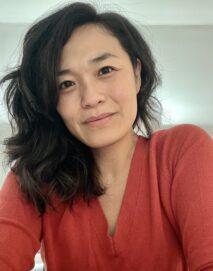
by Emily Webber
I first met Molly Gaudry in Florida during her book tour. As we walked along the Jupiter Inlet, a pelican dived into the water, scooped up an impossibly large fish, and held it in its elastic neck pouch. The fish wrestled for a long time, and the pelican mostly remained calm before swallowing it whole. As Gaudry and I talked about writing, I returned to this image again and again. Sometimes you’re the fish, where it feels like all fight and no reward; sometimes you’re the pelican just calmly waiting, and it all comes together.
Gaudry holds master’s degrees in fiction and poetry from the University of Cincinnati and George Mason University, respectively, and a PhD in experimental prose from the University of Utah. She is the author of two novels in verse, We Take Me Apart (Mud Luscious Press, 2010) and Desire: A Haunting (Ampersand, 2018); both explore the same fictional world through the perspective of a mother and daughter. Her latest book, Fit Into Me: A Novel: A Memoir (Rose Metal Press, $17.95), is a hybrid work revisiting other characters—including the tea house woman, who appears in her earlier works first as a bride-to-be and then as a widow.
In the following interview, Gaudry offers a fascinating look into her creative process.
EW: How did you become a writer? Was it something you always wanted to do?
MG: I don’t really know how I became a writer, but I’m sure that I was a reader first. When I was very young, I used to make up little stories and turn them into booklets with construction paper “covers.” In kindergarten, I remember my desk was separated from the other kids’ and I was encouraged to work on reading and writing skills. Later, in grade school, I was never the best student in my classes, but I was often allowed to turn in stories for extra credit to help save my grades. Eventually, I ended up studying creative writing in a vocational arts high school. Although I’d gone there to study jazz and music composition, I learned quickly that I didn’t have the chops or dedication that my fellow music majors did, so I ended up switching majors to creative writing. By senior year, our portfolios included short stories, poems, and a one-act play. I think it was around this time, transitioning out of high school and into college, that I began to think of myself as someone who could one day be a writer.
EW: So you were exposed to writing across genres early, and your first two books are novels in verse. Did you mostly identify as a poet in the beginning?
MG: Oh, gosh, no. I definitely considered myself a fiction writer back then. I still do, really. But when my first book, We Take Me Apart, came out, even though my publisher and I considered it experimental fiction, only the poets paid it any attention. The book was shortlisted for the PEN/Osterweil, a poetry prize, and named a finalist for the Asian American Literary Award for Poetry, and this was when my identity crisis as a writer began. Because I felt like such a fraud, I ended up in George Mason University’s MFA program, so I could study poetry for three years, even though it terrified me. I think for three years, I sat in those classes thinking of myself as a terrified fiction writer. Even upon graduating, I still felt like I didn’t really understand poetry. I was wrong, though—I can see this now, more clearly—because my professors and my fellow classmates really did help me become a stronger reader of poems, and they gave me the skills I would need to continue to develop on my own as a reader, and now as a professor, of poetry.
EW: You had a period when you were renovating a dollhouse. What interested you about this creative outlet compared to writing?
MG: That was long after my MFA and toward the very end of my PhD program, when I lived in Salt Lake City. I was working on Fit Into Me, a hybrid novel/memoir for my dissertation, and I had become obsessed with 1:12 scale miniature artists from around the world. Two of my favorite Instagram accounts were @ibuildsmallthings and @lavenderbelle_miniatures, and just like other miniature artists they both included their hands in their photos. Without their hand, it was really hard to tell that their work was miniature!
On a whim I found an old dollhouse for sale on Craigslist, and I started refurbishing it. I spent maybe a month or two fixing it up. I think what I loved most was that I could focus on specific tasks and, by the end of the day, see tangible results. I would tell myself, “Today, I’m going to prime and paint the walls on the second floor,” and “Today, I’ll cut and install the floorboards,” and “Today, I’ll put the lights in.” I really needed it at the time. With writing, I often had nothing to show by the end of the day, but with the dollhouse I could see the progress I was making, day by day, even hour by hour.
EW: Speaking of blending the real and unreal, I hadn’t encountered a work quite like Fit Into Me. How would you describe this book?
MG: I think of it as a memoir titled Fit Into Me, which is about trying to write a novel titled Fit Into Me. To put this another way: Fit Into Me: A Novel is the subject to Fit Into Me: A Memoir.
EW: Rose Metal Press seems like the perfect publisher for a book like Fit Into Me because of their championing of hybrid work, but I know you had a slightly difficult path to publishing this work. Can you describe the book’s journey and how you persevered through some setbacks?
MG: Well, my first two books were published by small presses that no longer exist—Mud Luscious and Ampersand Books. After Mud Luscious shut down, Jason Cook at Ampersand offered me a multi-book contract, which included a reprint of We Take Me Apart. Together, we worked closely on my second verse novel, and I also completed the first full draft of Fit Into Me with him. We really had a great working relationship, and I’m grateful for all the time and attention he gave me and my work. Unfortunately, for personal reasons, he decided to shut down Ampersand, and so I no longer had a publisher for Fit.
EW: What kept you going? Did you continue to revise the book?
MG: I mostly put it away, but occasionally I’d pull it back out and revise a bit more. As the years went by, I was able to pursue leads with a few other small presses, but ultimately none of these panned out. In truth, I never really felt like I was in any particular rush to find a publisher. At some point, I set it aside completely and challenged myself to write more long-form, mainstream work. Over the course of three years, I wrote and published a few short stories and a long essay about my biological family in Korea. At first, I didn’t think of this essay as anything but a standalone piece. Later, though, I decided to include it at the end of Fit Into Me, and I subbed it in for what had been the final essay. Once I had done this, I knew it was the last substantial edit I would make on my own. Around this time, I decided to submit this version to the Rose Metal Press Hybrid Genre Open contest, and in my mind, this was it. If it didn’t get accepted, I would let it go and forget about it.
EW: In that essay, you start to incorporate fiction into your story, describing an incident with your biological family that didn’t actually happen. Why this shift to including fiction even within your own story?
MG: That essay was written in 2022, while the rest of the book was written in 2015. By then, I had been teaching and writing across genres, and this multi-genre identity had served me well on the academic job market. But somewhere around my third-year review, I felt I was spreading myself too thin, and after I had a chance to catch up with my former dissertation advisor, Lance Olsen, I decided to focus on a specific genre so I could try to home in on just one area of expertise. I chose nonfiction, and that essay was my first attempt at speculative nonfiction.
EW: What are some good examples of speculative nonfiction?
MG: I recommend the online journal Speculative Nonfiction: Jerald Walker’s “Advice to an Honorable Man,” Caite McNeil’s “She Ran Like A ______,” and Sean Prentiss’s “Buying a House: Every Story Is True and Every Story Is A Lie” are particular favorites of mine. Of course, there’s Jami Nakamura Lin’s The Night Parade: A Speculative Memoir (Mariner Books, 2023), and Larraine Herring released an anthology fairly recently titled Becoming Real: Women Reclaim the Power of the Imagined through Speculative Nonfiction (Regal House Publishing, 2024).
EW: Your two previous verse novels and the fictional novel that constitutes part of Fit Into Me feature the same characters. They don’t need to be read together, but I had the pleasure of reading your work in reverse. Getting an introduction to your fictional world along with your creative process through Fit Into Me, I loved that I could dive into your novels and get more of these characters with this inside knowledge. Did you always know you’d write multiple books with these characters?
MG: No. After We Take Me Apart came out, though, I came up with the idea for Desire: A Haunting. It was not, from the start, a companion project. But once I realized it could be, I knew I wanted to tell one of the main events in We Take Me Apart from a different perspective—to show how the same event could affect another character differently.
I think there’s something wonderful about books that have a shared universe. I’m obsessed with Tana French’s Dublin Murder Squad mysteries, for instance, and more recently I’ve gotten into the Lucy Barton books by Elizabeth Strout. Even as a young writer, I loved interconnected books. Probably one of my greatest early influences was Gabriel García Márquez, and I always loved seeing Macondo from the different perspectives of his characters across books.
When I began writing the fiction sections of Fit Into Me, I wasn’t thinking they would become a book. But eventually, when I realized Fit Into Me could be a novel, and that Fit Into Me could be a memoir about that novel, that’s when I realized I could say goodbye to one of the more important minor characters, Sam, who appears across all three books as the tea house woman’s father.
EW: Do you think you’ll revisit these characters again?
MG: It’s possible, but in some ways I feel I’ve moved on. During the editing process, I was asked to change the name of the city from a made-up city to a real city. The easiest answer was to call it Salt Lake City, whose grid and street names I had used as inspiration anyway. But because, suddenly, the tea house woman existed in Salt Lake City, in the real world, rather than in the made-up place I always thought it was, that made it feel like the end of the tea house for me. I no longer live in Salt Lake City, and Salt Lake City feels to me like the past, not like any part of my future.
EW: At your book event, you said every story we tell is a love story to everything we’ve read; Fit Into Me embodies this on every page. You have over 170 footnotes, many of which serve as citations for where you seamlessly weave in sentences from other works of literature. Without the footnotes, the reader wouldn’t even be able to tell. What was your process like, and how did you choose the source material and formatting?
MG: It’s only because of interviews like this one that I’ve been able to go back and revisit my process for including quotations. In my memory, all the cited texts were always there, but in reality, they were not. The only time I quoted anyone in the earliest drafts were when I was in fact engaging with authors that were, themselves, the subjects of my nonfiction: Marguerite Duras, Sappho and Anne Carson, and Nathaniel Hawthorne. In the fiction, one of the characters is reading José Saramago’s Blindness to another character, and so that was quoted text from the start as well. But every other author, every other quotation, was added later, at various times.
EW: In a multi-page footnote I adore, you finally give the tea house woman a name, Constance or Connie, in a very offhand, casual way. Can you talk about how you name your characters and why you sometimes don’t?
MG: My first book was largely influenced by fairy tales, fables, and myths. So, the tea house woman didn’t have a name in We Take Me Apart. She didn’t get a name in Desire either. But by the third book, since the tea house was handed down through the generations, I suddenly had multiple tea house women, and it was becoming confusing telling them apart. So I just had fun in the footnotes and directly addressed the problem of needing to name them. I chose the name Connie because my grandfather’s name was Conrad, but he went by Connie his whole life. Then I named the tea house woman’s mother Clarissa, after Mrs. Dalloway, because why not?
EW: A lot of your writing leans into this sense of play. In Fit Into Me, you demonstrate the process you use to generate your work: You take a piece of literature meaningful to you, cut up the words, and select some to incorporate into your own writing. You show the word lists you pull and how you use them. How did you develop this process? Have you used it for all your books?
MG: With my first book, I was up against a deadline, so I transcribed words from Gertrude Stein’s Tender Buttons as an act of desperation. I get into the specifics in Fit Into Me, but the quick version is that I created lists of ten words each and had to use these lists to quickly write and finish that book. Because it worked for We Take Me Apart, I did the same thing for Desire, using words from John Ratti’s poetry collection A Remembered Darkness.
I like to think that this process helps to infuse your writing with the spirit of the works you pull from. We Take Me Apart is obsessed with food, rooms, and objects. Desire turned out to be a Gothic-ish ghost story. Both reflect the spirit of Tender Buttons and A Remembered Darkness. So I repeated the process for Fit Into Me, using words from Anne Carson’s translation of Sappho’s If Not, Winter.
EW: Now that you’ve finally seen Fit Into Me go out into the world and receive positive reviews, what comes next?
MG: Well, I’ve finished another hybrid work, The Time Loop: A Speculative Memoir: A Novel, which is currently out on submission. It’s a novel, but it presents as a speculative memoir that asks: What if I got stuck in a time loop as a metaphor for being stuck in grief?
When I began this manuscript, I still did not have a publisher for Fit Into Me, and I knew I had to finish this one quickly in order to have any chance of meeting my publication requirement for tenure. Because I’m such a slow writer, though, and from day to day often delete everything and start over, I needed to find a way to make consistent forward progress. That’s how the idea of the time loop came to me, because all I had to do was write a version of the day, and if I hated it, I could just write a different version of the day without deleting all of that material. The many variations of the day in the time loop allowed me to keep making progress without losing pages in the process. The conceit of my narrator’s need to finally get her day right applied perfectly to my own need to finally get the writing of her day right.
EW: What advice do you have for writers, especially those trying to do something experimental or in a different genre?
MG: It’s funny that you ask this, because I find myself now in need of such advice! I suppose a lot of it comes down to just trying different things on the page—like word lists, or like any other constraints you might come up with for yourself—and seeing what happens. The writing process can and should be messy (which is something I’m emphasizing for myself by saying, and repeating, it here!). Likely, what’s in your heart will eventually come out onto the page. Just trust yourself, let go of fear and doubt and ego and the idea of whatever it is you think you need to have happen on the page, and see what emerges instead. I think, if we’re lucky, it’ll feel fresh and weird and exciting and interesting, and we’ll want to keep molding that clay until we can step back and say, “It’s done.”
Click below to purchase this book through Bookshop.org and support your local independent bookstore:
Rain Taxi Online Edition Summer 2026 | © Rain Taxi, Inc. 2026