
Denise Duhamel
University of Pittsburgh Press ($20)
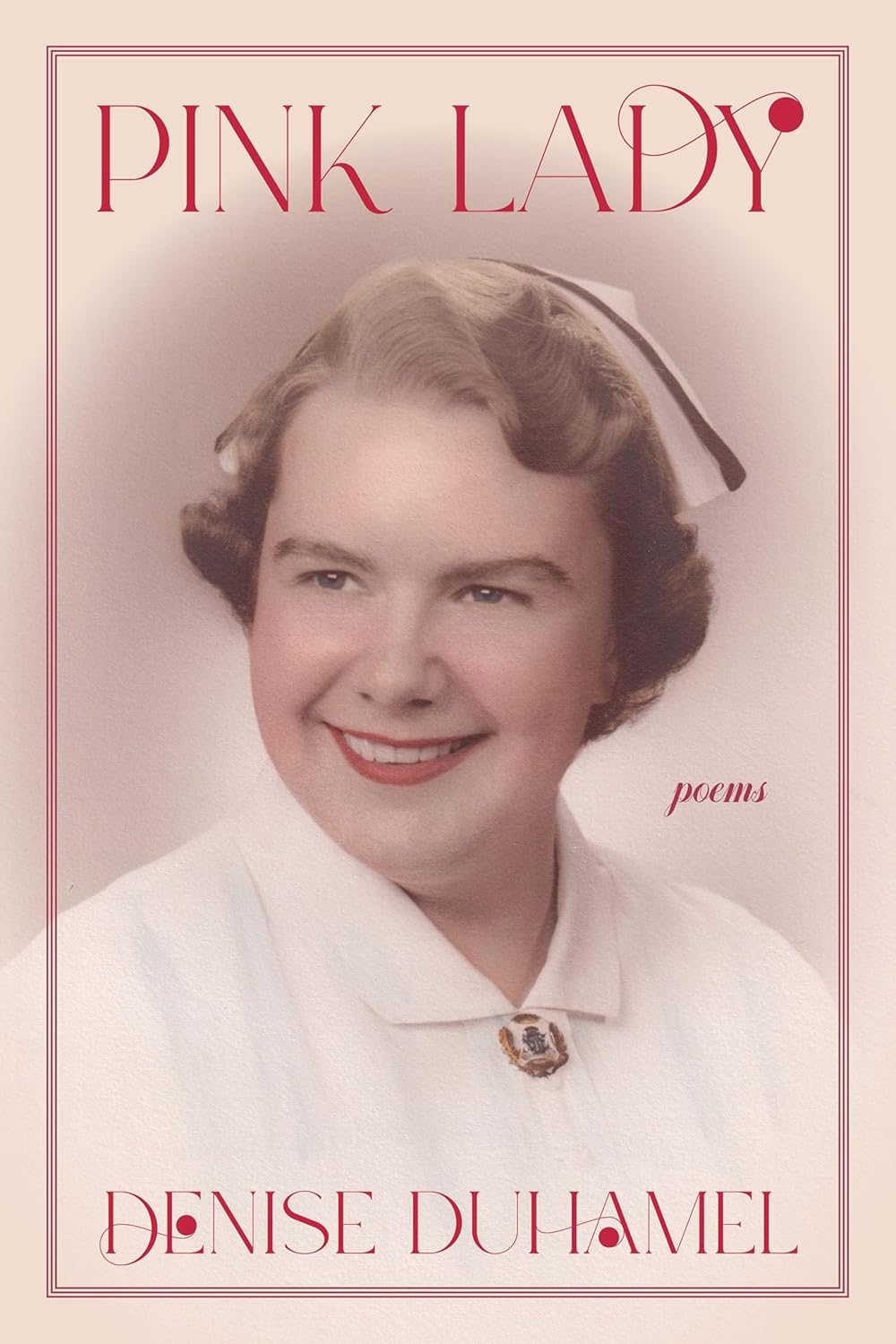
Sentimental without being saccharine, Denise Duhamel’s Pink Lady takes us through her mother’s decline and death at a nursing home in Rhode Island. While the book is a poetic memoir of sorts, Duhamel uses her mastery of craft to draw in the outer world of the COVID-19 pandemic and the 2020 election.
The book starts with “Prodigal Prayer,” in which the poet travels from Florida to be with her mother who is slowly declining in the same nursing home where she once worked as a nurse: “I drive her twenty-year-old Toyota to see her / in the Catholic nursing home where the priest reminds us / ‘this too shall pass.’” In “Last Picnic,” Duhamel and her sister take their mother out to a meal: “My mother’s chowder flipped in the wind and landed on her lap. / I wiped her up with a bunch of napkins. / My sister rescued the rolling bag of clam cakes.” “What My Mother Left Behind, What She Discarded,” a list poem of letting go, will surely be relatable to anyone who’s helped an aging parent clean out their home: “she’d given away the frying pans too heavy to lift / . . . / my dad’s bicentennial quarters (he collected one from every state) / . . . / the Encyclopedia Britannica . . .” Details like these are specific and touching.
As Pink Lady continues, Duhamel is able to weave in themes from the wider world. In “Wackadoodle,” the poet recalls when her mother had still been able to travel:
She visited me in Florida the day after
Trump won in 2016. When I’d sent her a ticket,
I thought we’d both be celebrating
the first woman president. I was baffled, sure
that the planes of the world would stop flying,
their wings too heavy with grief.
“Communique: Emails from Mount St. Rita’s” tersely describes what so many who had loved ones in hospitals or nursing homes went through during the Covid lockdowns, and “Purse” offers a sensual metaphor:
I emptied her white purse—
tissue pack and reading glasses, coupons
and address book. I once lived in a purse
inside her, my first pink home, the umbilical cord
a knotted strap. When I grew up, I took care
of my own purse, its pristine lining never stretched
or stuffed with a fetus.
Of course, any narrative arc about death can only lead one way, as related in “Baby Mouse, July 11, 2021:” “I’d gotten up early as I’d heard / clanking. My sister found a baby / mouse in her sink . . . What did the mouse / mean, if anything?” Duhamel and her family arrive at the nursing home to find “My mom was under / a white sheet, her eyes closed . . . We whispered as though my mom / could still hear. We were quiet / as three little mice.”
Despite Pink Lady’s deep current of grief, the collection ultimately opens possibilities for renewal after the death of a parent, as in “Poem in Which I Banish Sorrow”:
I have my mother in my pocket—her face
on the prayer card we had printed for her wake.
I ate oatmeal with maple syrup for breakfast
so how can the front page news hurt me?
Click below to purchase this book through Bookshop and support your local independent bookstore:
Rain Taxi Online Edition Winter 2026 | © Rain Taxi, Inc. 2026