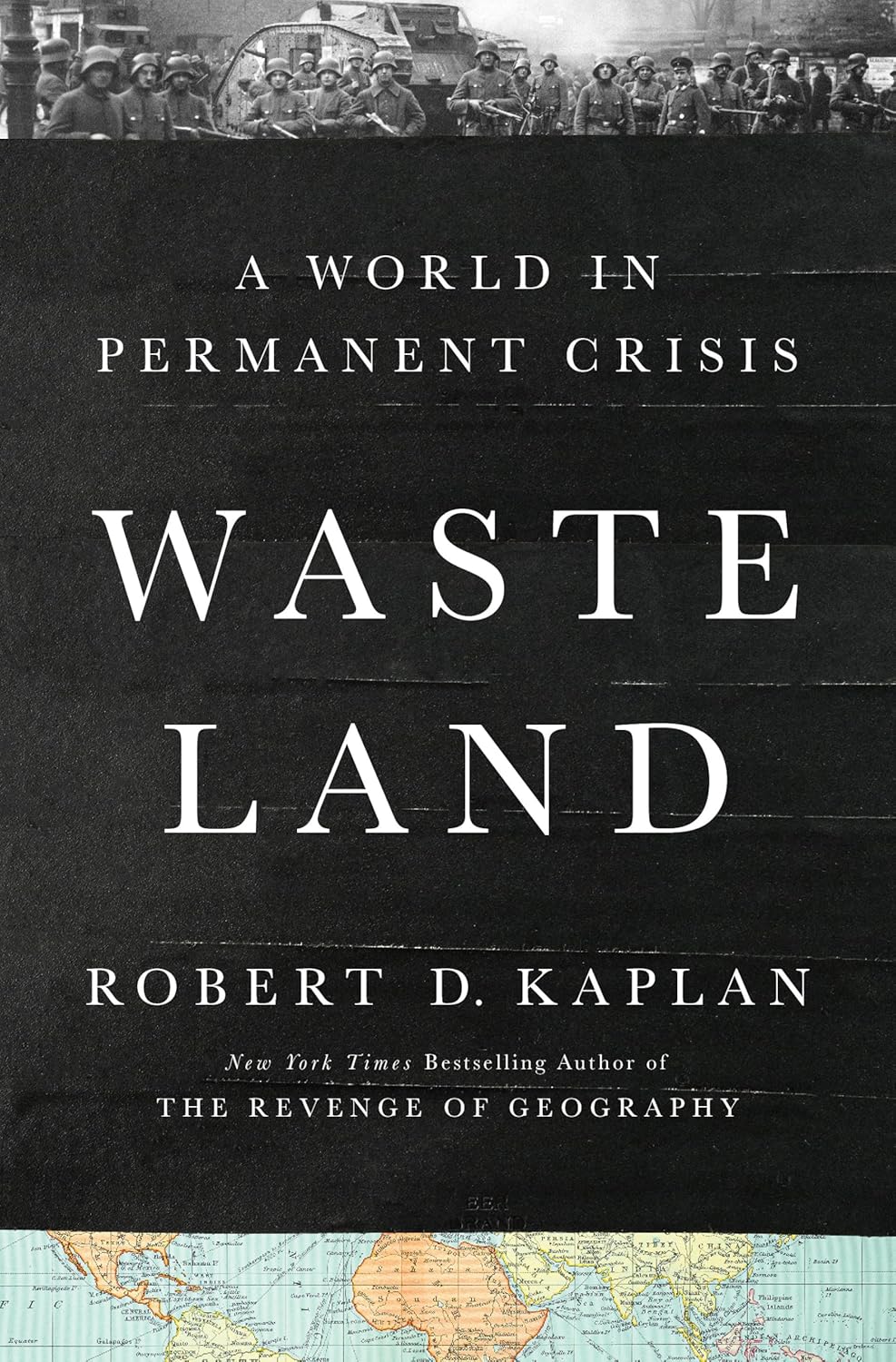
A World in Permanent Crisis
Robert D. Kaplan
Random House ($31)
by Poul Houe
In his 2012 book The Revenge of Geography: What the Map Tells Us About Conflicts and the Battle Against Fate (Random House), noted foreign affairs observer Robert D. Kaplan explored the spatial dimension of the crisis haunting the world, also labeled the “crisis of room.” In his new volume, this worldwide crisis has moved to a time(less) dimension; both “waste land” and “permanent crisis” imply that the times they are a-changin’—but not for the better. Admittedly a “relentlessly pessimistic” observer, Kaplan doesn’t ignore progress and betterments per se but puts them in historical contexts that tend to prove them unsustainable.
The state of modern democracy may be the most troubling case facing this approach. It dominates “Weimar Goes Global,” the first of Waste Land’s three sections, and describes, for better and worse, our current situation with its most typical pretext and sounding board: the way technology reduces distance while alienating closeness, thus intertwining globalization’s two poles. Much of our divided world appears as Weimar “of scale”—an advanced society that easily disintegrates into a Beer Hall Putsch. Weimar was a double-edged sword to be feared constructively. By Kaplan’s standard, conservative stability beats the illusion of progress, since freedom devoid of institutional order may only replace hierarchy with anarchy, unlike true freedom, which depends on order (as Solzhenitsyn put it).
In Kaplan’s view, failing to realize that history is not governed by reason inevitably leads to the falsehood of optimism and to a “borderless world” whose juxtapositions cause further disruptions and crises—presumably a forecast of today’s “terrifying technological and ideological innovations” and their erosion of a moderation based on tradition. These are instances of Kaplan’s “obsessively negative” outlook, which he acknowledges underlies his pessimism.
In addition, he considers today’s polarizing social media less conducive to cool thinking than cold war print culture; and while technology may pacify and feminize life, some leaders will rebel and become even more brutal chieftains. So, is Steven Pinker’s peaceful image of the West a beacon of hope—or one of self-delusion? Though still more peaceful than the rest of the world, the West is slowly dissolving and becoming like the rest; and in many places war “is not a means but an end,” as Kaplan puts it with a quote from Martin van Cleveld. To Paul Theroux’s point that anarchy (in Africa) is more likely than tyranny, Kaplan adds his own deterministic view that America’s cold war victory makes for an irrelevant optimism. Instead, “The Coming Anarchy: How Scarcity, Crime, Overpopulation, Tribalism, and Disease Are Destroying the Social Fabric of the Planet” is the title his editors, with his approval, gave one of his articles.
Predictably, the second section of his Waste Land is about “The Great Powers in Decline”—with an America weakened by technology, deification of the present, and an undermined sense of history. Meanwhile, a war-faring Russia remains “the sick man of Eurasia” and the whole world “one of pitiless power struggles that make a mockery of elite posturing.” Quite simply, this is a “brawling, tumultuous world defined by upheaval,” backed by an antiquated United Nations and “superseded by the very messy reality of globalization itself.” Because “everything intersects with everything else,” such a world is “by definition unstable” and its resulting confrontations the very “totemic reality of globalization.”
As for Russia, Kaplan deems its army “a mob on the move,” and while Putin differs from Hitler, their histories “follow similar patterns.” It’s a waste land, in T.S. Eliot’s sense, or an incompetent aggressor in a mix of war, climate change, and AI. Even more than China, and the U.S., it is a crumbling empire in the globe’s “unified theater of conflict” or “geopolitical bear market.” Kaplan’s doomsday conclusion to his section on declining great powers reads: “Isolationism is the past: full immersion in a chaotic world is the inevitable future.”
To break down what this means at the socio-cultural level of everyday urban life, Waste Land’s third section on “Crowds and Chaos” draws especially upon Jane Jacobs’s classic The Death and Life of Great American Cities (Random House, 1961), a classic work about different people getting along—before social media changed it all, re-segregating the urban locales and putting the segregated classes in contact with each other, say, in Brooklyn with three-quarters of the population well off and the rest being on food stamps. The digital web became a city of its own and replicated its inhabitants’ countless interactions, “not always for the better” but in a way that presaged how geopolitics will deteriorate as well. Worse even than Stalinism’s exteriorization of everything, by Kaplan’s account today’s tech world will hollow out human souls completely and put the urban elite’s “groupthink” (or “google-think”) in their place. Much in the way Oswald Spengler once predicted world cities’ production of “the mob” would replace “the folk” of the country-sides.
To all that Kaplan adds that ‘folks’ in today’s U.S. are Trumpsters, Confederacy-nostalgic haters of liberal bastions, world media, cosmopolitan cities, and left-wing mobs. Both in Russia 1917 and in the U.S. 2020, liberals were intimidated to support their violent far left, while “cancel culture’s” mode of rectifying opinions became the virtual, non-violent version of Leninism’s mob mentality. Such a combination of digital video tech and Hannah Arendt’s vision of lonely individuals seeking shelter in crowds assailed New York Times editors for not being purely ideological, much in sync with Spengler’s image of “the urban horde” and fear of the media, a wedding of “urbanization and weaponry” that Kaplan finds especially menacing today.
He goes even further than Spengler and accounts for “the world-city and its pathologies … with its access to the Internet” as the site for undermining “the nation-state.” It’s a stylish beginning of the end of civilization, as when modern art with its abstract cities shows disconnection from the land becoming rigid as (Spengler’s) “deep soil ties” disappear. This is how Kaplan with his (and Eliot’s) title signals the alienation of our modern world “of futility and anarchy,” “a pile of fragments,” situated between an eradicated national culture and an insufficient international replacement thereof. With his bent for existentialism, Kaplan’s take on reality is individualistic, unlike the sensations of crowds and mobs, which by his definition are untrue, especially when such groups are formed by self-obsessed tech individuals who have become too anxiety-ridden to be themselves.
As reason yields to the “ideological abstraction and crowd psychology” that governs the modern world beneath its surface, our century’s future will be subject to similar tumultuous and self-destructive forces. According to Elias Canetti, lone and isolated individuals form “the most fearsome crowd” and deem this tyrannic form of equality the best shelter from which to seek “retribution.” Crowds are the bedrock of dark human experiences, and the McCarthy era’s witch-hunt may well be repeated when high tech “encourages intellectual mobs,” much as 1984 and Brave New World predicted. Post-modern tech exploits what already “the Founders of the American Revolution knew, that unrestrained democracy is the proving ground of anarchy.”
Still, Kaplan claims that “it isn’t that the world is getting worse. It’s getting better.” A rare pronouncement on his part, and soon followed up by renewed thumbs-down claims: about AI’s negative impact upon democracy as it worsens crowd mentality; about the modernist breaking of rational rules and “rational man” yielding to “psychological man”; about elites turning more conformist, masses more ignorant, and civilization likely to die as conflict on Earth intensifies, despite an overbearing urban sameness. Most certainly, the tyranny of the crowd is both an indicator and producer of inconsistent chaos everywhere.
Ultimately, totalitarianism and progress prove intertwined, which Kaplan finds evidenced by Zbigniew Brzezinski and Carl Friedrich; while the West did free the individual from group dominance, it also enacted a cosmopolitanism that “can itself be anti-democratic” by dispensing with soil, roots, and location. Kaplan ends by recalling the Weimar republic with its great hope but insufficient order: How do we inherit its best side while avoiding its worst? I’m rather reminded of Hans Christian Andersen’s tale “The Shadow,” in which progress casts a shadow that only grows more deadly by being ignored.
There are important lessons to be learned from Kaplan’s Waste Land. That modernity’s upsides are dwarfed by the abundance of gloom that the author rightly accounts for is indeed regrettable, though not always sustainable. His literary approach to several cultural and political pitfalls is mostly refreshing, but sometimes outdated, such as his existentialistic conception, which seems too stereotypical and cliché-oriented to measure up to current insights into this artistic and philosophical idiom. Yet, Waste Land is all in all an important and timely memento.
Click below to purchase this book through Bookshop and support your local independent bookstore:
Rain Taxi Online Edition Fall 2025 | © Rain Taxi, Inc. 2025