Edited by Dan Nadel, Laura Phipps, Scott Rothkopf, and Elisabeth Sussman
Whitney Museum of American Art ($50)
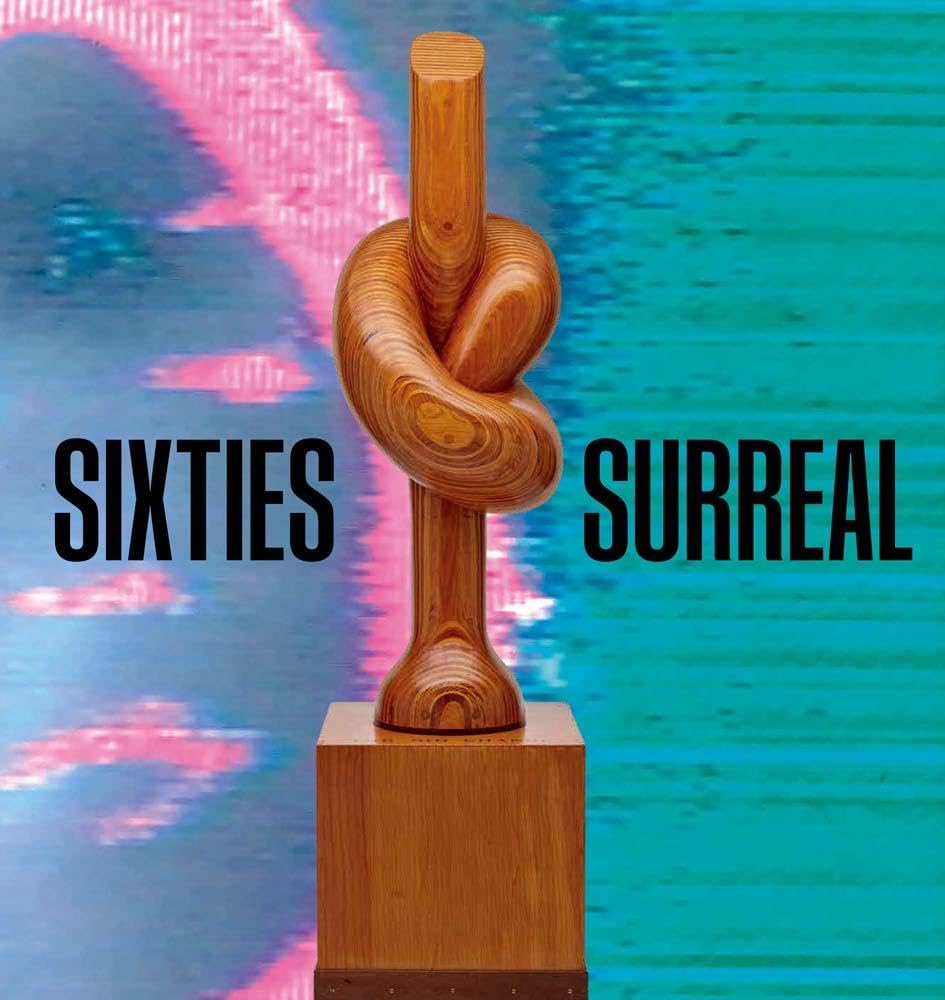
by Paul Buhle
Originally a product of France, Surrealism spawned adherents around the globe—including, here in the Midwest, the Chicago Surrealist Group, formed in 1966. Yet just as it grew to transcend geographical borders, surrealism as an art movement with a small “s” expanded beyond its original visual identity. The art in the pages of Sixties Surreal may thus be unfamiliar to many viewers, but as its three editors argue, it demonstrates a different logic of surrealism’s meanings, roles, and influences within the world of American art as it evolved in the postwar U.S.
In the Foreword, Scott Rothkopf suggests that the “generative” influence of surrealism had already helped shape the work of Mark Rothko and Jackson Pollack, among others, by 1950—but the trend (if it was a trend) was abandoned in favor of a narrow abstractionism, only to be rediscovered in the middle 1960s. By that time a “radical escape hatch” for artistic young outsiders, surrealism notably included gay and lesbian artists (at least in the U.S.); new influences from the art world itself further widened the aperture as versions of surrealism advanced via Pop Art and minimalism.
When art critic and political radical Lucy Lippard entered the picture, she foregrounded the centrality of a “sexual charge” in the newly emerging art, without the polemical “narcissism” of the classic European surrealists. That is to say, rather than being confined to those artists accepted in official circles—essentially those blessed by founder Andre Breton—the surrealist influence now manifested itself amidst the social and cultural turbulence of the times. Rothkopf concludes that this was “the most fulsome animating impulse of American art in the 1960s and the most perspicacious mirror of its era.”
A few pages later, in an Introduction titled “Feelings are Things: a Sixties Surreal,” the three editors provocatively and usefully ask, “What if Surrealism, not Cubism, had emerged as the dominant force to shape the course of postwar art in America,” (xiii) which translates remarkably as “What if it were subject matter, not form, that had been primary to artists in those crucial Atomic years in the United States?” (xiii) What a thought! They go on to suggest how Surrealism, attacked in art criticism by Clement Greenberg and other purists, might have had a different trajectory in the art world.
There is something missing here, of course. Greenberg and his erstwhile allies at the once-radical Partisan Review had set themselves upon the Cold War (the PR itself would take on a new sponsor, the Congress for Cultural Freedom, whose bills were paid by the Central Intelligence Agency). On the other hand, as the Soviet Union became a principal sponsor of liberation projects in the Global South, Communist aesthetics remained relentlessly realist—with remarkable exceptions to come, notably Cuban revolutionary art—even if artists long associated with the Popular Front, like Charles White, continued to take their own paths.
In short, improbability argues against the thesis. But so what? Throughout Sixties Surreal, we see artists experimenting, playing with “processes that included found-object assemblage, dismantling and reimagining bodies, and picturing altered consciousness through surreal forms.” Still, the argument comes to a rather stark conclusion: As the “Sixties” of both reality and lore came to an end, aesthetic diversity among artists across the country gave way to a formalism in Manhattan, the center of the booming art market. Everything else, everywhere else, became “regional,” with obvious and gloomy implications.
The 1958-1972 framework of Sixties Surreal further explains the scope, with a sudden, unexpected art rebellion mirroring the wider social and cultural unrest. Lucy Lippard noted in 1966 that for most people, the surreal suggested “anything odd, suspicious, impolite, unfamiliar, threatening, obscene or just plain unfamiliar.” Not that the term “Surrealism” would be uncontested even among its most prominent and best-organized devotees. An extraordinary 1968 exhibit at the Museum of Modern Art, “Dada, Surrealism and their Heritage,” included more than 300 art objects; it also inspired the rage of the aforementioned Chicago Surrealist Group, which considered art that was experimental but not particularly political (and thus undangerous) unrevolutionary.
Outside New York, the “Hairy Who” exhibits of 1966-’69 actually made a huge splash, not only on the fine art scene but on several future underground comic artists. This group of Chicago artists, however, seemed to pass by the Chicago Surrealist Group entirely, proving that different worlds did not communicate with each other even in the same city. The School of the Art Institute of Chicago, whose lecturers prompted students from the late 1950s onward to think about surrealism, had been pointing toward something larger—perhaps that elusive synthesis of radical art and politics—but the connection was somehow never made. Perhaps the rebellious moods of the 1960s ran out of time.
Never mind: There is a lot to find in Sixties Surreal. Artists like Claus Oldenburg and Louise Bourgeois will be familiar to readers, but how about Jay DeFeo? A proto-feminist artist working in San Francisco in the late 1950s, DeFeo is best remembered for The Rose, a painting so large that it could not be removed from her apartment by any normal means (she died of the toxic substances in the paint), but she also collaborated with artist Wallace Berman to create images depicting her body, semi-nude, as part of a dialogue with her artwork. This was the kind of art that unsettled critics of the time—what Lippard called the “abstractly sensuous object.” DeFeo’s work spoke for many but seemed to leave no successors. Or would Judy Chicago offer the realization, within and beyond the art world, of a radical political vision? Kenneth Anger? Yayoi Kusama? Robert Crumb?
All these and nearly 100 other artists are featured in Sixties Surreal. If it is an exhibition catalog that illustrates a giant disconnect amidst its winding historical paths, it is also, and more importantly, one that will bring any interested reader pleasure, provocation, and insight.
Click below to purchase this book through Bookshop and support your local independent bookstore:
Rain Taxi Online Edition Winter 2026 | © Rain Taxi, Inc. 2026