

by Kit Robinson
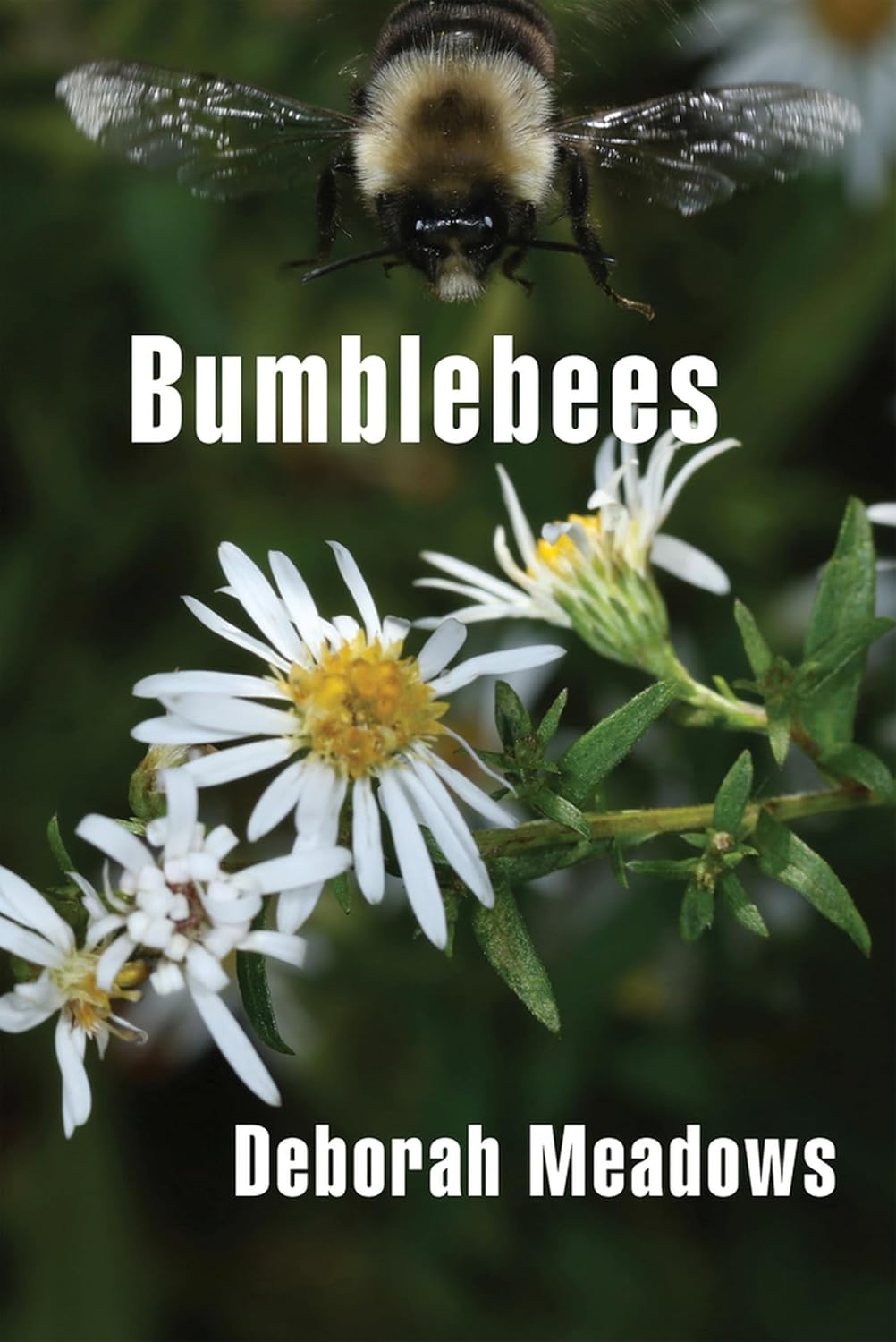 The poet Deborah Meadows has made a career of collaging materials from a wide array of specialized disciplines to create conceptual works with lively, surprisingly personable surfaces. Her work demonstrates what happens when you put together words from disparate vocabularies to achieve a kind of de-specialization suggestive of the fact that postmodern life is, itself, a lesson in hybridity. Her latest book, Bumblebees (Roof Books, $20), is a case in point.
For her earlier book Lecture Notes: A Duration Poem in Twelve Parts (BlazeVOX, 2018), Meadows attended a series of lectures in Humanities and Social Sciences at California Institute of Technology in Pasadena. Topics included game theory, neuroscience, history of financial capitalism, history of slave trade, comparative judicial politics, planetary science, evolutionary biology, and philosophy of science. In Lecture Notes, Meadows presented her rough notes as poetry.
In a like manner, Bumblebees hybridizes such linguistic domains as suggested by “Mongolian sandstorm,” “disturbed bones, quarried first causes, harp recordings,” “tangerine miniaturization plots,” “pet rocks,” and “mineral pigment flaked by time.”
Many of Meadows’s works are text-based, composed by extracting or commenting on fragments from an existing text arranged to form new combinations and sequences. For example, sections from her long serial poem “The Theory of Subjectivity in Moby-Dick” were published across multiple books, including Representing Absence (Green Integer, 2004), Thin Gloves (Green Integer, 2006), The 60’s and 70’s (Tinfish Press, 2003), and Itinerant Men (Krupskaya, 2004). This work comprises meditations on Melville’s stupendous novel by embedding key words within a commentary that assumes some of the same high rhetoric Melville deploys. Consider this passage from Chapter 26 of Moby-Dick:
“I will have no man in my boat,” said Starbuck, “who is not afraid of a whale.” By this, he seemed to mean, not only that the most reliable and useful courage was that which arises from the fair estimation of the encountered peril, but that an utterly fearless man is a far more dangerous comrade than a coward.
From these sentences, Meadows spins a fractal verse in Itinerant Men:
the ordinary irrational struggle
(fear of the whale Starbuck
requires, never hunting after sun-
down) menace you from the centre
and circumference of flesh
not as fearful as the dignity of divine
or spiritual terror
not as tragic as the undoing of goodness
in our Starbuck.
Meadows thus plies a scavenger’s art, picking up gems of knowledge hither and yon. In another telling example, the acknowledgments in her Saccade Patterns (BlazeVOX, 2011) include Wikipedia entries, artwork by sculptor Robert Morris, and books ranging from Engines of Logic: Mathematics and the Origin of the Computer to Frank Zappa, Captain Beefheart and the Secret History of Maximalism. But how exactly such sources are absorbed and deployed in Meadows’s poetry often remains a mystery. Suffice to say there is a great deal going on in the background, and these deep strata give the work a shape and tone that conveys an urgent quest for knowledge backed by a stringent skepticism of received ideas.
In her preface to Translation – the bass accompaniment: Selected Poems (Shearsman Books, 2013), Meadows partially explains her method:
The bass guitar creates patterns that make music into a visceral experience – they are what infect the body. The poems … are in dialog with other authors, and here, experimental poetry engages logician Quine, encyclopedic novelist Melville, philosophers Irigaray and Deleuze, theologian and synthetic philosopher Aquinas, poets Dragomoshchenko, Hejinian, Raworth, Baudelaire, and Celan, Soviet cinematographer Vertov, video artist Bill Viola, and others.
And Meadows doesn’t simply mean that the poetry draws on works by such figures—she often puts texts in dialog with each other. In the book’s selections from involutia (Shearsman Books, 2007), for example, Meadows revisits the Blue Cliff Record, a 12th-century compendium of 100 koans and a foundational text of Soto Zen Buddhism, from the differing perspectives of French philosophers Luce Irigaray and Gilles Deleuze. The resulting lyrics form an imaginary conversation that yoke classical wisdom to postmodern thought:
Irigaray:
Without dwelling on anything, four gates.Go on through, standing erect like
the free birds we are.A flow, a percolation
a favored edge.Deleuze:
myriad forms & dimensions
the little cup afloat
raises a wave.
Another poem, titled “Midnight in Our Motivated,” showcases Meadows’s penchant for metonymic signification, wherein a part stands in for an otherwise unassimilable whole:
Hadn’t you hoped for a change adding fire,
telling-knots addressed to mind by hand, but the musicacquired measure runs its blood circuit, what’s there
after midnight in our motivated glacial moraine. None.
Here the poem’s title is produced by carving out a fragment of text irrespective of its syntactic position within the poem, a gesture that highlights the modularity of language and touts a healthy skepticism concerning the truth value of generalizing statements. Such linguistic flexibility unsurprisingly gives rise to much playfulness and wit in Meadows’s heady verse:
gen: many one and one and one
depend from
penned from
rendered pretty
so pretty, we’re blind
but now eye sea
general forms
in particular
stances,
that’s got his own
Here multivalent signification gets a workout with punning references to lyrics from “West Side Story,” “Amazing Grace,” and “God Bless the Child.” Elsewhere, Meadows links semantic domains via sound values, where the aural qualities of words set off echoes that shift their senses:
… speckled show when man doesn’t
show up to sign the lease, off-leash
area, three words good-for-younot for me, green matter grouped apart, fermented
to another life: gone, boulder on my chest,
grieve a friend, gone
In a sense, Meadows’s work is a poet’s solution to the problem of the fractured episteme of the postmodern world: Since each field of knowledge is reflective of the specialized language used to describe it, a holistic picture is hard to come by. Meadows attacks this problem by grafting terms from disparate fields into lines that are feminine, marvelous, and tough—that is, she blends the quest for knowledge with casual expressions of the everyday.
To illustrate the power of poetry to span worldviews, Meadows at times turns epigrammatic, as in the following lines from the prose poem “Another Interview”:
Let’s be precise, no analog, no wooden sanctified tradition.
……………………………………………………………………
Mostly, poetry is against having results.
During the last quarter of a century, poetry in this country differs in who has the bad taste to mention capitalism or not.
Half the people worry about where the poetry of our country is going; the other half worry about the status of their dialog with reality.
I agree: to write is to inscribe the world.
………………………………………………
All our good current writers are reticent to be a party or school.
…………………………………………………………………………
I’m not interested in knowledge about knowledge, or art about art – they are all a trap.
To enjoy Meadows’s poetry, it is not necessary to study all her sources; the surface qualities of her verse are sufficient for an alluring and entertaining reading experience. Yet for the curious reader, the poet’s sources may open doors to further horizons of awareness. Research-based poetries can serve as directories to knowledge in a wide variety of arts and sciences. Along with Meadows’s Bumblebees, Lyn Hejinian’s Positions of the Sun (Belladonna Collaborative, 2018), and Tyrone Williams’s Az iZ (Omnidawn, 2018) are examples of contemporary research-based poetics that reward the reader simultaneously at both depth and surface levels.
In Bumblebees, Meadows constructs her poems by linking phrases drawn from diverse semantic domains and separated by commas to form long, twisting sentences that leap across stanzas of variegated measure. Written from and into the chilling winds of the Anthropocene, Bumblebees is a cry in the darkness that bravely assesses the damage caused by so-called civilization while affirming humanity’s talent for riding the sine waves of perception, articulation, and harmony:
We made terrible mistakes, got off the train at the wrong stop, miscalculated how much our earth could take.
Maintenance of vision is marking our minds as we convene a forest of signs and get on.
Meadows has long created a kaleidoscopic display on the screen of the brain, and Bumblebees does so with a vivid urgency. Whether with this volume or with any other in her fine oeuvre, it is time for readers to grapple with the poetry of Deborah Meadows.